9KL1 | pdb_00009kl1

Crystal structure of DNA/RNA duplex obtained using the counter diffusion method in space (Na form)

  • Classification: DNA/RNA
  • Organism(s): synthetic construct
  • Mutation(s): No 

  • Deposited: 2024-11-14 Released: 2025-02-19 
  • Deposition Author(s): Kondo, J., Ando, S.
  • Funding Organization(s): Japan Agency for Medical Research and Development (AMED)

Experimental Data Snapshot

  • Method: X-RAY DIFFRACTION
  • Resolution: 1.60 Å
  • R-Value Free: 
    0.209 (Depositor), 0.210 (DCC) 
  • R-Value Work: 
    0.196 (Depositor), 0.196 (DCC) 
  • R-Value Observed: 
    0.197 (Depositor) 

Starting Model: experimental
View more details

wwPDB Validation   3D Report Full Report


Ligand Structure Quality Assessment 


This is version 1.1 of the entry. See complete history


Literature

The first report of structural analysis of a nucleic acid using crystals grown in space.

Ando, S.Takahashi, M.Kondo, J.

(2025) Acta Crystallogr F Struct Biol Commun 81: 95-100

  • DOI: https://doi.org/10.1107/S2053230X25000810
  • Primary Citation of Related Structures:  
    9K7R, 9K8Z, 9KKZ, 9KL1

  • PubMed Abstract: 

    For the success of structure-based drug design, three-dimensional structures solved by X-ray crystallography at atomic resolution are mandatory. In order to obtain high-quality single crystals with strong diffraction power, crystallization under microgravity conditions has been attempted for proteins. Since nucleic acid duplexes have chemical, structural and crystallographic characteristics that differ from those of globular proteins, such as intermolecular repulsion due to negative charge and molecular and crystallographic anisotropies, it is interesting to investigate whether microgravity crystallization improves the crystal growth of nucleic acids. However, to our knowledge there has been only one report on nucleic acid crystallization in a microgravity environment, and there have been no reports of successful structural analysis. Here, we conducted the crystallization of a DNA/RNA heteroduplex in space. The heteroduplex was successfully crystallized in a microgravity environment, and the size and appearance of the crystals were improved compared with control experiments conducted on Earth. Although the effect of the counter-diffusion method is likely to be more significant than the effect of microgravity in this study, we were able to analyze the structure at a higher resolution (1.4 Å) than our previously reported crystal structure (1.9 Å).


  • Organizational Affiliation
    • Graduate School of Science and Technology, Sophia University, 7-1 Kioi-cho, Chiyoda-ku, Tokyo 102-8554, Japan.

Macromolecules

Find similar nucleic acids by:  Sequence   |   3D Structure  

Entity ID: 1
MoleculeChains LengthOrganismImage
RNA (5'-R(*GP*AP*AP*GP*AP*AP*GP*AP*G)-3')9synthetic construct
Sequence Annotations
Expand
  • Reference Sequence

Find similar nucleic acids by:  Sequence   |   3D Structure  

Entity ID: 2
MoleculeChains LengthOrganismImage
DNA (5'-D(*(5CM)P*TP*CP*TP*TP*CP*TP*TP*(5CM))-3')9synthetic construct
Sequence Annotations
Expand
  • Reference Sequence
Small Molecules
Ligands 1 Unique
IDChains Name / Formula / InChI Key2D Diagram3D Interactions
SPM
Query on SPM

Download Ideal Coordinates CCD File 
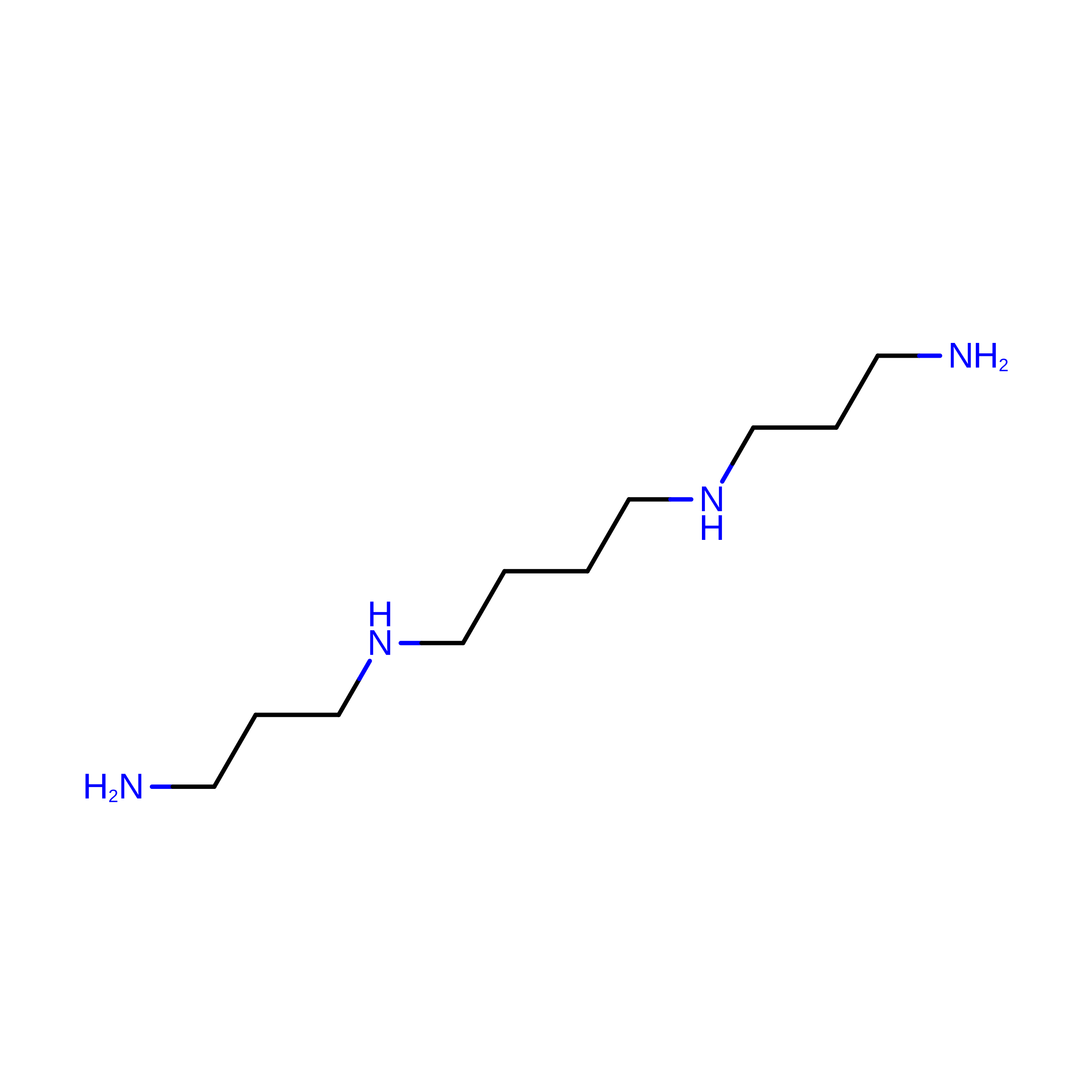
C [auth A]SPERMINE
C10 H26 N4
PFNFFQXMRSDOHW-UHFFFAOYSA-N
Experimental Data & Validation

Experimental Data

  • Method: X-RAY DIFFRACTION
  • Resolution: 1.60 Å
  • R-Value Free:  0.209 (Depositor), 0.210 (DCC) 
  • R-Value Work:  0.196 (Depositor), 0.196 (DCC) 
  • R-Value Observed: 0.197 (Depositor) 
Space Group: P 61
Unit Cell:
Length ( Å )Angle ( ˚ )
a = 49.015α = 90
b = 49.015β = 90
c = 45.706γ = 120
Software Package:
Software NamePurpose
PHENIXrefinement
XSCALEdata scaling
XDSdata reduction
PHASERphasing

Structure Validation

View Full Validation Report


Ligand Structure Quality Assessment 


Entry History & Funding Information

Deposition Data


Funding OrganizationLocationGrant Number
Japan Agency for Medical Research and Development (AMED)JapanJP23ama121014

Revision History  (Full details and data files)

  • Version 1.0: 2025-02-19
    Type: Initial release
  • Version 1.1: 2025-03-12
    Changes: Database references