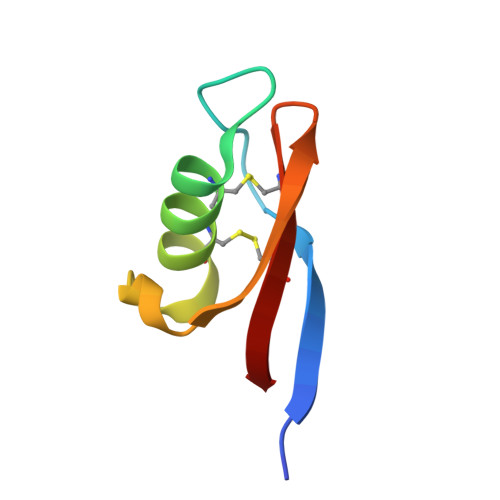
Inhibition Mechanism of Pancreatic K ATP Channels by Centipede Toxin.
Hou, T., Wang, M., Tan, Y., Fan, C., Chen, L.(2026) Research (Wash D C) 9: 1401-1401
- PubMed: 42609583 Search on PubMedSearch on PubMed Central
- DOI: https://doi.org/10.34133/research.1401
- Primary Citation Related Structures: 
9KGA, 9KGL - PubMed Abstract: 
The pancreatic adenosine triphosphate (ATP)-sensitive potassium (K ATP ) channel acts as a crucial metabolic sensor, regulating insulin secretion to maintain whole-body energy homeostasis. Gain-of-function mutations in this channel lead to neonatal diabetes mellitus, a rare disorder in which certain mutants exhibit resistance to standard sulfonylurea therapy. Recent studies have identified a centipede toxin, SpTx1, as a potent inhibitor of both human pancreatic K ATP channels and their gain-of-function mutants. This toxin stimulates insulin secretion, offering a promising therapeutic strategy for neonatal diabetes. However, the molecular mechanism by which SpTx1 inhibits the K ATP channel has remained unclear. Here, we report the crystal structure of SpTx1 and the cryo-electron microscopy structure of the K ATP channel in complex with SpTx1. The structure reveals that a single SpTx1 molecule binds to the extracellular surface of the Kir6.2 tetramer. Multiple interactions at the SpTx1-Kir6.2 interface underpin the high affinity and specificity of SpTx1 for human Kir6.2. We demonstrate that SpTx1 inhibits potassium currents by physically blocking the ion conduction pore. Furthermore, a structure-guided search identified another centipede toxin, Sm3a, as a novel K ATP channel blocker. Together, these findings provide key insights into the inhibitory mechanism of centipede toxins against the human Kir6.2-containing K ATP channel and establish a foundation for developing these toxins into potential therapeutics for K ATP channel-related diseases.
- State Key Laboratory of Membrane Biology, College of Future Technology, Institute of Molecular Medicine, Beijing Key Laboratory of Novel Antibodies and Multifunctional Conjugated Drugs, Peking University, Beijing 100871, China.
Organizational Affiliation: