Download Mendeley
Proline-Mediated Enhancement in Evolvability of Disulfide-Rich Peptides for Discovering Protein Binders.
Liu, H., Song, L., Meng, X., Li, J., Fan, S., Dong, H., Wang, X., Li, M., Yu, H., Tsai, Y.H., Yin, Y., Wu, C.(2025) J Am Chem Soc 147: 24870-24883
- PubMed: 40601296 Search on PubMed
- DOI: https://doi.org/10.1021/jacs.5c07075
- Primary Citation Related Structures:
9KFP, 9KFQ, 9KFR, 9KFS - PubMed Abstract:
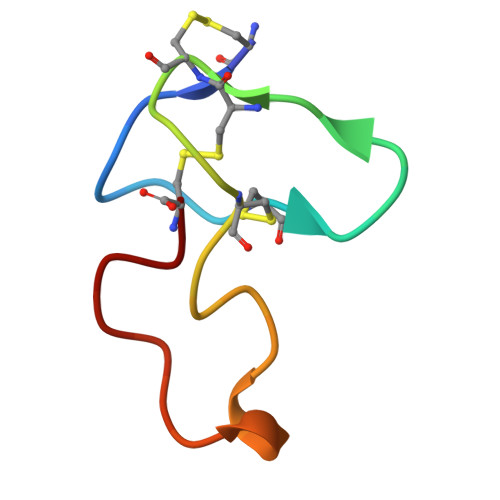
Disulfide-rich peptides (DRPs), particularly those featuring the inhibitor cystine knot (ICK) motif, represent promising scaffolds for developing next-generation protein modulators and therapeutic agents due to their remarkable stability and specificity. However, their inherent structural integrity and lack of structural plasticity significantly limit their evolvability, creating a fundamental bottleneck in engineering novel functionalities. To address this challenge, we developed a novel proline scanning strategy aimed at enhancing the evolvability of the ICK scaffolds. This strategy leverages the proline-mediated structural decoupling between scaffold and nonscaffold residues in DRPs to promote their evolvability. By strategically incorporating prolines as pre-encoded scaffold residues, we engineered ICK variants with significantly improved foldability and tolerance to sequence variations. This advancement enabled the construction of diverse peptide libraries suitable for screening platforms, including mRNA and phage display. Utilizing this approach, we successfully identified DRPs exhibiting low-nanomolar affinity to clinically important targets, such as TROP2 and 4-1BB. Structural characterization revealed that these evolved DRPs adopted unique three-dimensional structures stabilized by up to four disulfide bonds, demonstrating both high oxidative folding efficiency and enhanced evolvability due to proline incorporation. To evaluate their therapeutic potential, we developed a DRP-based chimeric antigen receptor (CAR) targeting TROP2. The DRP-based CAR T cells exhibited potency comparable to conventional single-chain variable fragment (scFv)-based CAR T cells but with a notably improved safety profile. Overall, our work establishes a robust framework for expanding the functional versatility of DRP scaffolds, facilitating the discovery and development of structurally diverse and functional DRPs for broad applications in therapeutics and drug development.
- The MOE Key Laboratory of Spectrochemical Analysis and Instrumentation, State Key Laboratory of Physical Chemistry of Solid Surfaces, Department of Chemistry, College of Chemistry and Chemical Engineering, Xiamen University, Xiamen 361005, China.
Organizational Affiliation: