9KDS | pdb_00009kds

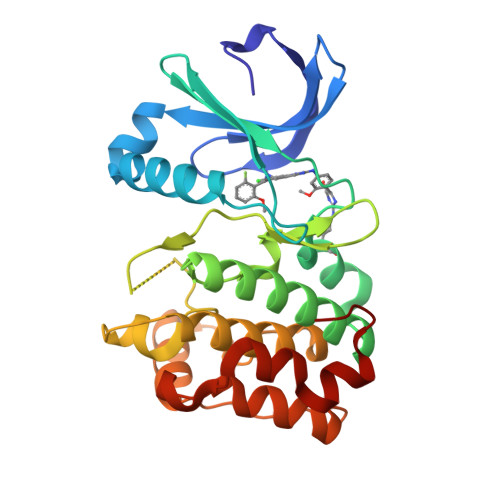
The crystal structure of human AURKA kinase domain in complex with RA1


Experimental Data Snapshot

  • Method: X-RAY DIFFRACTION
  • Resolution: 2.50 Å
  • R-Value Free: 
    0.253 (Depositor), 0.270 (DCC) 
  • R-Value Work: 
    0.213 (Depositor), 0.232 (DCC) 
  • R-Value Observed: 
    0.217 (Depositor) 

Starting Model: experimental
View more details

wwPDB Validation 3D Report Full Report

Validation slider image for 9KDS

This is version 1.1 of the entry. See complete history. 

Literature

Cell-Active, Arginine-Targeting Irreversible Covalent Inhibitors for Non-Kinases and Kinases.

Chen, P., Wang, L., Wang, X., Sun, J., Miao, F., Wang, Z., Yang, F., Xiang, M., Gu, M., Li, S., Zhang, J., Yuan, P., Lu, X., Zhang, Z.M., Gao, L., Yao, S.Q.

(2025) Angew Chem Int Ed Engl 64: e202422372-e202422372

  • DOI: https://doi.org/10.1002/anie.202422372
  • Primary Citation Related Structures: 
    9KDS

  • PubMed Abstract: 

    Targeted covalent inhibitors (TCIs) play an essential role in the fields of kinase research and drug discovery. TCI strategies to target more common amino acid side-chains have yet to be demonstrated. Targeting other amino acids would also expand the pharmaceutical industry's toolbox for targeting other tough-to-drug proteins. We report herein a glyoxal-based, arginine-reactive strategy to generate potent and selective small-molecule TCIs of Mcl-1 (an important anti-apoptotic protein) by selectively targeting the conserved arginine (R263) in the protein. We further validated the generality of this strategy by developing glyoxal-based, irreversible covalent inhibitors of AURKA (a cancer-related kinase) that showed exclusive reactivity with a solvent-exposed arginine (R220) of this enzyme. We showed the resulting compounds were potent, selective and cell-active, capable of covalently engaging endogenous AURKA in MV-4-11 cells with long residence time. Finally, we showed the potential application of glyoxal-based TCIs in targeting an acquired drug-resistance mutant of ALK kinase (G1202R).


  • Organizational Affiliation: 
    • Department of Chemistry, National University of Singapore, Singapore, 117543, Singapore.

Macromolecule Content 

  • Total Structure Weight: 31.39 kDa 
  • Atom Count: 2,039 
  • Modeled Residue Count: 257 
  • Deposited Residue Count: 266 
  • Unique protein chains: 1

Macromolecules

Find similar proteins by:|  3D Structure
Entity ID: 1
MoleculeChains  Sequence LengthOrganismDetailsImage
Aurora kinase A266Homo sapiensMutation(s): 1 
Gene Names: AURKA, AIK, AIRK1, ARK1, AURA, AYK1, BTAK, IAK1, STK15, STK6
EC: 2.7.11.1
UniProt & NIH Common Fund Data Resources
Find proteins for O14965 (Homo sapiens)
Explore O14965 
Go to UniProtKB:  O14965
PHAROS:  O14965
GTEx:  ENSG00000087586 
Entity Groups
Sequence Clusters30% Identity50% Identity70% Identity90% Identity95% Identity100% Identity
UniProt GroupO14965
Sequence Annotations
Expand
Reference Sequence

Small Molecules

Non-standard Monomers  1 Unique
IDChains TypeFormula2D Diagram
A1EFT
Query on A1EFT
L-PEPTIDE LINKINGC34 H32 Cl F N8 O5

Experimental Data & Validation

Experimental Data

  • Method: X-RAY DIFFRACTION
  • Resolution: 2.50 Å
  • R-Value Free:  0.253 (Depositor), 0.270 (DCC) 
  • R-Value Work:  0.213 (Depositor), 0.232 (DCC) 
  • R-Value Observed: 0.217 (Depositor) 
Space Group: P 61 2 2
Unit Cell:
Length ( Å )Angle ( ˚ )
a = 81.943α = 90
b = 81.943β = 90
c = 172.904γ = 120
Software Package:
Software NamePurpose
PHENIXrefinement
Cootmodel building
HKL-3000data reduction
HKL-3000data scaling
PHASERphasing

Structure Validation

View Full Validation Report


Entry History 

& Funding Information

Deposition Data


Funding OrganizationLocationGrant Number
Not funded--

Revision History  (Full details and data files)

  • Version 1.0: 2025-10-22
    Type: Initial release
  • Version 1.1: 2026-07-01
    Changes: Data collection