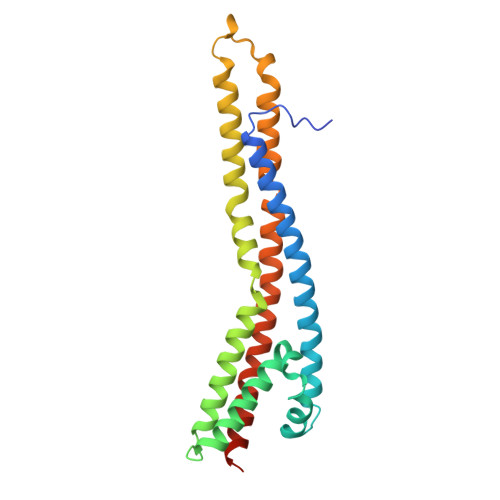
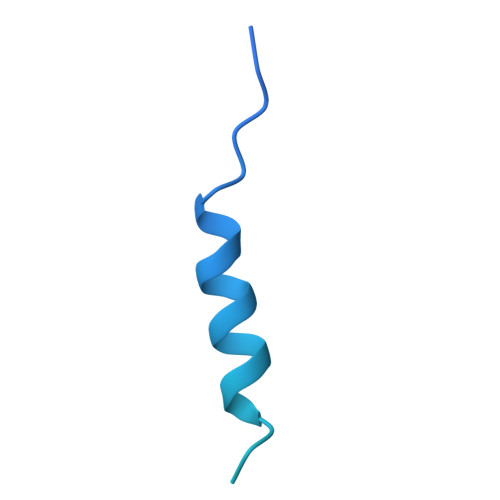
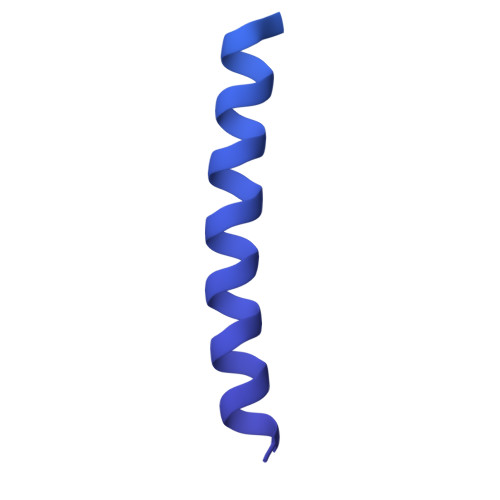
9KCH | pdb_00009kch

Cryo-EM structure of inner membrane TolQRA complex in CYMAL-6-Neopentyl Glycol detergent micelles


Experimental Data Snapshot

  • Method: ELECTRON MICROSCOPY
  • Resolution: 4.19 Å
  • Aggregation State: PARTICLE 
  • Reconstruction Method: SINGLE PARTICLE 

Starting Models: in silico
View more details

wwPDB Validation   3D Report Full Report


This is version 1.1 of the entry. See complete history


Literature

Structural Insights into the Force-Transducing Mechanism of a Motor-Stator Complex Important for Bacterial Outer Membrane Lipid Homeostasis.

Yeow, J.Chia, C.G.Lim, N.Z.Zhao, X.Yan, J.Chng, S.S.

(2025) J Am Chem Soc 147: 24299-24308

  • DOI: https://doi.org/10.1021/jacs.4c18050
  • Primary Citation of Related Structures:  
    9K49, 9KCH

  • PubMed Abstract: 

    Gram-negative bacteria assemble an asymmetric outer membrane (OM) that functions as an effective barrier against antibiotics. Building a stable and functional OM requires the assembly and maintenance of balanced levels of proteins, lipopolysaccharides, and phospholipids into the bilayer. In Escherichia coli , the trans-envelope Tol-Pal complex has recently been established to play a primary role in maintaining OM lipid homeostasis. It is believed that the motor-stator complex TolQR exploits the proton motive force in the inner membrane to induce conformational changes in the TolA effector, ultimately generating a force across the cell envelope to activate processes at the OM. Molecular details of how such force transduction occurs via the TolQRA complex are unknown. Here, we solve structures of the E. coli TolQRA complex using single-particle cryo-EM, capturing the transmembrane (TM) regions of the purified complex in two distinct states at ∼3.6 and ∼4.2 Å nominal resolutions. We define how the TolA N-terminal TM helix interacts with an asymmetric TolQ 5 R 2 subcomplex in two different positions, revealing how the two TolQRA states are related by rotation of the TolQ pentamer. By considering structural prediction and biochemical evidence for the periplasmic domains of the complex, we propose a working model for how proton passage through the complex induces rotary movement that can be coupled to TolA for force transduction across the cell envelope.


  • Organizational Affiliation
    • Department of Chemistry, Faculty of Science, National University of Singapore, 117543 Singapore.

Macromolecules
Find similar proteins by:  (by identity cutoff)  |  3D Structure
Entity ID: 1
MoleculeChains Sequence LengthOrganismDetailsImage
Tol-Pal system protein TolQ
A, B, C, D, E
230Escherichia coli K-12Mutation(s): 0 
Gene Names: tolQfiib0737JW0727
Membrane Entity: Yes 
UniProt
Find proteins for P0ABU9 (Escherichia coli (strain K12))
Explore P0ABU9 
Go to UniProtKB:  P0ABU9
Entity Groups  
Sequence Clusters30% Identity50% Identity70% Identity90% Identity95% Identity100% Identity
UniProt GroupP0ABU9
Sequence Annotations
Expand
  • Reference Sequence
Find similar proteins by:  (by identity cutoff)  |  3D Structure
Entity ID: 2
MoleculeChains Sequence LengthOrganismDetailsImage
Tol-Pal system protein TolR
F, G
152Escherichia coli K-12Mutation(s): 0 
Gene Names: tolRb0738JW0728
Membrane Entity: Yes 
UniProt
Find proteins for P0ABV6 (Escherichia coli (strain K12))
Explore P0ABV6 
Go to UniProtKB:  P0ABV6
Entity Groups  
Sequence Clusters30% Identity50% Identity70% Identity90% Identity95% Identity100% Identity
UniProt GroupP0ABV6
Sequence Annotations
Expand
  • Reference Sequence
Find similar proteins by:  (by identity cutoff)  |  3D Structure
Entity ID: 3
MoleculeChains Sequence LengthOrganismDetailsImage
Tol-Pal system protein TolA421Escherichia coli K-12Mutation(s): 0 
Gene Names: tolAcimexcClkyb0739JW0729
Membrane Entity: Yes 
UniProt
Find proteins for P19934 (Escherichia coli (strain K12))
Explore P19934 
Go to UniProtKB:  P19934
Entity Groups  
Sequence Clusters30% Identity50% Identity70% Identity90% Identity95% Identity100% Identity
UniProt GroupP19934
Sequence Annotations
Expand
  • Reference Sequence
Experimental Data & Validation

Experimental Data

  • Method: ELECTRON MICROSCOPY
  • Resolution: 4.19 Å
  • Aggregation State: PARTICLE 
  • Reconstruction Method: SINGLE PARTICLE 
EM Software:
TaskSoftware PackageVersion
RECONSTRUCTIONcryoSPARC4.5.2
MODEL REFINEMENTPHENIX1.20.1-4487

Structure Validation

View Full Validation Report


Entry History & Funding Information

Deposition Data


Funding OrganizationLocationGrant Number
Other governmentSingaporeMOH-000145

Revision History  (Full details and data files)

  • Version 1.0: 2025-07-09
    Type: Initial release
  • Version 1.1: 2025-07-30
    Changes: Data collection, Database references