9K2Y | pdb_00009k2y

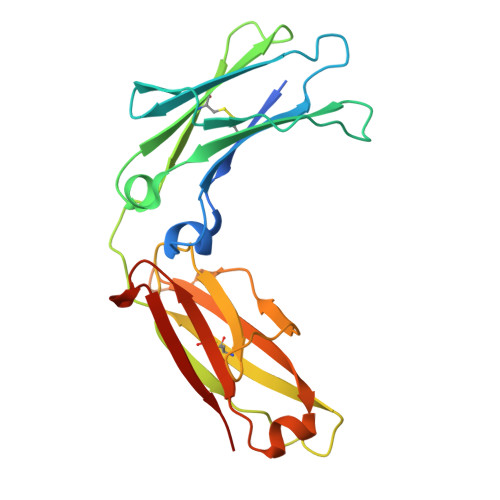
Human IgG1 Fc fragments, mutant (2CT1.1)


Experimental Data Snapshot

  • Method: X-RAY DIFFRACTION
  • Resolution: 3.12 Å
  • R-Value Free: 
    0.281 (Depositor), 0.298 (DCC) 
  • R-Value Work: 
    0.236 (Depositor), 0.259 (DCC) 
  • R-Value Observed: 
    0.238 (Depositor) 

Starting Model: experimental
View more details

wwPDB Validation   3D Report Full Report


Ligand Structure Quality Assessment 


This is version 1.1 of the entry. See complete history


Literature

Engineering IgG antibodies for intracellular targeting and drug delivery.

Kim, D.S.Kim, S.E.Byeon, J.S.Lee, H.J.Kim, J.W.Kim, H.Chae, B.H.Ko, D.H.Lee, S.G.Yoon, S.R.Lee, J.Kim, J.S.Kim, Y.S.

(2025) J Control Release 382: 113727-113727

  • DOI: https://doi.org/10.1016/j.jconrel.2025.113727
  • Primary Citation of Related Structures:  
    9K2Y, 9K34

  • PubMed Abstract: 

    Enabling immunoglobulin G (IgG)-format antibodies to autonomously internalize and localize in the cytosol of targeted cells-referred to as cytosol-penetrating antibodies (cytotransmab, CT)-is challenging yet highly promising. A primary barrier to cytosolic access for CT is limited endosomal escape. Herein, we developed a second-generation (2G) CT, named in2CT4.1, featuring an endosomal acidic pH-responsive endosomal escape motif (R-W/E motif) with Arg-Trp pairs and a Glu patch in the CH3 and CL domains of IgG1/κ antibody. This motif selectively destabilizes endosomal membranes at endosomal acidic pH to facilitate cytosolic access while remaining inactive at neutral pH. The 2G CT, in2CT4.1, achieves efficient cytosolic localization at nanomolar concentrations, demonstrating approximately 3-fold higher endosomal escape efficiency compared to the first-generation CT. The potential of 2G CT is validated by engineering a cytosolic α-tubulin-targeting CT via an α-tubulin-specific variable domain in in2CT4.1. Additionally, the 2G CT effectively delivers the catalytic domain of diphtheria toxin to the cytosol of epidermal growth factor receptor-overexpressing tumor cells, resulting in near-complete suppression of tumor growth in a xenograft mouse model. These results establish 2G CT as a versatile platform for targeting cytosolic proteins and delivering therapeutic payloads, with broad potential in targeted cancer therapy and other applications.


  • Organizational Affiliation
    • Department of Molecular Science and Technology, College of Engineering, Ajou University, Suwon 16499, Republic of Korea.

Macromolecules
Find similar proteins by:  (by identity cutoff)  |  3D Structure
Entity ID: 1
MoleculeChains Sequence LengthOrganismDetailsImage
Immunoglobulin gamma-1 heavy chainA [auth C],
B [auth A],
C [auth B],
D
223Homo sapiensMutation(s): 0 
UniProt
Find proteins for P0DOX5 (Homo sapiens)
Explore P0DOX5 
Go to UniProtKB:  P0DOX5
Entity Groups  
Sequence Clusters30% Identity50% Identity70% Identity90% Identity95% Identity100% Identity
UniProt GroupP0DOX5
Sequence Annotations
Expand
  • Reference Sequence
Oligosaccharides

Help

Entity ID: 2
MoleculeChains Length2D Diagram Glycosylation3D Interactions
beta-D-galactopyranose-(1-4)-2-acetamido-2-deoxy-beta-D-glucopyranose-(1-2)-alpha-D-mannopyranose-(1-3)-[beta-D-galactopyranose-(1-4)-2-acetamido-2-deoxy-beta-D-glucopyranose-(1-2)-alpha-D-mannopyranose-(1-6)]beta-D-mannopyranose-(1-4)-2-acetamido-2-deoxy-beta-D-glucopyranose-(1-4)-[beta-L-fucopyranose-(1-6)]2-acetamido-2-deoxy-beta-D-glucopyranoseE [auth G],
G [auth F]
10N/A
Glycosylation Resources
GlyTouCan:  G23770JR
GlyCosmos:  G23770JR
GlyGen:  G23770JR
Entity ID: 3
MoleculeChains Length2D Diagram Glycosylation3D Interactions
beta-D-galactopyranose-(1-4)-2-acetamido-2-deoxy-beta-D-glucopyranose-(1-2)-alpha-D-mannopyranose-(1-6)-[2-acetamido-2-deoxy-beta-D-glucopyranose-(1-2)-alpha-D-mannopyranose-(1-3)]beta-D-mannopyranose-(1-4)-2-acetamido-2-deoxy-beta-D-glucopyranose-(1-4)-2-acetamido-2-deoxy-beta-D-glucopyranoseF [auth E]8N/A
Glycosylation Resources
GlyTouCan:  G89993FE
GlyCosmos:  G89993FE
GlyGen:  G89993FE
Entity ID: 4
MoleculeChains Length2D Diagram Glycosylation3D Interactions
2-acetamido-2-deoxy-beta-D-glucopyranose-(1-2)-alpha-D-mannopyranose-(1-6)-beta-D-mannopyranose-(1-4)-2-acetamido-2-deoxy-beta-D-glucopyranose-(1-4)-2-acetamido-2-deoxy-beta-D-glucopyranose
H
5N/A
Glycosylation Resources
GlyTouCan:  G12045WP
GlyCosmos:  G12045WP
GlyGen:  G12045WP
Entity ID: 5
MoleculeChains Length2D Diagram Glycosylation3D Interactions
2-acetamido-2-deoxy-beta-D-glucopyranose-(1-2)-alpha-D-mannopyranose
I
2N/A
Glycosylation Resources
GlyTouCan:  G85856KC
GlyCosmos:  G85856KC
GlyGen:  G85856KC
Small Molecules
Ligands 1 Unique
IDChains Name / Formula / InChI Key2D Diagram3D Interactions
GAL
Query on GAL

Download Ideal Coordinates CCD File 
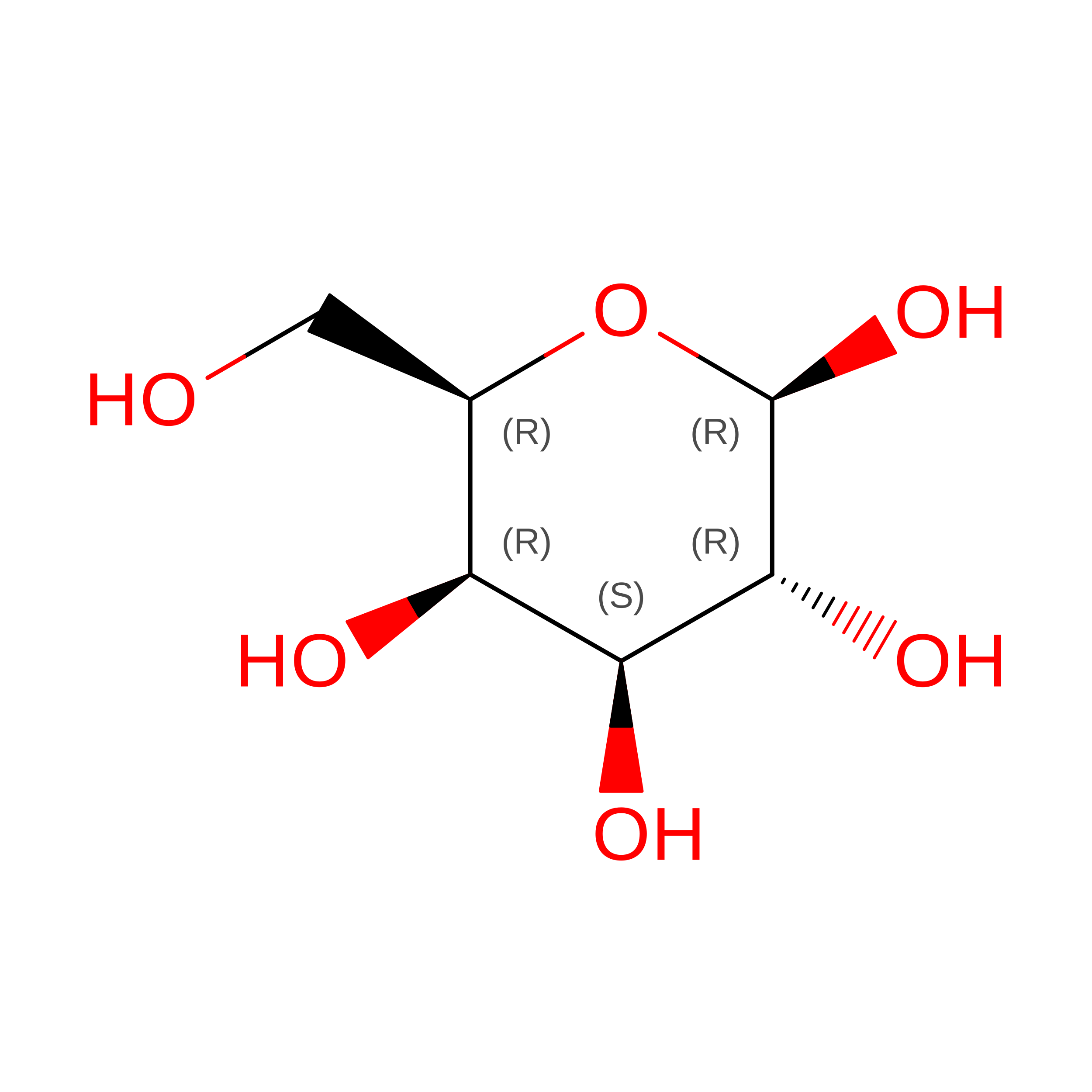
J [auth D]beta-D-galactopyranose
C6 H12 O6
WQZGKKKJIJFFOK-FPRJBGLDSA-N
Experimental Data & Validation

Experimental Data

  • Method: X-RAY DIFFRACTION
  • Resolution: 3.12 Å
  • R-Value Free:  0.281 (Depositor), 0.298 (DCC) 
  • R-Value Work:  0.236 (Depositor), 0.259 (DCC) 
  • R-Value Observed: 0.238 (Depositor) 
Space Group: P 21 21 21
Unit Cell:
Length ( Å )Angle ( ˚ )
a = 62.946α = 90
b = 123.325β = 90
c = 150.026γ = 90
Software Package:
Software NamePurpose
PHENIXrefinement
HKL-2000data scaling
HKL-2000data reduction
PHENIXphasing

Structure Validation

View Full Validation Report


Ligand Structure Quality Assessment 


Entry History & Funding Information

Deposition Data


Funding OrganizationLocationGrant Number
Not funded--

Revision History  (Full details and data files)

  • Version 1.0: 2025-10-22
    Type: Initial release
  • Version 1.1: 2025-12-17
    Changes: Database references