Download Mendeley
Shigella effector IpaH1.4 subverts host E3 ligase RNF213 to evade antibacterial immunity.
Zhou, X., Zhang, H., Wang, Y., Wang, D., Lin, Z., Zhang, Y., Tang, Y., Liu, J., Yao, Y.F., Zhang, Y., Pan, L.(2025) Nat Commun 16: 3099-3099
- PubMed: 40164614 Search on PubMedSearch on PubMed Central
- DOI: https://doi.org/10.1038/s41467-025-58432-y
- Primary Citation Related Structures:
9JTA, 9JW1, 9JWG - PubMed Abstract:
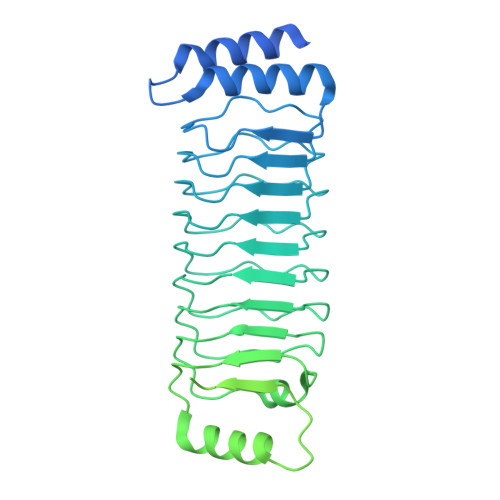
Ubiquitination plays vital roles in modulating pathogen-host cell interactions. RNF213, a E3 ligase, can catalyze the ubiquitination of lipopolysaccharide (LPS) and is crucial for antibacterial immunity in mammals. Shigella flexneri, an LPS-containing pathogenic bacterium, has developed mechanisms to evade host antibacterial defenses during infection. However, the precise strategies by which S. flexneri circumvents RNF213-mediated antibacterial immunity remain poorly understood. Here, through comprehensive biochemical, structural and cellular analyses, we reveal that the E3 effector IpaH1.4 of S. flexneri can directly target human RNF213 via a specific interaction between the IpaH1.4 LRR domain and the RING domain of RNF213, and mediate the ubiquitination and proteasomal degradation of RNF213 in cells. Furthermore, we determine the cryo-EM structure of human RNF213 and the crystal structure of the IpaH1.4 LRR/RNF213 RING complex, elucidating the molecular mechanism underlying the specific recognition of RNF213 by IpaH1.4. Finally, our cell based functional assays demonstrate that the targeting of host RNF213 by IpaH1.4 promotes S. flexneri proliferation within infected cells. In summary, our work uncovers an unprecedented strategy employed by S. flexneri to subvert the key host immune factor RNF213, thereby facilitating bacterial proliferation during invasion.
- State Key Laboratory of Chemical Biology, Shanghai Institute of Organic Chemistry, University of Chinese Academy of Sciences, Chinese Academy of Sciences, Shanghai, 200032, China.
Organizational Affiliation: