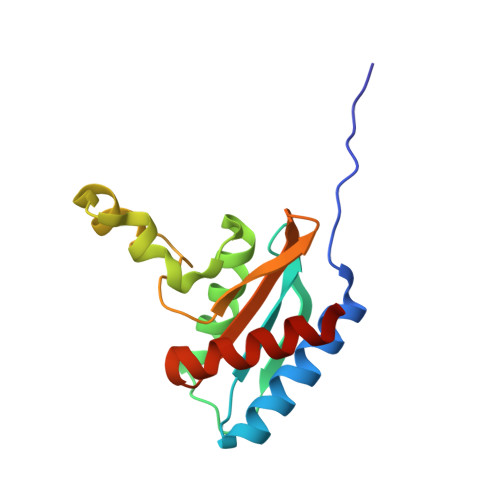
9JTH | pdb_00009jth

Crystal structure of NahX from Pseudomonas sp. MC1


Experimental Data Snapshot

  • Method: X-RAY DIFFRACTION
  • Resolution: 1.70 Å
  • R-Value Free: 
    0.208 (Depositor), 0.207 (DCC) 
  • R-Value Work: 
    0.199 (Depositor), 0.198 (DCC) 
  • R-Value Observed: 
    0.199 (Depositor) 

Starting Model: experimental
View more details

wwPDB Validation 3D Report Full Report

Validation slider image for 9JTH

This is version 1.1 of the entry. See complete history. 

Literature

Structural insights into the role of NahX from Pseudomonas sp. MC1 in the naphthalene degradation pathway.

Son, J., Park, A.K., Shin, S.C., Kim, D., Kim, H.W.

(2025) Biochem Biophys Res Commun 742: 151120-151120

  • DOI: https://doi.org/10.1016/j.bbrc.2024.151120
  • Primary Citation Related Structures: 
    9JTH

  • PubMed Abstract: 

    Polycyclic aromatic hydrocarbons (PAHs) are among the most widespread organic pollutants known for their carcinogenic and mutagenic properties. There is a growing interest in understanding the degradation and detoxification processes of these substances using biological approaches. The bacterium Pseudomonas sp. MC1 contains a metabolic plasmid (81 kb) that encodes enzymes involved in the conversion of naphthalene (the simplest and most soluble PAH) to salicylate. Therein, nahX is a part of the lower naphthalene degradation operon and encodes a 140-amino acid protein. However, the function of NahX remains unclear. To understand its function more clearly, we first determined the three-dimensional structure of NahX. It has a fold similar to that of HbpS, which acts as a sensory component in response to oxidative stress. Biochemical studies have also shown that NahX and HbpS exhibit heme degradation activity and bind to iron ions. Heme degradation and iron-sequestering activity protect bacteria against oxidative stress. Previous studies have shown that oxidative stress occurs during naphthalene degradation. Therefore, we postulate that NahX has a defense mechanism against the oxidative stress that may occur during naphthalene metabolism.


  • Organizational Affiliation: 
    • Division of Life Sciences, Korea Polar Research Institute, Incheon, 21990, South Korea; New Drug Development Center, Daegu-Gyeongbuk Medical Innovation Foundation, Daegu, 41061, South Korea.

Macromolecule Content 

  • Total Structure Weight: 58.96 kDa 
  • Atom Count: 4,473 
  • Modeled Residue Count: 552 
  • Deposited Residue Count: 560 
  • Unique protein chains: 1

Macromolecules

Find similar proteins by:|  3D Structure
Entity ID: 1
MoleculeChains  Sequence LengthOrganismDetailsImage
NahX
A, B, C, D
140Pseudomonas sp. MC1Mutation(s): 0 
Gene Names: nahX, pYIC1_54
UniProt
Find proteins for G9G7K4 (Pseudomonas sp. MC1)
Explore G9G7K4 
Go to UniProtKB:  G9G7K4
Entity Groups
Sequence Clusters30% Identity50% Identity70% Identity90% Identity95% Identity100% Identity
UniProt GroupG9G7K4
Sequence Annotations
Expand
Reference Sequence

Experimental Data & Validation

Experimental Data

  • Method: X-RAY DIFFRACTION
  • Resolution: 1.70 Å
  • R-Value Free:  0.208 (Depositor), 0.207 (DCC) 
  • R-Value Work:  0.199 (Depositor), 0.198 (DCC) 
  • R-Value Observed: 0.199 (Depositor) 
Space Group: I 41 2 2
Unit Cell:
Length ( Å )Angle ( ˚ )
a = 108.169α = 90
b = 108.169β = 90
c = 198.058γ = 90
Software Package:
Software NamePurpose
PHENIXrefinement
HKL-2000data scaling
HKL-2000data reduction
PHASERphasing

Structure Validation

View Full Validation Report


Entry History 

& Funding Information

Deposition Data


Funding OrganizationLocationGrant Number
National Research Foundation (NRF, Korea)Korea, Republic OfNRF-2021M1A5A1075524

Revision History  (Full details and data files)

  • Version 1.0: 2025-10-08
    Type: Initial release
  • Version 1.1: 2026-10-28
    Changes: Database references