9JQV | pdb_00009jqv

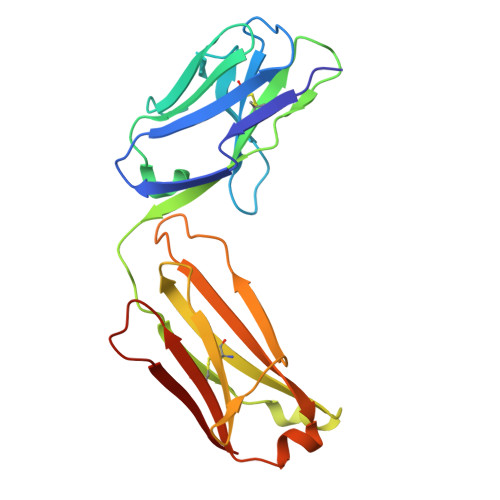
The crystal structure of SFTSV Gn and SD12 antibody complex


Experimental Data Snapshot

  • Method: X-RAY DIFFRACTION
  • Resolution: 2.40 Å
  • R-Value Free: 
    0.255 (Depositor), 0.255 (DCC) 
  • R-Value Work: 
    0.225 (Depositor), 0.225 (DCC) 
  • R-Value Observed: 
    0.227 (Depositor) 

Starting Models: experimental
View more details

wwPDB Validation   3D Report Full Report


Ligand Structure Quality Assessment 


This is version 1.1 of the entry. See complete history


Literature

Molecular mechanism of potently neutralizing human monoclonal antibodies against severe fever with thrombocytopenia virus infection.

Quan, C.Nie, K.Ma, D.Su, C.Li, L.Zheng, W.Yin, C.Wang, Y.Yang, P.Peng, D.Liu, X.Li, W.Liu, W.Shan, C.Zheng, J.Liu, D.Zhang, H.Carr, M.J.Gao, G.F.Qi, J.Shi, W.

(2025) J Virol 99: e0053325-e0053325

  • DOI: https://doi.org/10.1128/jvi.00533-25
  • Primary Citation of Related Structures:  
    9JQU, 9JQV, 9L2K

  • PubMed Abstract: 

    Although severe fever with thrombocytopenia syndrome (SFTS) was first described in China in 2009, the case fatality rate remains >40% among patients with multi-organ failure. To date, no antivirals specifically targeting SFTSV have been approved. We obtained several monoclonal antibodies (mAbs) from SFTS survivors by single-cell RNA-seq. Neutralization and animal experiments were applied to assess the effects of these mAbs in vitro and in vivo , and co-crystal structures with SFTSV-Gn glycoproteins were determined by X-ray crystallography. The mAbs SD4, SD12, and SD22 targeted the SFTSV-Gn with high neutralizing activities, and, remarkably, SD4 and SD22 exhibited K D values in the range of 32-83 pM for different viral genotypes. Notably, a single administration (20 mg/kg) of SD4 and SD22 showed 100% protection in mice at day 3 post-inoculation (dpi). Importantly, SD4 also provided 60% protection at a lower dose (0.3 mg/kg) when administered at 3 dpi. The crystallographic structures of SD4, SD22, and SD12 with Gn were determined at 3.3 Å, 2.8 Å, and 2.4 Å, respectively, which revealed that they recognized a conserved antigenic epitope around the hexon wellhead edge. These human-derived mAbs have significant therapeutic potential for severe SFTS cases and provide a basis for rational antibody-based vaccine designs and clinical trials. The incidence of severe fever with thrombocytopenia syndrome (SFTS) has been increasing in Asia in recent years; however, no specific antiviral agents have been approved to date. Herein, we report a panel of anti-SFTSV Gn monoclonal antibodies (mAbs) with excellent neutralizing capacities and remarkable therapeutic potential in vitro and in vivo in a mouse model. In addition, crystallographic structures of mAbs complexed with Gn were resolved with atomic resolution (2.4 Å-3.3 Å), revealing a conserved antigenic epitope near the hexon wellhead edge. In sum, the neutralizing antibodies reported in the present study have significant therapeutic potential, paving the way for effective treatment of severe SFTS patients.


  • Organizational Affiliation
    • Key Laboratory of Emerging Infectious Diseases in Universities of Shandong, Shandong First Medical University & Shandong Academy of Medical Sciences, Ji'nan, China.

Macromolecules
Find similar proteins by:  (by identity cutoff)  |  3D Structure
Entity ID: 1
MoleculeChains Sequence LengthOrganismDetailsImage
Envelopment polyproteinA,
D [auth B]
325SFTS virus HB29Mutation(s): 0 
UniProt
Find proteins for A0A0B5A886 (SFTS phlebovirus (isolate SFTSV/Human/China/HB29/2010))
Explore A0A0B5A886 
Go to UniProtKB:  A0A0B5A886
Entity Groups  
Sequence Clusters30% Identity50% Identity70% Identity90% Identity95% Identity100% Identity
UniProt GroupA0A0B5A886
Glycosylation
Glycosylation Sites: 2
Sequence Annotations
Expand
  • Reference Sequence
Find similar proteins by:  (by identity cutoff)  |  3D Structure
Entity ID: 2
MoleculeChains Sequence LengthOrganismDetailsImage
SD12 heavy chainB [auth H],
E [auth C]
223Homo sapiensMutation(s): 0 
Entity Groups  
Sequence Clusters30% Identity50% Identity70% Identity90% Identity95% Identity100% Identity
Sequence Annotations
Expand
  • Reference Sequence
Find similar proteins by:  (by identity cutoff)  |  3D Structure
Entity ID: 3
MoleculeChains Sequence LengthOrganismDetailsImage
SD12 light chainC [auth L],
F [auth D]
214Homo sapiensMutation(s): 0 
Entity Groups  
Sequence Clusters30% Identity50% Identity70% Identity90% Identity95% Identity100% Identity
Sequence Annotations
Expand
  • Reference Sequence
Oligosaccharides

Help

Entity ID: 4
MoleculeChains Length2D Diagram Glycosylation3D Interactions
2-acetamido-2-deoxy-beta-D-glucopyranose-(1-4)-2-acetamido-2-deoxy-beta-D-glucopyranoseG [auth E]2N-Glycosylation
Glycosylation Resources
GlyTouCan:  G42666HT
GlyCosmos:  G42666HT
GlyGen:  G42666HT
Entity ID: 5
MoleculeChains Length2D Diagram Glycosylation3D Interactions
beta-D-mannopyranose-(1-4)-2-acetamido-2-deoxy-beta-D-glucopyranose-(1-4)-2-acetamido-2-deoxy-beta-D-glucopyranoseH [auth F],
I [auth G]
3N-Glycosylation
Glycosylation Resources
GlyTouCan:  G15407YE
GlyCosmos:  G15407YE
GlyGen:  G15407YE
Small Molecules
Ligands 1 Unique
IDChains Name / Formula / InChI Key2D Diagram3D Interactions
NAG (Subject of Investigation/LOI)
Query on NAG

Download Ideal Coordinates CCD File 
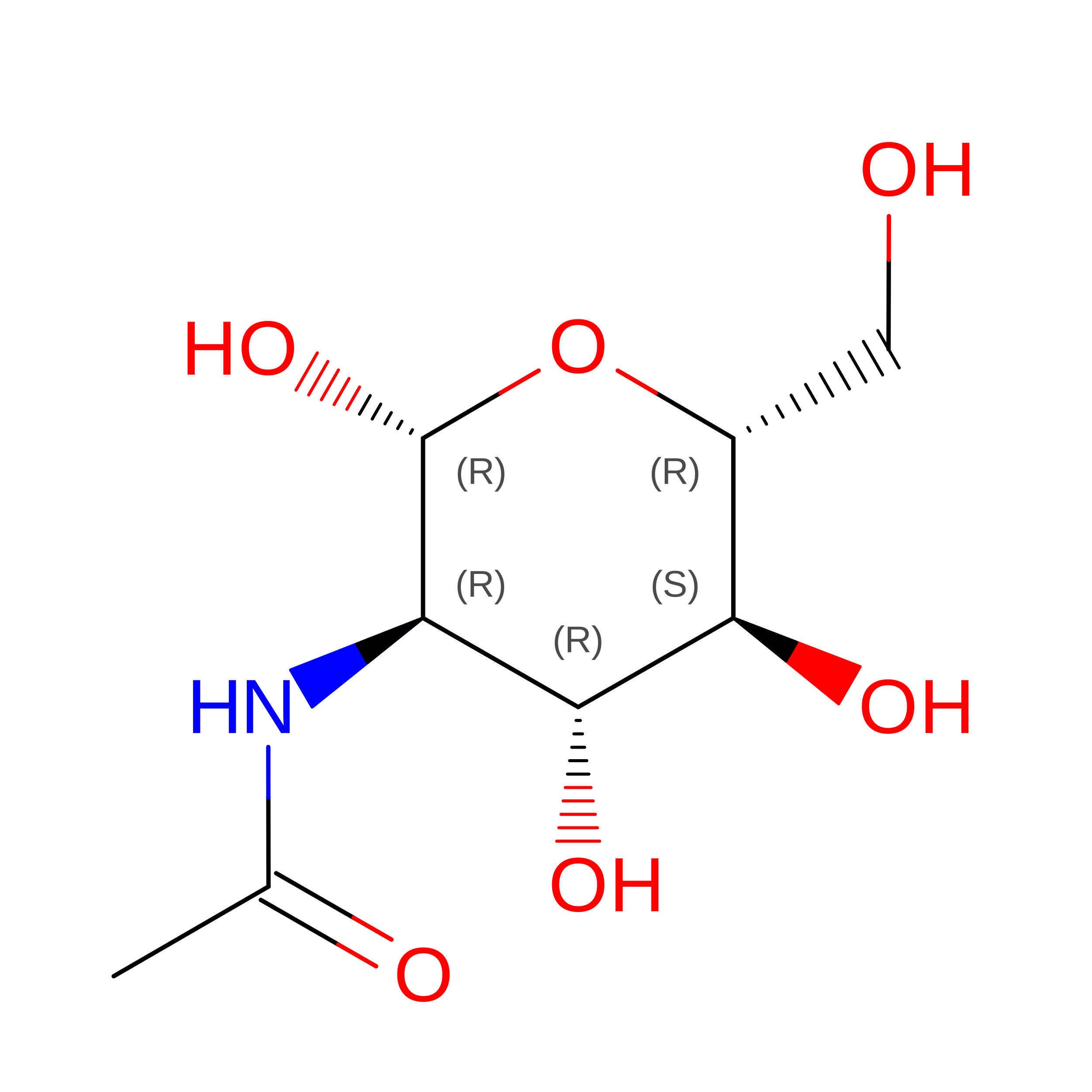
J [auth B]2-acetamido-2-deoxy-beta-D-glucopyranose
C8 H15 N O6
OVRNDRQMDRJTHS-FMDGEEDCSA-N
Experimental Data & Validation

Experimental Data

  • Method: X-RAY DIFFRACTION
  • Resolution: 2.40 Å
  • R-Value Free:  0.255 (Depositor), 0.255 (DCC) 
  • R-Value Work:  0.225 (Depositor), 0.225 (DCC) 
  • R-Value Observed: 0.227 (Depositor) 
Space Group: P 1 21 1
Unit Cell:
Length ( Å )Angle ( ˚ )
a = 96.064α = 90
b = 82.342β = 104.31
c = 125.293γ = 90
Software Package:
Software NamePurpose
PHENIXrefinement
HKL-2000data scaling
PHASERphasing

Structure Validation

View Full Validation Report


Ligand Structure Quality Assessment 


Entry History & Funding Information

Deposition Data


Funding OrganizationLocationGrant Number
National Science Foundation (NSF, China)China32325003

Revision History  (Full details and data files)

  • Version 1.0: 2025-06-18
    Type: Initial release
  • Version 1.1: 2025-12-31
    Changes: Database references