9JKL | pdb_00009jkl

LYSYL-TRNA SYNTHETASE(LysRS) COMPLEXED WITH LYSINE


Experimental Data Snapshot

  • Method: X-RAY DIFFRACTION
  • Resolution: 2.30 Å
  • R-Value Free: 
    0.228 (Depositor), 0.215 (DCC) 
  • R-Value Work: 
    0.204 (Depositor), 0.191 (DCC) 

Starting Model: in silico
View more details

wwPDB Validation   3D Report Full Report


Ligand Structure Quality Assessment 


This is version 1.1 of the entry. See complete history


Literature

Unravelling the plasticity of substrate recognition by Staphylococcus aureus lysyl-tRNA synthetase and its implications for misacylation.

Jani, J.Mochi, J.Shah, S.Das, A.Patel, D.Pananghat, G.Pappachan, A.

(2025) FEBS J 292: 5835-5854

  • DOI: https://doi.org/10.1111/febs.70185
  • Primary Citation Related Structures: 
    9JKL

  • PubMed Abstract: 

    Transfer RNA (tRNA) misacylation is a widespread phenomenon that affects translational fidelity due to the incorporation of non-cognate amino acids into proteins. We investigated the structural basis for the misacylation of tRNA Lys by Staphylococcus aureus lysyl-tRNA synthetase (SaLysRS). Activity studies showed that SaLysRS misacylated tRNA Lys with methionine and arginine. In vivo studies and MALDI-TOF analysis revealed the utilisation of these mischarged tRNAs in protein translation, as deciphered from the incorporation of non-cognate methionine and arginine into proteins. The misincorporation was also detrimental to cell growth. The three-dimensional structure of SaLysRS with its cognate substrate lysine was resolved at 2.3 Å resolution, which revealed key residues and conserved motifs needed for substrate recognition. Structural and mutational analysis and molecular dynamics simulations identified Glu233, Tyr273 and Glu420 as crucial residues for both cognate and non-cognate ligand binding. These insights, well-supported by structural, biochemical and computational data, enhance our knowledge of the mechanisms underlying misacylation in tRNA synthetases and its implications for cell growth.


  • Organizational Affiliation
    • School of Life Sciences, Central University of Gujarat, Gandhinagar, India.

Macromolecules
Find similar proteins by:  (by identity cutoff)  |  3D Structure
Entity ID: 1
MoleculeChains Sequence LengthOrganismDetailsImage
Lysine--tRNA ligase523Staphylococcus aureus subsp. aureus Mu50Mutation(s): 0 
Gene Names: lysSSAV0517
EC: 6.1.1.6
UniProt
Find proteins for Q2G0Q3 (Staphylococcus aureus (strain NCTC 8325 / PS 47))
Explore Q2G0Q3 
Go to UniProtKB:  Q2G0Q3
Entity Groups  
Sequence Clusters30% Identity50% Identity70% Identity90% Identity95% Identity100% Identity
UniProt GroupQ2G0Q3
Sequence Annotations
Expand
  • Reference Sequence
Small Molecules
Ligands 2 Unique
IDChains Name / Formula / InChI Key2D Diagram3D Interactions
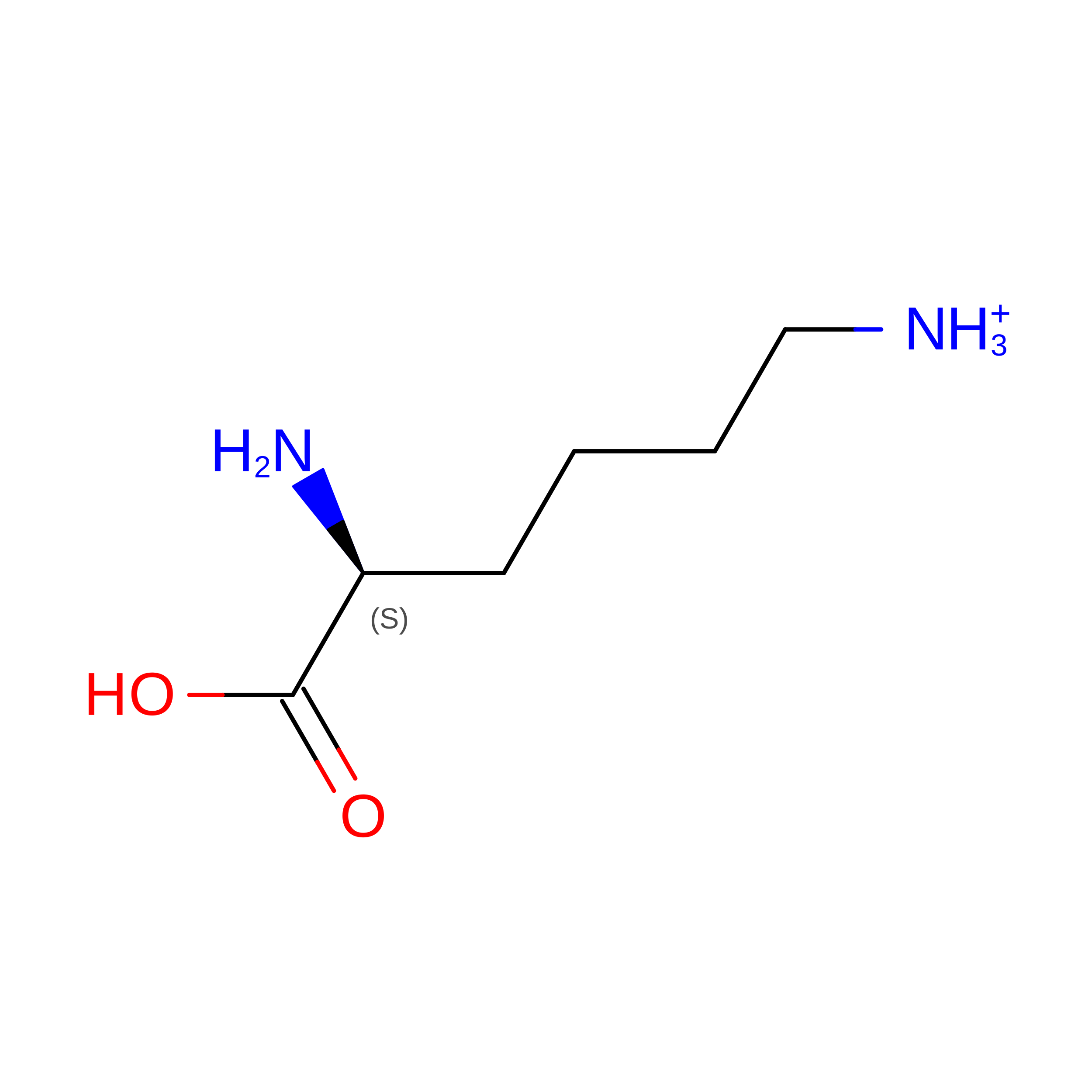
LYS (Subject of Investigation/LOI)
Query on LYS

Download Ideal Coordinates CCD File 
B [auth A]LYSINE
C6 H15 N2 O2
KDXKERNSBIXSRK-YFKPBYRVSA-O
GOL (Subject of Investigation/LOI)
Query on GOL

Download Ideal Coordinates CCD File 
C [auth A]
D [auth A]
E [auth A]
F [auth A]
G [auth A]
C [auth A],
D [auth A],
E [auth A],
F [auth A],
G [auth A],
H [auth A],
I [auth A]
GLYCEROL
C3 H8 O3
PEDCQBHIVMGVHV-UHFFFAOYSA-N
Experimental Data & Validation

Experimental Data

  • Method: X-RAY DIFFRACTION
  • Resolution: 2.30 Å
  • R-Value Free:  0.228 (Depositor), 0.215 (DCC) 
  • R-Value Work:  0.204 (Depositor), 0.191 (DCC) 
Space Group: P 41 21 2
Unit Cell:
Length ( Å )Angle ( ˚ )
a = 105.015α = 90
b = 105.015β = 90
c = 241.35γ = 90
Software Package:
Software NamePurpose
REFMACrefinement
Cootmodel building
DIALSdata collection
Aimlessdata scaling
PHASERphasing
MOSFLMdata reduction

Structure Validation

View Full Validation Report


Ligand Structure Quality Assessment 


Entry History & Funding Information

Deposition Data


Funding OrganizationLocationGrant Number
Not funded--

Revision History  (Full details and data files)

  • Version 1.0: 2025-09-10
    Type: Initial release
  • Version 1.1: 2026-03-25
    Changes: Database references