Download Mendeley
Molecular basis of the phosphorothioation-sensing antiphage defense system IscS-DndBCDE-DndI.
Tang, Y., Wu, D., Zhang, Y., Liu, X., Chu, H., Tan, Q., Jiang, L., Chen, S., Wu, G., Wang, L.(2024) Nucleic Acids Res 52: 13594-13604
- PubMed: 39611571 Search on PubMed
- DOI: https://doi.org/10.1093/nar/gkae1133
- Primary Citation Related Structures:
9JFL - PubMed Abstract:
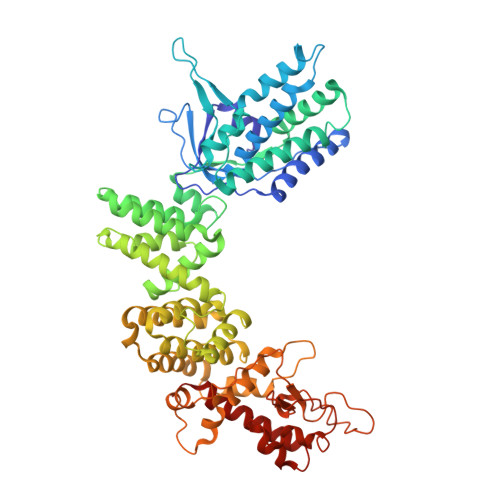
Phosphorothioation serves as a DNA backbone modification mechanism, wherein a sulfur atom substitutes the nonbridging oxygen atom within the phosphodiester, facilitated by the gene products of dndABCDE or sspABCD. The combination of dndABCDE with dndFGH forms a bona fide defense system, where the DndFGH protein complex exhibits DNA nickase and DNA translocase activities to prevent phage invasion. In this study, we identified that dndI, co-transcribed with dndFGH, can independently couple with iscS-dndBCDE as an anti-phage defense system. Moreover, we resolved the crystal structure of DndI from Salmonella at a resolution of 3.10 Å. We discovered that its residue Y25, residing within a hydrophobic region of DndI, is involved in phosphorothioate (PT) sensing. Upon sensing PT modifications at 5'-GPSAAC-3'/5'-GPSTTC-3', the ATPase activity of DndI is stimulated, which subsequently triggers a conformational transition, facilitating the dissociation of DndI from self-DNA, thereby allowing DndI to avoid cleaving self-DNA while restricting PT-deficient phage DNA. This research broadens the knowledge of the mechanistic diversity underlying PT-based defense systems and highlights their complexity in the course of evolution.
- Department of Gastroenterology, Ministry of Education Key Laboratory of Combinatorial Biosynthesis and Drug Discovery, Hubei Clinical Center and Key Laboratory of Intestinal and Colorectal Disease, TaiKang Center for Life and Medical Sciences, Zhongnan Hospital of Wuhan University, School of Pharmaceutical Sciences, Wuhan University, 169 Donghu Road, Wuchang District, Wuhan 430071, China.
Organizational Affiliation: