Download Mendeley
Biodegradation of p-nitrophenol by Rhodococcus sp. 21391 unveils a two-component p-nitrophenol monooxygenase with broad substrate specificity.
Yang, J., Lin, S., Li, W., Wang, X., Li, R.(2025) Microb Cell Fact 24: 85-85
- PubMed: 40247276 Search on PubMedSearch on PubMed Central
- DOI: https://doi.org/10.1186/s12934-025-02712-1
- Primary Citation Related Structures:
9J9J - PubMed Abstract:
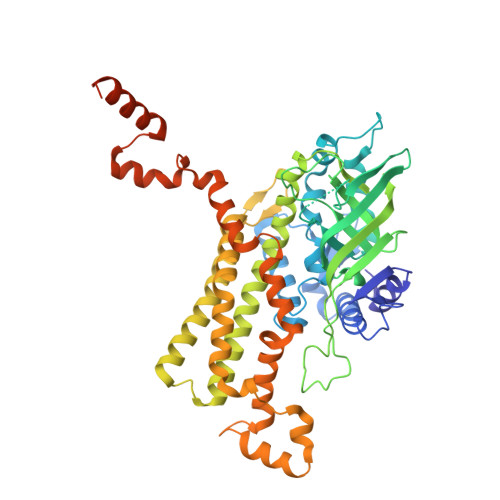
Bioremediation relying on highly efficient degrading bacteria constitutes a promising and sustainable avenue for controlling and reducing nitrophenol contamination in the environment. A thorough understanding of the bacterial degradation mechanism of nitrophenol is of paramount importance for supporting the development of efficient microbial remediation technology. In this study, a new bacterium, Rhodococcus sp. 21391, endowed with superior p-nitrophenol (PNP) degradation ability was obtained. Genomic and comparative proteomic analyses revealed that it utilizes the 1,2,4-benzenetriol (BT) pathway for PNP degradation. The catalytic properties of the two-component p-nitrophenol monooxygenase RsNcpAB from the strain were investigated in vitro. The enzyme exhibited a broad substrate selectivity, catalyzing the oxidation of various nitrophenols and halogenated phenols, with significant potential for further research and development. Additionally, the crystal structure of the oxidative component of p-nitrophenol monooxygenase, RsNcpA, was determined. Structural analysis and site-directed mutagenesis revealed that residues Arg100 and His293 in the active site play a crucial role in enzyme catalysis, and a catalytic mechanism model was subsequently proposed. This study reports a high-performance nitrophenol-degrading bacterium and enzyme, and reveals their mechanisms at the molecular level. These findings increase the understanding of the bacterial degradation of nitrophenol, thereby providing a crucial foundation for the development of efficient bioremediation technologies.
- School of Life and Health Technology, Dongguan University of Technology, Dongguan, China. yangjian@dgut.edu.cn.
Organizational Affiliation: