9J0A | pdb_00009j0a

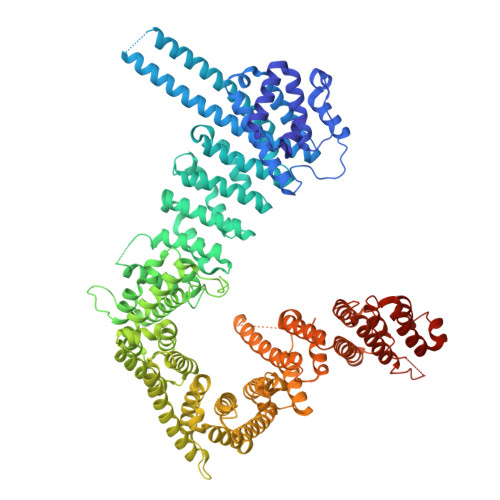
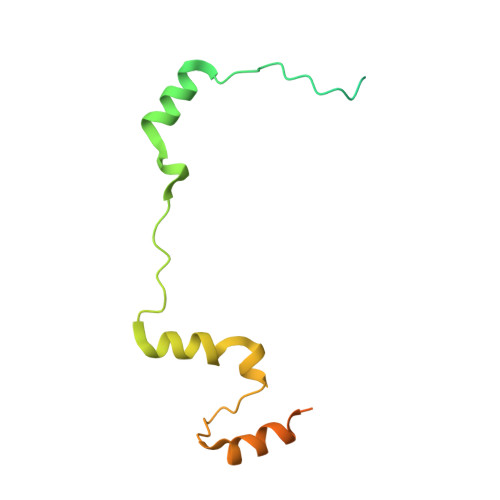
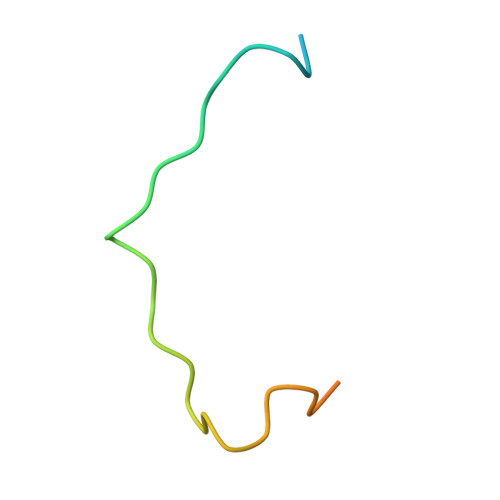
Complex structure of ANKRD11/STAG2/RAD21


Experimental Data Snapshot

  • Method: X-RAY DIFFRACTION
  • Resolution: 3.30 Å
  • R-Value Free: 
    0.279 (Depositor), 0.277 (DCC) 
  • R-Value Work: 
    0.233 (Depositor), 0.233 (DCC) 
  • R-Value Observed: 
    0.235 (Depositor) 

Starting Model: experimental
View more details

wwPDB Validation   3D Report Full Report


This is version 1.0 of the entry. See complete history


Literature

ANKRD11 binding to cohesin suggests a connection between KBG syndrome and Cornelia de Lange syndrome.

Liu, H.Li, H.Cai, Q.Zhang, J.Zhong, H.Hu, G.Zhao, S.Lu, Y.Mao, Y.Lu, Y.Yao, H.Zhang, M.

(2025) Proc Natl Acad Sci U S A 122: e2417346122-e2417346122

  • DOI: https://doi.org/10.1073/pnas.2417346122
  • Primary Citation of Related Structures:  
    9J0A

  • PubMed Abstract: 

    Ankyrin Repeat Domain-containing Protein 11 ( ANKRD11 ) is a causative gene for KBG syndrome, a significant risk factor for Cornelia de Lange syndrome (CdLS), and a highly confident autism spectrum disorder gene. Mutations of ANKRD11 lead to developmental abnormalities in multiple organs/tissues including the brain, craniofacial and skeletal bones, and tooth structures with unknown mechanism(s). Here, we find that ANKRD11, via a short peptide fragment in its N-terminal region, binds to the cohesin complex with a high affinity, implicating why ANKRD11 mutation can cause CdLS. The crystal structure of the ANKRD11 peptide in complex with cohesin, together with biochemical experiments, revealed that ANKRD11 competes with CCCTC-binding factor in binding to the cohesin complex. Importantly, a single point mutation in ANKRD11 (Tyr347 to Ala) specifically disrupted the interaction between ANKRD11 and cohesin and perturbed gene expressions in a mouse embryonic stem cell model. Mice carrying the ANKRD11 Y347A mutation display neural and craniofacial anomalies, which mirror clinical phenotypes observed in KBG syndrome patients. Thus, our study reveals how ANKRD11 functions together with cohesin to regulate gene expression and also provides insights into the molecular mechanisms underpinning developmental disorders caused by ANKRD11 mutations.


  • Organizational Affiliation
    • Shenzhen Key Laboratory of Biomolecular Assembling and Regulation, Department of Neuroscience, School of Life Sciences, Southern University of Science and Technology, Shenzhen 518055, China.

Macromolecules
Find similar proteins by:  (by identity cutoff)  |  3D Structure
Entity ID: 1
MoleculeChains Sequence LengthOrganismDetailsImage
Cohesin subunit SA-2
A, D
985Mus musculusMutation(s): 0 
Gene Names: Stag2Sa2Sap2
UniProt
Find proteins for O35638 (Mus musculus)
Explore O35638 
Go to UniProtKB:  O35638
Entity Groups  
Sequence Clusters30% Identity50% Identity70% Identity90% Identity95% Identity100% Identity
UniProt GroupO35638
Sequence Annotations
Expand
  • Reference Sequence
Find similar proteins by:  (by identity cutoff)  |  3D Structure
Entity ID: 2
MoleculeChains Sequence LengthOrganismDetailsImage
64-kDa C-terminal product
B, E
143Mus musculusMutation(s): 0 
Gene Names: Rad21Hr21Scc1
UniProt
Find proteins for Q61550 (Mus musculus)
Explore Q61550 
Go to UniProtKB:  Q61550
Entity Groups  
Sequence Clusters30% Identity50% Identity70% Identity90% Identity95% Identity100% Identity
UniProt GroupQ61550
Sequence Annotations
Expand
  • Reference Sequence
Find similar proteins by:  (by identity cutoff)  |  3D Structure
Entity ID: 3
MoleculeChains Sequence LengthOrganismDetailsImage
Ankyrin repeat domain-containing protein 11
C, F
41Mus musculusMutation(s): 0 
Gene Names: Ankrd11
UniProt & NIH Common Fund Data Resources
Find proteins for E9Q4F7 (Mus musculus)
Explore E9Q4F7 
Go to UniProtKB:  E9Q4F7
IMPC:  MGI:1924337
Entity Groups  
Sequence Clusters30% Identity50% Identity70% Identity90% Identity95% Identity100% Identity
UniProt GroupE9Q4F7
Sequence Annotations
Expand
  • Reference Sequence
Experimental Data & Validation

Experimental Data

  • Method: X-RAY DIFFRACTION
  • Resolution: 3.30 Å
  • R-Value Free:  0.279 (Depositor), 0.277 (DCC) 
  • R-Value Work:  0.233 (Depositor), 0.233 (DCC) 
  • R-Value Observed: 0.235 (Depositor) 
Space Group: I 1 2 1
Unit Cell:
Length ( Å )Angle ( ˚ )
a = 280.535α = 90
b = 48.773β = 90
c = 290.906γ = 90
Software Package:
Software NamePurpose
PHENIXrefinement
DIALSdata scaling
DIALSdata reduction
PHASERphasing

Structure Validation

View Full Validation Report


Entry History & Funding Information

Deposition Data


Funding OrganizationLocationGrant Number
National Natural Science Foundation of China (NSFC)China--

Revision History  (Full details and data files)

  • Version 1.0: 2025-03-19
    Type: Initial release