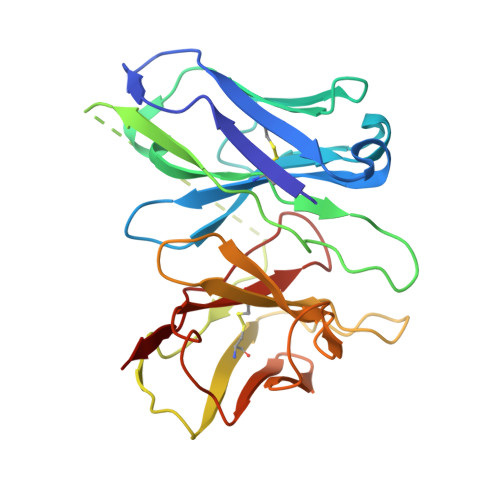
9IZD | pdb_00009izd

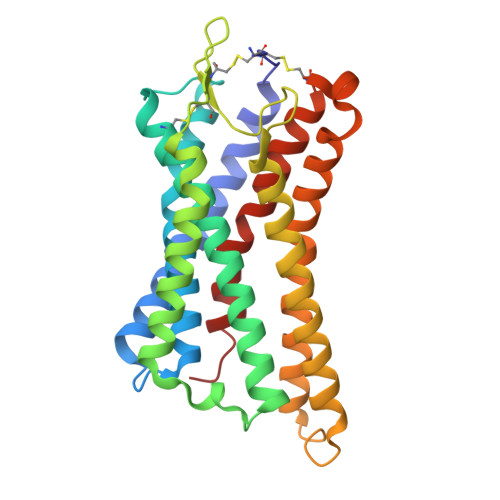
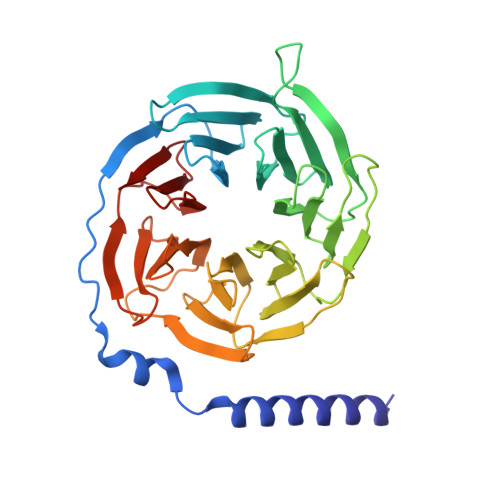
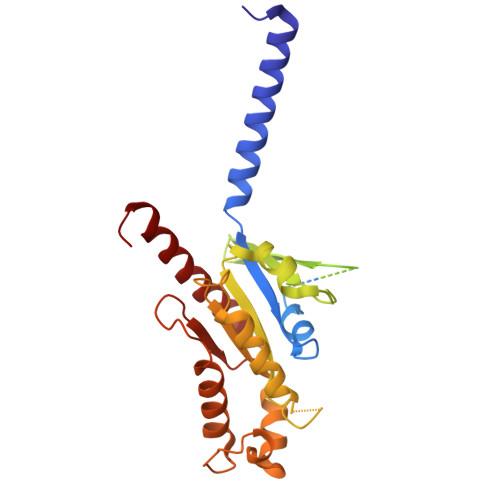
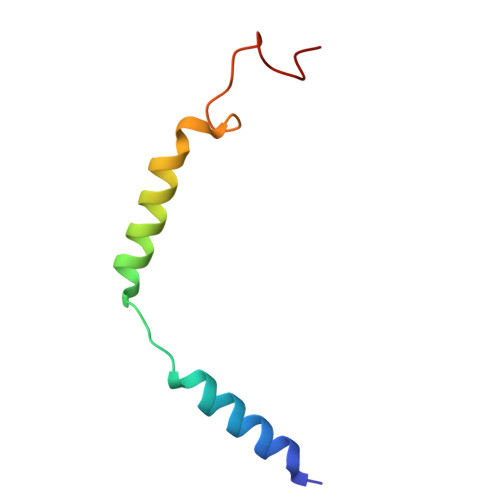
Cryo-EM structure of human HCAR1-Gi complex with CHBA


Experimental Data Snapshot

  • Method: ELECTRON MICROSCOPY
  • Resolution: 3.16 Å
  • Aggregation State: PARTICLE 
  • Reconstruction Method: SINGLE PARTICLE 

wwPDB Validation   3D Report Full Report


This is version 1.2 of the entry. See complete history


Literature

Structures of G-protein coupled receptor HCAR1 in complex with Gi1 protein reveal the mechanistic basis for ligand recognition and agonist selectivity.

Pan, X.Ye, F.Ning, P.Yu, Y.Zhang, Z.Wang, J.Chen, G.Wu, Z.Qiu, C.Li, J.Chen, B.Zhu, L.Qian, C.Gong, K.Du, Y.

(2025) PLoS Biol 23: e3003126-e3003126

  • DOI: https://doi.org/10.1371/journal.pbio.3003126
  • Primary Citation of Related Structures:  
    9IZA, 9IZC, 9IZD, 9J8Z

  • PubMed Abstract: 

    Hydroxycarboxylic acid receptor 1 (HCAR1), also known as lactate receptor or GPR81, is a class A G-protein-coupled receptor with key roles in regulating lipid metabolism, neuroprotection, angiogenesis, cardiovascular function, and inflammatory response in humans. HCAR1 is highly expressed in numerous types of cancer cells, where it participates in controlling cancer cell metabolism and defense mechanisms, rendering it an appealing target for cancer therapy. However, the molecular basis of HCAR1-mediated signaling remains poorly understood. Here, we report four cryo-EM structures of human HCAR1 and HCAR2 in complex with the Gi1 protein, in which HCAR1 binds to the subtype-specific agonist CHBA (3.16 Å) and apo form (3.36 Å), and HCAR2 binds to the subtype-specific agonists MK-1903 (2.68 Å) and SCH900271 (3.06 Å). Combined with mutagenesis and cellular functional assays, we elucidate the mechanisms underlying ligand recognition, receptor activation, and G protein coupling of HCAR1. More importantly, the key residues that determine ligand selectivity between HCAR1 and HCAR2 are clarified. On this basis, we further summarize the structural features of agonists that match the orthosteric pockets of HCAR1 and HCAR2. These structural insights are anticipated to greatly accelerate the development of novel HCAR1-targeted drugs, offering a promising avenue for the treatment of various diseases.


  • Organizational Affiliation
    • Department of Cardiology, Institute of Cardiovascular Disease, Yangzhou Key Lab of Innovation Frontiers in Cardiovascular Disease, Affiliated Hospital of Yangzhou University, Yangzhou University, Yangzhou, China.

Macromolecules
Find similar proteins by:  (by identity cutoff)  |  3D Structure
Entity ID: 1
MoleculeChains Sequence LengthOrganismDetailsImage
Hydroxycarboxylic acid receptor 1279Homo sapiensMutation(s): 0 
Gene Names: HCAR1GPR104GPR81HCA1FKSG80
UniProt & NIH Common Fund Data Resources
Find proteins for Q9BXC0 (Homo sapiens)
Explore Q9BXC0 
Go to UniProtKB:  Q9BXC0
PHAROS:  Q9BXC0
GTEx:  ENSG00000196917 
Entity Groups  
Sequence Clusters30% Identity50% Identity70% Identity90% Identity95% Identity100% Identity
UniProt GroupQ9BXC0
Sequence Annotations
Expand
  • Reference Sequence
Find similar proteins by:  (by identity cutoff)  |  3D Structure
Entity ID: 2
MoleculeChains Sequence LengthOrganismDetailsImage
Guanine nucleotide-binding protein G(I)/G(S)/G(T) subunit beta-1337Homo sapiensMutation(s): 0 
Gene Names: GNB1
UniProt & NIH Common Fund Data Resources
Find proteins for P62873 (Homo sapiens)
Explore P62873 
Go to UniProtKB:  P62873
PHAROS:  P62873
GTEx:  ENSG00000078369 
Entity Groups  
Sequence Clusters30% Identity50% Identity70% Identity90% Identity95% Identity100% Identity
UniProt GroupP62873
Sequence Annotations
Expand
  • Reference Sequence
Find similar proteins by:  (by identity cutoff)  |  3D Structure
Entity ID: 3
MoleculeChains Sequence LengthOrganismDetailsImage
Guanine nucleotide-binding protein G(i) subunit alpha-1351Homo sapiensMutation(s): 0 
Gene Names: GNAI1
EC: 3.6.5
UniProt & NIH Common Fund Data Resources
Find proteins for P63096 (Homo sapiens)
Explore P63096 
Go to UniProtKB:  P63096
PHAROS:  P63096
GTEx:  ENSG00000127955 
Entity Groups  
Sequence Clusters30% Identity50% Identity70% Identity90% Identity95% Identity100% Identity
UniProt GroupP63096
Sequence Annotations
Expand
  • Reference Sequence
Find similar proteins by:  (by identity cutoff)  |  3D Structure
Entity ID: 4
MoleculeChains Sequence LengthOrganismDetailsImage
Guanine nucleotide-binding protein G(I)/G(S)/G(O) subunit gamma-2D [auth G]56Homo sapiensMutation(s): 0 
Gene Names: GNG2
UniProt & NIH Common Fund Data Resources
Find proteins for P59768 (Homo sapiens)
Explore P59768 
Go to UniProtKB:  P59768
PHAROS:  P59768
GTEx:  ENSG00000186469 
Entity Groups  
Sequence Clusters30% Identity50% Identity70% Identity90% Identity95% Identity100% Identity
UniProt GroupP59768
Sequence Annotations
Expand
  • Reference Sequence
Find similar proteins by:  (by identity cutoff)  |  3D Structure
Entity ID: 5
MoleculeChains Sequence LengthOrganismDetailsImage
scFv16E [auth S]248Homo sapiensMutation(s): 0 
Entity Groups  
Sequence Clusters30% Identity50% Identity70% Identity90% Identity95% Identity100% Identity
Sequence Annotations
Expand
  • Reference Sequence
Small Molecules
Ligands 1 Unique
IDChains Name / Formula / InChI Key2D Diagram3D Interactions
A1D71 (Subject of Investigation/LOI)
Query on A1D71

Download Ideal Coordinates CCD File 
F [auth A]3-chloranyl-5-oxidanyl-benzoic acid
C7 H5 Cl O3
RJOLIYHZZKAIET-UHFFFAOYSA-N
Experimental Data & Validation

Experimental Data

  • Method: ELECTRON MICROSCOPY
  • Resolution: 3.16 Å
  • Aggregation State: PARTICLE 
  • Reconstruction Method: SINGLE PARTICLE 
EM Software:
TaskSoftware PackageVersion
MODEL REFINEMENTPHENIX

Structure Validation

View Full Validation Report


Entry History & Funding Information

Deposition Data


Funding OrganizationLocationGrant Number
National Natural Science Foundation of China (NSFC)China--

Revision History  (Full details and data files)

  • Version 1.0: 2025-04-02
    Type: Initial release
  • Version 1.1: 2025-07-16
    Changes: Data collection
  • Version 1.2: 2025-10-22
    Changes: Data collection, Database references