9IXE | pdb_00009ixe

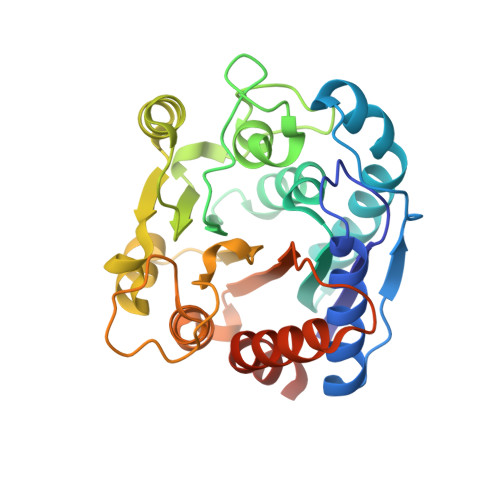
Crystal structure of Copper-bound N(omega)-hydroxy-L-arginine hydrolase without oxidized Cys86


Experimental Data Snapshot

  • Method: X-RAY DIFFRACTION
  • Resolution: 1.58 Å
  • R-Value Free: 
    0.216 (Depositor), 0.218 (DCC) 
  • R-Value Work: 
    0.179 (Depositor), 0.181 (DCC) 
  • R-Value Observed: 
    0.181 (Depositor) 

Starting Model: experimental
View more details

wwPDB Validation 3D Report Full Report

Validation slider image for 9IXE

This is version 1.2 of the entry. See complete history

Literature

Copper inactivates DcsB by oxidizing the metal ligand Cys86 to sulfinic acid.

Oda, K.Komaguchi, K.Matoba, Y.

(2024) FEBS J 291: 5486-5505

  • DOI: https://doi.org/10.1111/febs.17325
  • Primary Citation Related Structures: 
    9IXC, 9IXD, 9IXE, 9IXF, 9IXG

  • PubMed Abstract: 

    N ω -hydroxy-l-arginine amidinohydrolase (EC:3.5.3.25), an enzyme in the d-cycloserine (d-CS) biosynthetic pathway of Streptomyces lavendulae, catalyzes the hydrolysis of an arginase inhibitor, N ω -hydroxy-l-arginine, to produce l-ornithine and hydroxyurea, despite being homologous to arginase. Like arginase, the enzyme (DcsB) possesses two manganese ions (Mn A and Mn B ) essential for the enzymatic reaction at the bottom of the cavity formed within the molecule. However, one of the Mn A ligands in DcsB is Cys86, whereas the corresponding residues in arginase are histidine. In this study, we determined the crystal structure of Mn-free DcsB to elucidate the installation mechanism of the manganese ions. The flipping of the His111 residue after the formation of the coordination bond to the second manganese ion may facilitate the installation of Mn B and the closing of the cavity entrance to retain Mn A and Mn B at the active site. Copper ions, which are known to be a positive regulator of many secondary metabolites in Streptomyces species, were found to irreversibly inactivate the catalytic activity of DcsB. Mass spectrometric and crystallographic analyses of the Cu(II)-treated DcsB indicated that Cys86 is oxidized to sulfinic acid. The d-CS biosynthesis in the producing microorganism may be negatively regulated by the concentration of intracellular copper ions, which mediates the oxidative stress.


  • Organizational Affiliation
    • Department of Virology, Institute of Biomedical and Health Sciences, Hiroshima University, Japan.

Macromolecule Content 

  • Total Structure Weight: 60.36 kDa 
  • Atom Count: 4,713 
  • Modeled Residue Count: 546 
  • Deposited Residue Count: 562 
  • Unique protein chains: 1

Macromolecules

Find similar proteins by:|  3D Structure
Entity ID: 1
MoleculeChains  Sequence LengthOrganismDetailsImage
N(omega)-hydroxy-L-arginine amidinohydrolase
A, B
281Streptomyces lavendulaeMutation(s): 0 
Gene Names: dcsB
EC: 3.5.3.25
UniProt
Find proteins for D2Z025 (Streptomyces lavendulae)
Explore D2Z025 
Go to UniProtKB:  D2Z025
Entity Groups
Sequence Clusters30% Identity50% Identity70% Identity90% Identity95% Identity100% Identity
UniProt GroupD2Z025
Sequence Annotations
Expand
Reference Sequence

Experimental Data & Validation

Experimental Data

  • Method: X-RAY DIFFRACTION
  • Resolution: 1.58 Å
  • R-Value Free:  0.216 (Depositor), 0.218 (DCC) 
  • R-Value Work:  0.179 (Depositor), 0.181 (DCC) 
  • R-Value Observed: 0.181 (Depositor) 
Space Group: P 1
Unit Cell:
Length ( Å )Angle ( ˚ )
a = 46.502α = 83.57
b = 46.981β = 84.69
c = 59.559γ = 70.09
Software Package:
Software NamePurpose
PHENIXrefinement
Aimlessdata scaling
XDSdata reduction
PHENIXphasing

Structure Validation

View Full Validation Report


Entry History 

& Funding Information

Deposition Data


Funding OrganizationLocationGrant Number
Not funded--

Revision History  (Full details and data files)

  • Version 1.0: 2024-11-20
    Type: Initial release
  • Version 1.1: 2024-11-27
    Changes: Database references
  • Version 1.2: 2025-01-01
    Changes: Database references