9IOL | pdb_00009iol

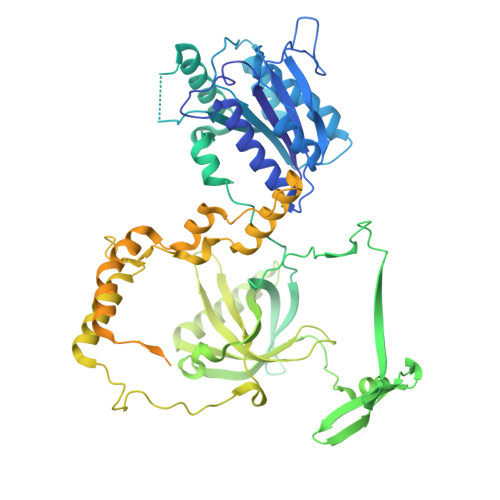
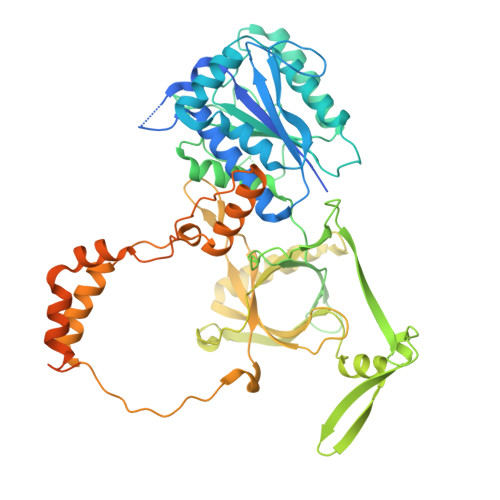
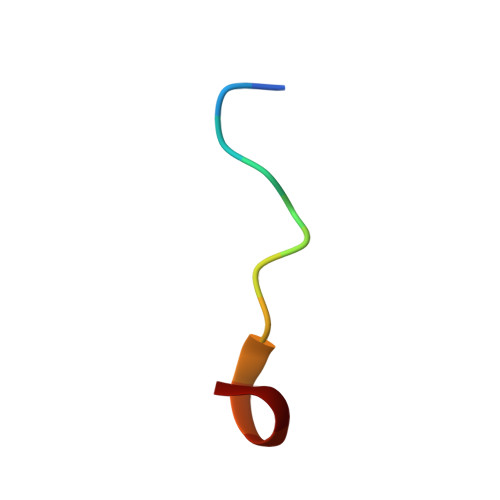
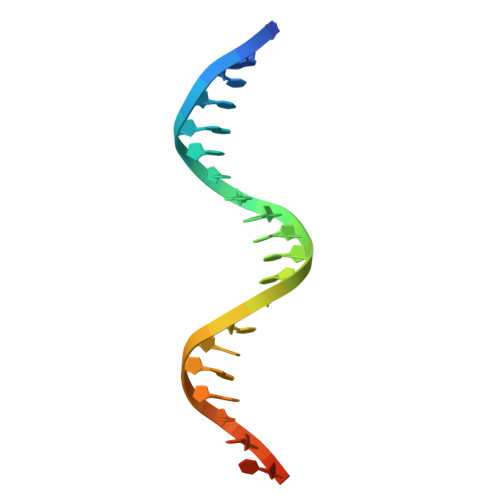
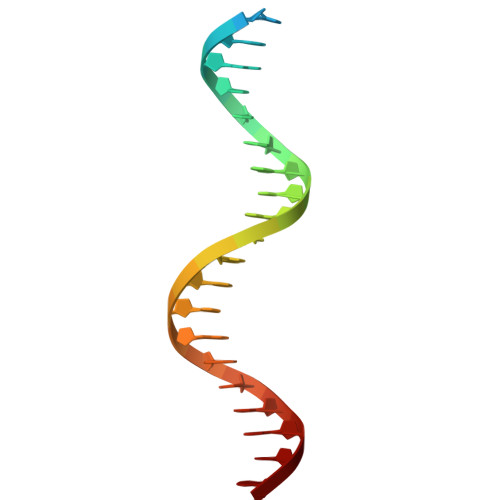
Cryo-EM structure of the complex of DNA, Ku70/80, and laXLF.


Experimental Data Snapshot

  • Method: ELECTRON MICROSCOPY
  • Resolution: 3.46 Å
  • Aggregation State: PARTICLE 
  • Reconstruction Method: SINGLE PARTICLE 

wwPDB Validation   3D Report Full Report


This is version 1.1 of the entry. See complete history


Literature

Lactylation of XLF promotes non-homologous end-joining repair and chemoresistance in cancer.

Jin, M.Huang, B.Yang, X.Wang, S.Wu, J.He, Y.Ding, X.Wang, X.Wang, Z.Yang, J.Li, R.Zhou, X.Wang, Q.Li, Y.Li, L.Zheng, W.Zeng, Z.Zhao, C.Liu, J.Zhu, Q.Kang, Z.Li, K.Liang, S.Chen, Y.Yuan, J.

(2025) Mol Cell 85: 2654-2672.e7

  • DOI: https://doi.org/10.1016/j.molcel.2025.06.019
  • Primary Citation of Related Structures:  
    9IOL

  • PubMed Abstract: 

    Metabolic reprogramming and DNA damage repair are essential in tumorigenesis and chemoresistance, yet their link remains elusive. Here, we show that LDHA deficiency impairs NHEJ and class switch recombination. Additionally, glycolysis-derived lactate promotes XLF lactylation at K288 within its Ku-binding motif (X-KBM) to regulate NHEJ. Mechanistically, DNA damage triggers ATM-mediated GCN5 phosphorylation to increase GCN5-XLF interaction and XLF lactylation, enhancing XLF-Ku80 binding, XLF recruitment to DSBs, and NHEJ efficiency. Cryo-EM structural analysis demonstrates that lactylated X-KBM (laX-KBM) forms a more extensive interface with Ku70/80, inducing conformational changes in the Ku80 vWA domain. XLF lactylation deficiency impairs NHEJ and sensitizes cancer cells to chemotherapy. A specific XLF K288 lactylation peptide inhibitor plus 5-fluorouracil synergistically kills colorectal cancer cells in PDX models with XLF hyperlactylation. These findings highlight that the GCN5-XLF lactylation axis is a critical NHEJ regulator and that targeting XLF lactylation can improve chemotherapy efficiency.


  • Organizational Affiliation
    • Shanghai Key Laboratory of Anesthesiology and Brain Functional Modulation, Clinical Research Center for Anesthesiology and Perioperative Medicine, Translational Research Institute of Brain and Brain-Like Intelligence, Department of Anesthesiology and Perioperative Medicine, Shanghai Fourth People's Hospital, School of Medicine, Tongji University, Shanghai 200434, China; Cancer Center, Tongji University School of Medicine, Shanghai 200331, China.

Macromolecules

Find similar proteins by:  (by identity cutoff)  |  3D Structure
Entity ID: 1
MoleculeChains Sequence LengthOrganismDetailsImage
X-ray repair cross-complementing protein 5732Homo sapiensMutation(s): 0 
Gene Names: XRCC5G22P2
EC: 3.6.4
UniProt & NIH Common Fund Data Resources
Find proteins for P13010 (Homo sapiens)
Explore P13010 
Go to UniProtKB:  P13010
PHAROS:  P13010
GTEx:  ENSG00000079246 
Entity Groups  
Sequence Clusters30% Identity50% Identity70% Identity90% Identity95% Identity100% Identity
UniProt GroupP13010
Sequence Annotations
Expand
  • Reference Sequence
Find similar proteins by:  (by identity cutoff)  |  3D Structure
Entity ID: 2
MoleculeChains Sequence LengthOrganismDetailsImage
X-ray repair cross-complementing protein 6609Homo sapiensMutation(s): 0 
Gene Names: XRCC6G22P1
EC: 3.6.4 (PDB Primary Data), 4.2.99 (PDB Primary Data)
UniProt & NIH Common Fund Data Resources
Find proteins for P12956 (Homo sapiens)
Explore P12956 
Go to UniProtKB:  P12956
PHAROS:  P12956
GTEx:  ENSG00000196419 
Entity Groups  
Sequence Clusters30% Identity50% Identity70% Identity90% Identity95% Identity100% Identity
UniProt GroupP12956
Sequence Annotations
Expand
  • Reference Sequence

Find similar proteins by:  Sequence   |   3D Structure  

Entity ID: 5
MoleculeChains Sequence LengthOrganismDetailsImage
Peptide from Non-homologous end-joining factor 1E [auth M]13Homo sapiensMutation(s): 0 
UniProt & NIH Common Fund Data Resources
Find proteins for Q9H9Q4 (Homo sapiens)
Explore Q9H9Q4 
Go to UniProtKB:  Q9H9Q4
PHAROS:  Q9H9Q4
GTEx:  ENSG00000187736 
Entity Groups  
Sequence Clusters30% Identity50% Identity70% Identity90% Identity95% Identity100% Identity
UniProt GroupQ9H9Q4
Sequence Annotations
Expand
  • Reference Sequence

Find similar nucleic acids by:  Sequence   |   3D Structure  

Entity ID: 3
MoleculeChains LengthOrganismImage
DNA (5'-D(P*CP*GP*CP*TP*GP*CP*CP*GP*AP*TP*TP*CP*GP*TP*CP*GP*AP*CP*CP*T)-3')23Homo sapiens
Sequence Annotations
Expand
  • Reference Sequence

Find similar nucleic acids by:  Sequence   |   3D Structure  

Entity ID: 4
MoleculeChains LengthOrganismImage
DNA (5'-D(P*AP*GP*GP*TP*CP*GP*AP*CP*GP*AP*AP*TP*CP*GP*GP*CP*AP*GP*CP*G)-3')23Homo sapiens
Sequence Annotations
Expand
  • Reference Sequence
Experimental Data & Validation

Experimental Data

  • Method: ELECTRON MICROSCOPY
  • Resolution: 3.46 Å
  • Aggregation State: PARTICLE 
  • Reconstruction Method: SINGLE PARTICLE 

Structure Validation

View Full Validation Report


Entry History & Funding Information

Deposition Data

  • Released Date: 2025-07-09 
  • Deposition Author(s): Liang, S.

Funding OrganizationLocationGrant Number
Other privateHong Kong--

Revision History  (Full details and data files)

  • Version 1.0: 2025-07-09
    Type: Initial release
  • Version 1.1: 2025-07-30
    Changes: Data collection, Database references