Download Mendeley
Structural basis of selective beta-carotene binding by a soluble protein.
Egorkin, N.A., Dominnik, E.E., Raevskii, R.I., Kuklina, D.D., Varfolomeeva, L.A., Popov, V.O., Boyko, K.M., Sluchanko, N.N.(2024) Structure 32: 2123-2133.e3
- PubMed: 39383875 Search on PubMed
- DOI: https://doi.org/10.1016/j.str.2024.09.014
- Primary Citation Related Structures:
9INK - PubMed Abstract:
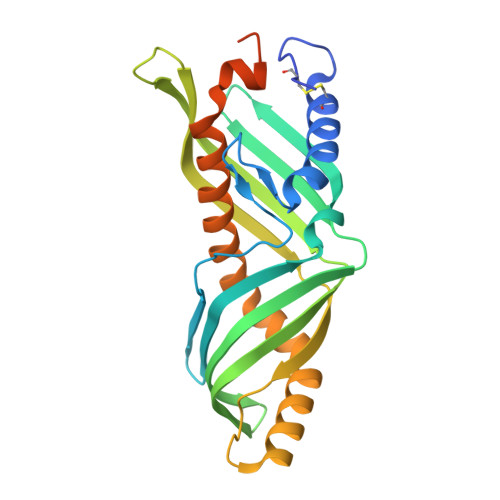
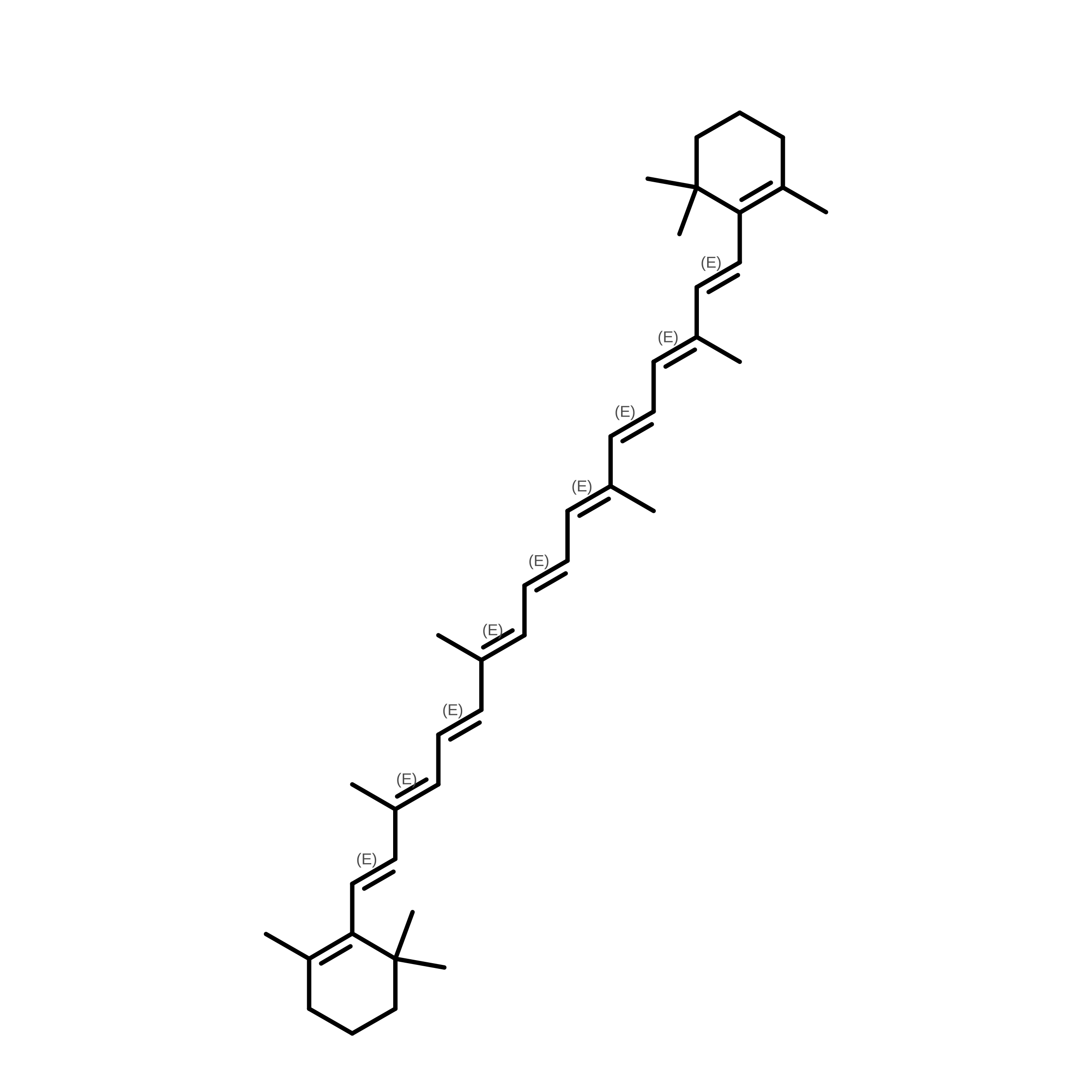
β-carotene (BCR) is the most abundant carotenoid, a colorant, antioxidant, and provitamin A. The extreme hydrophobicity of this hydrocarbon requires special mechanisms for distribution in aqueous media, including water-soluble carotenoproteins. However, all known carotenoproteins prefer oxygenated carotenoids and bind BCR inefficiently. Here, we present the crystal structure of the BCR-binding protein (BBP) from gregarious male locusts, which is responsible for their vivid yellow body coloration, in complex with its natural ligand, BCR. BBP forms an antiparallel tubular homodimer with α/β-wrap folded monomers, each forming a hydrophobic 47 Å long, coaxial tunnel that opens outward and is occupied by one s-cis C6-C7 , all-trans BCR molecule. In the BCR absence, BBP accepts a range of xanthophylls, with reduced efficiency depending on the position and number of oxygen atoms, but rejects lycopene. The structure captures a pigment complex with a Takeout 1 protein and inspires potential applications of BBP as a BCR solubilizer.
- A.N. Bach Institute of Biochemistry, Federal Research Centre of Biotechnology of the Russian Academy of Sciences, 33 Leninsky prospect, building 1, Moscow 119071, Russia; M.V. Lomonosov Moscow State University, School of Biology, 1 Lenin Hills, building 12, Moscow 119991, Russia.
Organizational Affiliation: