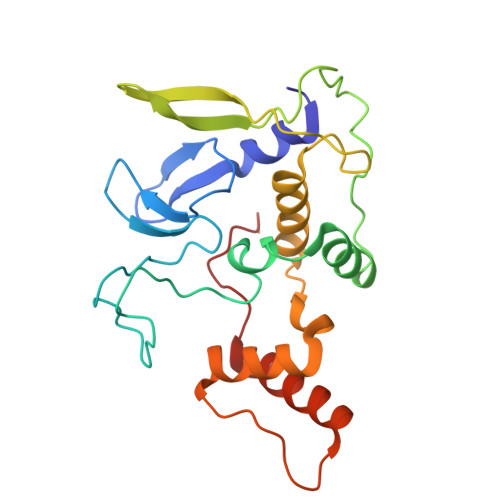
9IIC | pdb_00009iic

Crystal structure of HOIP RING2-LDD in complex with STK4 KD domain

  • Classification: LIGASE
  • Organism(s): Homo sapiens
  • Expression System: Escherichia coli
  • Mutation(s): Yes 

  • Deposited: 2024-06-20 Released: 2025-06-25 
  • Deposition Author(s): Wang, Y.R., Zhou, X.D., Pan, L.F.
  • Funding Organization(s): National Basic Research Program of China (973 Program), National Natural Science Foundation of China (NSFC)

Experimental Data Snapshot

  • Method: X-RAY DIFFRACTION
  • Resolution: 2.78 Å
  • R-Value Free: 
    0.280 (Depositor), 0.279 (DCC) 
  • R-Value Work: 
    0.237 (Depositor), 0.237 (DCC) 
  • R-Value Observed: 
    0.239 (Depositor) 

Starting Models: experimental
View more details

wwPDB Validation   3D Report Full Report


Ligand Structure Quality Assessment 


This is version 1.1 of the entry. See complete history


Literature

STK4 inhibits the E3 activity of HOIP by phosphorylating its allosteric ubiquitin-binding site.

Wang, Y.Zhou, X.Lin, Z.Huang, Y.Zhang, Y.Liu, H.Zhou, Y.Liu, J.Pan, L.

(2025) Cell Discov 11: 75-75

  • DOI: https://doi.org/10.1038/s41421-025-00824-x
  • Primary Citation of Related Structures:  
    9IIC

  • PubMed Abstract: 

    HOIP, an RBR-type E3 ligase and the catalytic subunit of the linear ubiquitin chain assembly complex (LUBAC), plays crucial roles in various cellular processes, including the NF-κB signaling pathway. The E3 activity of HOIP can be inhibited by the kinase STK4-mediated phosphorylation, although the mechanism is poorly understood. In this study, using biochemical, mass spectrometry and structural approaches, we systemically characterize the association of STK4 with HOIP, and unveil that STK4 can directly bind to the RING2-LDD module of HOIP through its kinase domain. The determined crystal structure of STK4 in complex with HOIP RING2-LDD not only elucidates the detailed binding mechanism of STK4 with HOIP, but also uncovers, for the first time, a unique binding mode of STK4 with its substrate. Moreover, we reveal that STK4 can directly phosphorylate the T786 residue of HOIP that is located in the allosteric ubiquitin-binding site of HOIP. Importantly, the phosphorylation of HOIP T786 mediated by STK4 can block the binding of ubiquitin to the allosteric site of HOIP, thereby attenuating the E3 activity of HOIP. In all, our findings provide mechanistic insights into the interaction between STK4 and HOIP as well as the negative regulation of HOIP's E3 activity by STK4-mediated phosphorylation, which are valuable for further understanding the regulatory modes of RBR-type E3 ligases.


  • Organizational Affiliation
    • School of Chemistry and Materials Science, Hangzhou Institute for Advanced Study, University of Chinese Academy of Sciences, 1 Sub-lane Xiangshan, Hangzhou, Zhejiang, China.

Macromolecules
Find similar proteins by:  (by identity cutoff)  |  3D Structure
Entity ID: 1
MoleculeChains Sequence LengthOrganismDetailsImage
Serine/threonine-protein kinase 4 37kDa subunitA [auth B],
C [auth A]
302Homo sapiensMutation(s): 1 
Gene Names: STK4KRS2MST1
EC: 2.7.11.1
UniProt & NIH Common Fund Data Resources
Find proteins for Q13043 (Homo sapiens)
Explore Q13043 
Go to UniProtKB:  Q13043
PHAROS:  Q13043
GTEx:  ENSG00000101109 
Entity Groups  
Sequence Clusters30% Identity50% Identity70% Identity90% Identity95% Identity100% Identity
UniProt GroupQ13043
Sequence Annotations
Expand
  • Reference Sequence
Find similar proteins by:  (by identity cutoff)  |  3D Structure
Entity ID: 2
MoleculeChains Sequence LengthOrganismDetailsImage
E3 ubiquitin-protein ligase RNF31B [auth C],
D
215Homo sapiensMutation(s): 0 
Gene Names: RNF31ZIBRA
EC: 2.3.2.31
UniProt & NIH Common Fund Data Resources
Find proteins for Q96EP0 (Homo sapiens)
Explore Q96EP0 
Go to UniProtKB:  Q96EP0
PHAROS:  Q96EP0
GTEx:  ENSG00000092098 
Entity Groups  
Sequence Clusters30% Identity50% Identity70% Identity90% Identity95% Identity100% Identity
UniProt GroupQ96EP0
Sequence Annotations
Expand
  • Reference Sequence
Small Molecules
Ligands 2 Unique
IDChains Name / Formula / InChI Key2D Diagram3D Interactions
GOL (Subject of Investigation/LOI)
Query on GOL

Download Ideal Coordinates CCD File 
E [auth B],
J [auth A]
GLYCEROL
C3 H8 O3
PEDCQBHIVMGVHV-UHFFFAOYSA-N
ZN (Subject of Investigation/LOI)
Query on ZN

Download Ideal Coordinates CCD File 
F [auth C]
G [auth C]
H [auth C]
I [auth C]
K [auth D]
F [auth C],
G [auth C],
H [auth C],
I [auth C],
K [auth D],
L [auth D],
M [auth D],
N [auth D]
ZINC ION
Zn
PTFCDOFLOPIGGS-UHFFFAOYSA-N
Experimental Data & Validation

Experimental Data

  • Method: X-RAY DIFFRACTION
  • Resolution: 2.78 Å
  • R-Value Free:  0.280 (Depositor), 0.279 (DCC) 
  • R-Value Work:  0.237 (Depositor), 0.237 (DCC) 
  • R-Value Observed: 0.239 (Depositor) 
Space Group: C 1 2 1
Unit Cell:
Length ( Å )Angle ( ˚ )
a = 138.989α = 90
b = 96.363β = 118.82
c = 115.773γ = 90
Software Package:
Software NamePurpose
PHENIXrefinement
autoPROCdata reduction
autoPROCdata scaling
PHENIXphasing

Structure Validation

View Full Validation Report


Ligand Structure Quality Assessment 


Entry History & Funding Information

Deposition Data


Funding OrganizationLocationGrant Number
National Basic Research Program of China (973 Program)China2022YFC2303102
National Natural Science Foundation of China (NSFC)China32071219
National Natural Science Foundation of China (NSFC)China92253301
National Natural Science Foundation of China (NSFC)China21822705
National Natural Science Foundation of China (NSFC)China32071297

Revision History  (Full details and data files)

  • Version 1.0: 2025-06-25
    Type: Initial release
  • Version 1.1: 2026-01-14
    Changes: Database references