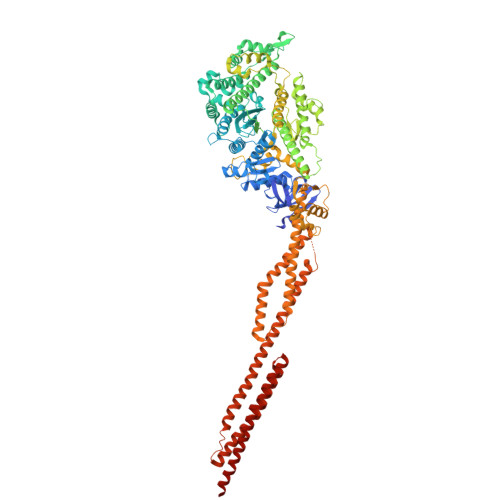
9IHL | pdb_00009ihl

Crystal Structure of the Human Nonmuscle Myosin 2A Motor Domain


Experimental Data Snapshot

  • Method: X-RAY DIFFRACTION
  • Resolution: 2.02 Å
  • R-Value Free: 
    0.259 (Depositor), 0.259 (DCC) 
  • R-Value Work: 
    0.205 (Depositor), 0.205 (DCC) 
  • R-Value Observed: 
    0.208 (Depositor) 

Starting Model: experimental
View more details

wwPDB Validation   3D Report Full Report


This is version 1.1 of the entry. See complete history


Literature

Structure of the human nonmuscle myosin 2A motor domain: Insights into isoform-specific mechanochemistry.

Heiringhoff, R.S.Greve, J.N.Zahn, M.Manstein, D.J.

(2025) J Biological Chem 301: 110691-110691

  • DOI: https://doi.org/10.1016/j.jbc.2025.110691
  • Primary Citation of Related Structures:  
    9IHL

  • PubMed Abstract: 

    Non-muscle myosin 2A (NM2A) is the predominant myosin isoform in non-muscle cells. Together with its paralogues NM2B and NM2C, NM2A enables tension and force generation, driving essential cellular processes such as membrane protrusion and retraction, directed migration, adhesion and cytokinesis. The NM2 isoforms display paralogue-specific mechanochemical characteristics that support their specific cellular functions. Here, we determined the structure of the human NM2A motor domain, addressing a critical gap in understanding myosin family diversification. Based on our experimentally resolved 2.1 Å structure of the NM2A motor domain in its nucleotide-free state, we demonstrate, through integrative modeling of NM2-actin complexes and molecular dynamics simulations, how sequence differences between NM2A and NM2B underpin their functional specialization. Loop2 emerges as a critical determinant of isoform-specific behavior. Comparative analysis of ATP interaction fingerprints across NM2 isoforms reveals a conserved ATP binding mechanism. These findings illuminate an allosteric energy transduction pathway that connects sequence variation to actin-binding dynamics, providing mechanistic insight into isoform-specific cytoskeletal functions.


  • Organizational Affiliation
    • Institute for Biophysical Chemistry, Fritz-Hartmann-Centre for Medical Research, Hannover Medical School, 30625 Hannover, Germany,; Division for Structural Biochemistry, Hannover Medical School, 30625 Hannover, Germany.

Macromolecules
Find similar proteins by:  (by identity cutoff)  |  3D Structure
Entity ID: 1
MoleculeChains Sequence LengthOrganismDetailsImage
Myosin-9,Alpha-actinin A1,025Homo sapiensDictyostelium discoideum
This entity is chimeric
Mutation(s): 0 
Gene Names: MYH9abpAactnADDB_G0268632
UniProt & NIH Common Fund Data Resources
Find proteins for P05095 (Dictyostelium discoideum)
Explore P05095 
Go to UniProtKB:  P05095
Find proteins for P35579 (Homo sapiens)
Explore P35579 
Go to UniProtKB:  P35579
PHAROS:  P35579
GTEx:  ENSG00000100345 
Entity Groups  
Sequence Clusters30% Identity50% Identity70% Identity90% Identity95% Identity100% Identity
UniProt GroupsP35579P05095
Sequence Annotations
Expand
  • Reference Sequence
Experimental Data & Validation

Experimental Data

  • Method: X-RAY DIFFRACTION
  • Resolution: 2.02 Å
  • R-Value Free:  0.259 (Depositor), 0.259 (DCC) 
  • R-Value Work:  0.205 (Depositor), 0.205 (DCC) 
  • R-Value Observed: 0.208 (Depositor) 
Space Group: P 21 21 21
Unit Cell:
Length ( Å )Angle ( ˚ )
a = 60.994α = 90
b = 120.879β = 90
c = 149.438γ = 90
Software Package:
Software NamePurpose
PHENIXrefinement
autoPROCdata reduction
STARANISOdata scaling
PHASERphasing

Structure Validation

View Full Validation Report


Entry History & Funding Information

Deposition Data


Funding OrganizationLocationGrant Number
German Research Foundation (DFG)Germany--

Revision History  (Full details and data files)

  • Version 1.0: 2025-09-24
    Type: Initial release
  • Version 1.1: 2025-10-22
    Changes: Database references