9IF1 | pdb_00009if1

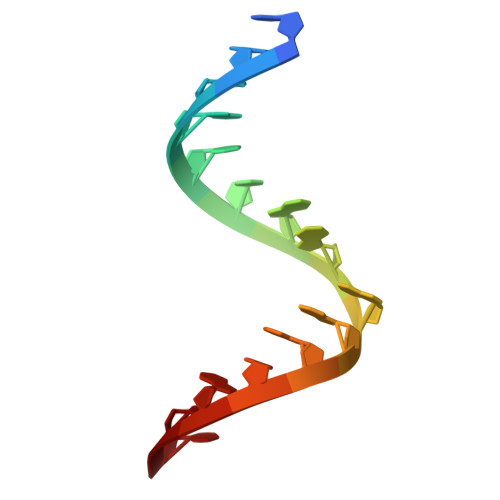
Unliganded structure of RNA duplex containing UGGAA/UGGAA motif

  • Classification: RNA
  • Organism(s): Homo sapiens
  • Mutation(s): No 

  • Deposited: 2025-02-17 Released: 2025-09-24 
  • Deposition Author(s): Mateja-Pluta, M., Kiliszek, A.
  • Funding Organization(s): Polish National Science Centre

Experimental Data Snapshot

  • Method: X-RAY DIFFRACTION
  • Resolution: 2.79 Å
  • R-Value Free: 
    0.308 (Depositor), 0.312 (DCC) 
  • R-Value Work: 
    0.257 (Depositor), 0.261 (DCC) 

Starting Model: experimental
View more details

wwPDB Validation   3D Report Full Report


This is version 1.1 of the entry. See complete history


Literature

Naphthyridine carbamate dimer ligand induces formation of Z-RNA-like fold of disease-related RNA and exhibits a molecular glue characteristics in crystal lattice formation.

Mateja-Pluta, M.Blaszczyk, L.Bejger, M.Nakatani, K.Kiliszek, A.

(2025) Nucleic Acids Res 53

  • DOI: https://doi.org/10.1093/nar/gkaf924
  • Primary Citation of Related Structures:  
    9I9W, 9IF0, 9IF1

  • PubMed Abstract: 

    The naphthyridine carbamate dimer (NCD) is a small molecule that recognizes disease-related RNA containing UGGAA repeats associated with spinocerebellar ataxia type 31 (SCA 31) and alleviates the disease phenotype in vitro and in vivo. In this study, we use X-ray crystallography to elucidate the mode of NCD binding in detail. We determine the crystal structures of the RNA-NCD complex and a structure of unliganded RNA. The NCD interacts differently than in previously reported nuclear magnetic resonance structure, forming pseudo-canonical base pairs with guanosine residues located on the same RNA strand. Furthermore, in one of the complexes, the ligand is located between symmetry-related RNA molecules, exhibiting a molecular glue characteristics in crystal lattice formation. The comparison of RNA-NCD and ligand-free models allows the identification of structural changes in RNA upon ligand binding from A-form to Z-RNA-like form. These observations extend our understanding of the interactions between RNA and small compounds and can be useful as a reference model in the development of bioinformatics tools for RNA-ligand structure predictions.


  • Organizational Affiliation
    • Institute of Bioorganic Chemistry, Polish Academy of Sciences, Z. Noskowskiego 12/14, 61-704, Poland.

Macromolecules

Find similar nucleic acids by:  Sequence   |   3D Structure  

Entity ID: 1
MoleculeChains LengthOrganismImage
RNA (5'-R(*GP*GP*CP*AP*CP*UP*GP*GP*AP*AP*GP*UP*GP*CP*C)-3')A [auth AAA],
B [auth BBB]
15Homo sapiens
Sequence Annotations
Expand
  • Reference Sequence
Small Molecules
Ligands 1 Unique
IDChains Name / Formula / InChI Key2D Diagram3D Interactions
NCO (Subject of Investigation/LOI)
Query on NCO

Download Ideal Coordinates CCD File 
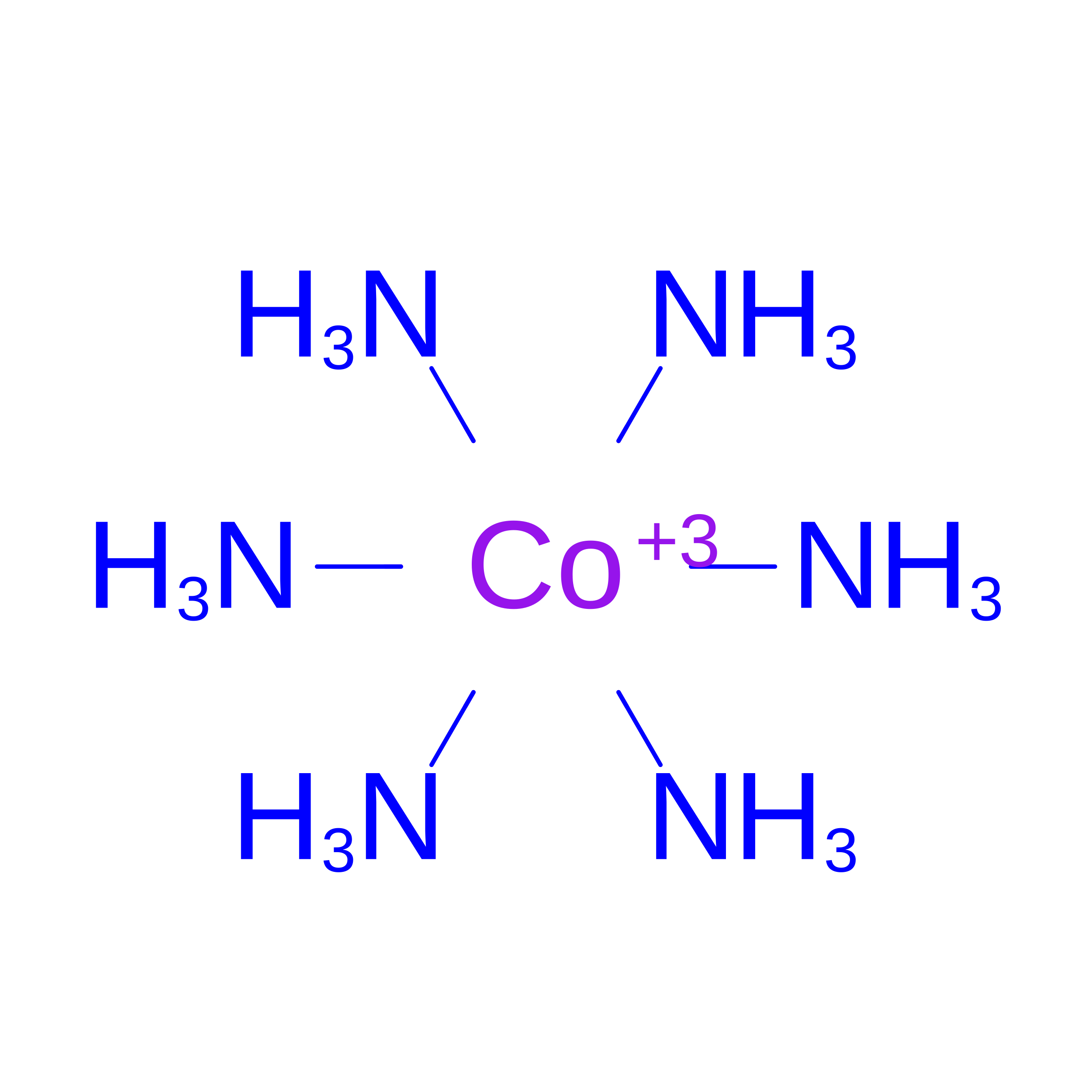
C [auth AAA]COBALT HEXAMMINE(III)
Co H18 N6
DYLMFCCYOUSRTK-UHFFFAOYSA-N
Experimental Data & Validation

Experimental Data

  • Method: X-RAY DIFFRACTION
  • Resolution: 2.79 Å
  • R-Value Free:  0.308 (Depositor), 0.312 (DCC) 
  • R-Value Work:  0.257 (Depositor), 0.261 (DCC) 
Space Group: P 41 21 2
Unit Cell:
Length ( Å )Angle ( ˚ )
a = 33.818α = 90
b = 33.818β = 90
c = 170.094γ = 90
Software Package:
Software NamePurpose
REFMACrefinement
XDSdata reduction
Aimlessdata scaling
PHASERphasing

Structure Validation

View Full Validation Report


Entry History & Funding Information

Deposition Data


Funding OrganizationLocationGrant Number
Polish National Science CentrePoland2022/45/B/NZ7/03543
Polish National Science CentrePoland2017/26/E/NZ1/00950

Revision History  (Full details and data files)

  • Version 1.0: 2025-09-24
    Type: Initial release
  • Version 1.1: 2025-10-01
    Changes: Database references