Download Mendeley
Discovery and Optimization of a Non-Nucleoside-Based Series of Inhibitors of 2'-Deoxynucleoside 5'-Monophosphate Glycosidase (DNPH1).
Barlaam, B., Alonso-Crisostomo, L., Anderson, N.A., Argyrou, A., Astles, P.C., Cadogan, E.B., Carlino, L., Collie, G.W., Davies, N.L., Hall, J., Kitching, L., Li, X., Michopoulos, F., Milbradt, A.G., Nikkila, J., Northall, S., O'Connor, M.J., Pei, X., Shaw, J., Slade, D., Southgate, H., Stead, D., Stubbs, C.J., Whitehurst, B.C., Xing, B., Yuan, Y., Zhou, J.(2025) J Med Chem 68: 24381-24403
- PubMed: 41194588 Search on PubMed
- DOI: https://doi.org/10.1021/acs.jmedchem.5c02356
- Primary Citation Related Structures:
9I3Q, 9I57, 9I58, 9I6E - PubMed Abstract:
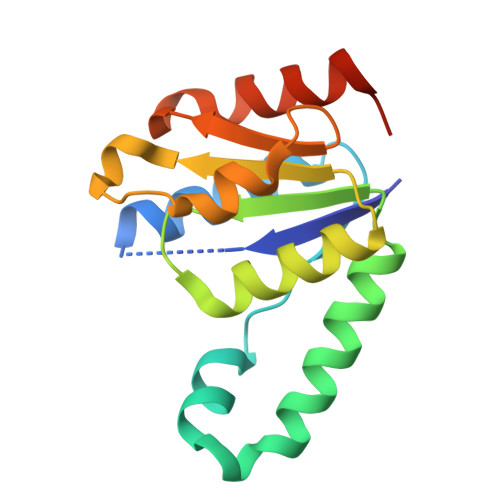
DNPH1 is a nucleotide pool sanitizer that cleaves 5-hydroxymethyl-2-deoxyuridine-5-monophosphate (hmdUMP), preventing incorporation of the correspondent non-natural nucleotide into DNA. Recent findings have demonstrated that loss of DNPH1 could potentiate the sensitivity of PARP inhibitors in homologous recombination repair (HRR)-deficient cancers. We report the optimization of a non-nucleoside-based series of DNPH1 inhibitors. Starting from a weak compound 1 (binding affinity pIC 50 4.7), we identified compound 38 as a very potent inhibitor of DNPH1 (pIC 50 9.3) using DNPH1 X-ray structure-guided drug design. Compound 38 demonstrated target engagement of DNPH1 in the SUM149PT cell line (pIC 50 7.2). Using this tool compound, we then report the in vitro pharmacology of a DNPH1 inhibitor in the BRCA1 mutant SUM149PT cell line.
- Oncology, R&D, AstraZeneca, Cambridge CB2 0AA, U.K.
Organizational Affiliation: