Download Mendeley
The herpes simplex origin-binding protein: mechanisms for sequence-specific DNA binding and dimerization revealed by Cryo-EM.
Gustavsson, E., Grunewald, K., Elias, P., Hallberg, B.M.(2025) Nucleic Acids Res 53
- PubMed: 41125242 Search on PubMedSearch on PubMed Central
- DOI: https://doi.org/10.1093/nar/gkaf1029
- Primary Citation Related Structures:
9HGI, 9HGJ - PubMed Abstract:
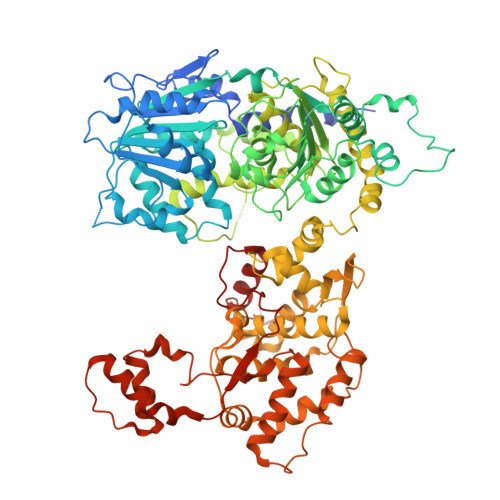
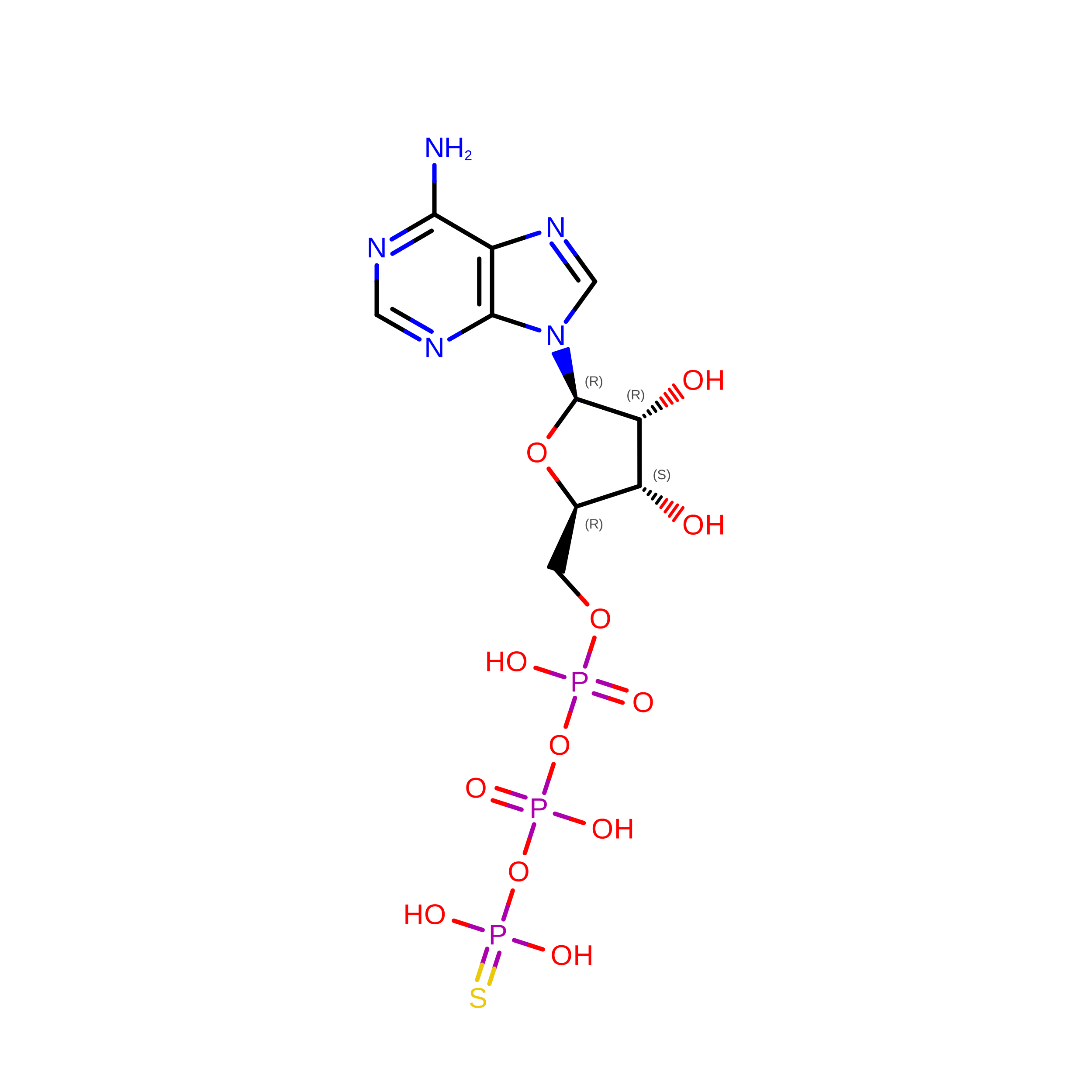
Herpes simplex viruses 1 and 2 (HSV-1,2) present growing treatment challenges due to increasing resistance to antivirals targeting viral DNA polymerase, particularly in immunocompromised individuals. The HSV-1 origin-binding protein (OBP), an essential Superfamily 2 (SF2) DNA helicase encoded by the UL9 gene, is a promising alternative therapeutic target. Here, we present cryo-EM structures of OBP at up to 2.8 Å resolution in multiple conformational states, including complexes with the OriS recognition sequence and the non-hydrolyzable ATP analog ATPγS. The structures reveal an unexpected head-to-tail dimer stabilized by the C-terminal domain, where the conserved RVKNL motif mediates sequence-specific DNA recognition. The C-terminal domain extends into the partner monomer, suggesting a regulatory mechanism involving the single-stranded DNA-binding protein ICP8. We also resolve an OBP monomer bound to a DNA hairpin with a 3' single-stranded tail (mini-OriS*), and at lower resolution, a dimer-dimer assembly of two OBP dimers bound simultaneously to OriS or mini-OriS*. These structures uncover the molecular basis of HSV-1 origin recognition and unwinding, and identify multiple druggable interfaces, laying the groundwork for structure-based antiviral development targeting HSV-1 OBP.
- Department of Cell and Molecular Biology, Karolinska Institutet, Stockholm 171 77, Sweden.
Organizational Affiliation: