Download Mendeley
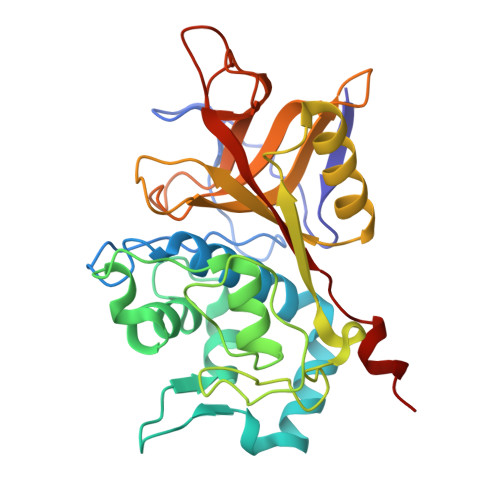
Structural and functional characterization of IdeC, a novel IgG-specific protease of Streptococcus canis.
Walsh, S., Lapschies, A.M., Miguel-Ruano, V., Batuecas, M.T., Acebron-Avalos, I., Kohler, T.P., Hammerschmidt, S., Eichhorn, I., Hermoso, J.A., Fulde, M.(2025) Infect Immun 93: e0024825-e0024825
- PubMed: 40741973 Search on PubMedSearch on PubMed Central
- DOI: https://doi.org/10.1128/iai.00248-25
- Primary Citation Related Structures:
9HB1, 9HB2 - PubMed Abstract:
Streptococcus canis is an important opportunistic pathogen of cats, dogs, and cows, which can cause a range of infections, ranging from skin and soft tissue infections to septicemia and endocarditis. As a zoonotic agent, S. canis has also recently been implicated in serious human infections, following trauma or immunosuppression. In this work, we describe a novel protease of S. canis , termed IdeC ( I mmunoglobulin G d egrading e nzyme of S. c anis), which may be involved in bacterial immune evasion. The cleaving ability of IdeC against IgG from various species was assessed; this revealed that IdeC successfully cleaved canine, feline, and human IgG. We also confirmed that IdeC is a cysteine protease, similar to IdeS of Streptococcus pyogenes . Investigation of the cleavage site in IgG sequences showed that it is highly conserved across IgGs from all species tested. From this analysis, it was determined that IdeC cleavage occurs between the CH2 and hinge regions of IgG. Interestingly, feline IgG was consistently cleaved with the highest efficiency, with human and canine IgG displaying less efficient cleavage. High-resolution crystal structures of two IdeC constructs provided insights into the catalytic machinery and substrate recognition. Modeling of the full-length IdeC:IgG complexes for human, canine, and feline cases explains the mechanism of action of the protease and reveals the molecular basis for the observed cleavage preference for feline IgG. Understanding and managing S. canis as a pathogen is important in both veterinary and human medicine, as this bacterium underscores the need for awareness of zoonotic transmission.
- Institute of Microbiology and Epizootics, School of Veterinary Medicine, Freie Universität Berlin, Berlin, Germany.
Organizational Affiliation: