Download Mendeley
Structures and mechanism of the AUX/LAX transporters involved in auxin import.
Ung, K.L., Schulz, L., Zuzic, L., Amsinck, B.L., Koutnik-Abele, S., Benhammouche, I., Andersen, C.G., Nel, L., Schiott, B., Stokes, D.L., Hammes, U.Z., Pedersen, B.P.(2025) Nat Plants 11: 1670-1680
- PubMed: 40759769 Search on PubMedSearch on PubMed Central
- DOI: https://doi.org/10.1038/s41477-025-02056-z
- Primary Citation Related Structures:
9H61, 9H62, 9H63, 9QQM - PubMed Abstract:
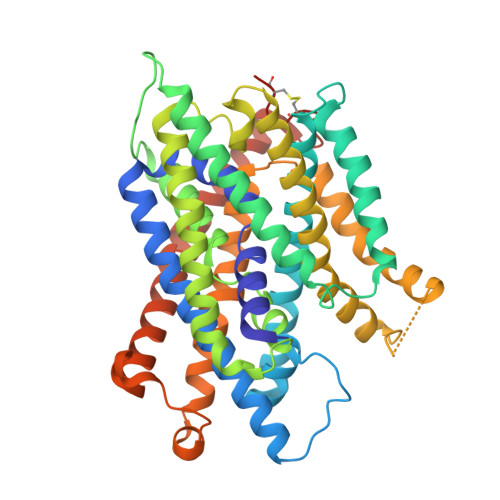
Auxins are plant hormones that direct the growth and development of organisms on the basis of environmental cues. Indole-3-acetic acid (IAA) is the most abundant auxin in most plants. A variety of membrane transport proteins work together to distribute auxins. These include the AUX/LAX protein family that mediate auxin import from the apoplast to the cytosol. Here we use structural and biophysical approaches combined with molecular dynamics to study transport by Arabidopsis thaliana LAX3, which is essential for plant root formation. Transport assays document high-affinity transport of IAA, as well as competitive behaviour of the synthetic phenoxyacetic acid auxin herbicide 2,4-dichlorophenoxyacetic acid and the auxin transport inhibitors 1-naphthoxyacetic acid and 2-naphthoxyacetic acid. Four cryo-EM structures were solved with resolutions of 2.9-3.4 Å: an inward open apo structure, two inward semi-occluded structures in complex with IAA and 2,4-dichlorophenoxyacetic acid, and a fully occluded structure in complex with 2-naphthoxyacetic acid. Structurally, LAX3 consists of a bundle and a scaffold domain. The ligand-binding site is sandwiched between these domains with two histidines occupying positions analogous to the sodium-binding sites in distantly related sodium:neurotransmitter transporters. This architecture suggests that these histidines couple transport to the proton motive force. Molecular dynamics simulations are used to explore substrate binding and release, including their dependence on specific protonation states. This study advances our understanding of auxin recognition and transport by AUX/LAX, providing insights into a fundamental aspect of plant physiology and development.
- Department of Molecular Biology and Genetics, Aarhus University, Aarhus, Denmark.
Organizational Affiliation: