Find PDB structures and Computed Structure Models (CSM) by combining queries from tools in this suite: Attribute Search, Sequence Similarity, Sequence Motif, 3D Similarity, and 3D Motif with 'AND' logic.
Primary Citation Related Structures: 9H2L, 9H4I, 9H73
PubMed Abstract:
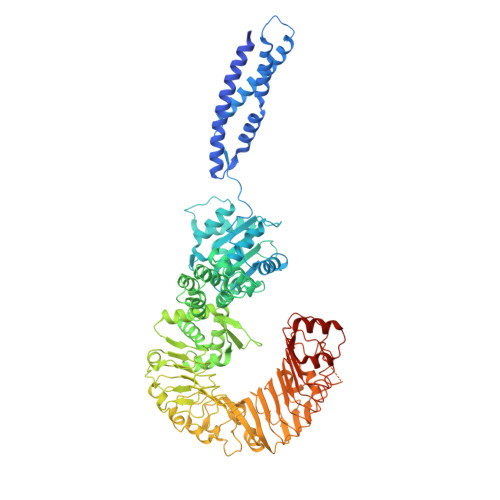
Nucleotide-binding, leucine-rich repeat (NLR) receptors are widespread intracellular immune sensors across kingdoms. Plant G10-type coiled-coil (CC G10 )-NLRs constitute a distinct phylogenetic clade that remains poorly characterized. Here, we identified a gain-of-function mutant of wheat autoimmunity 3 (WAI3 GOF ), which encodes a constitutively active CC G10 -NLR resulting from a residue substitution in the leucine-rich repeat (LRR) domain. Cryo-electron microscopy (cryo-EM) analysis reveals that activated WAI3 assembles into a distinctive octameric resistosome. Arabidopsis RPS2, another CC G10 -NLR, also forms an octamer, indicating a conserved structural property across monocot and dicot plants. The WAI3 resistosome induces a prolonged and sustained increase in cytosolic calcium, likely facilitated by a unique channel architecture arising from its divergent coiled-coil (CC) domain configuration. Notably, this domain arrangement may be shared by plant NLRs that lack the conserved EDVID (Glu-Asp-Val-Ile-Asp) motif in their CC domains. Together, our findings uncover a conserved yet previously uncharacterized NLR resistosome structure and provide insights into the plant immune receptor plasticity.
Organizational Affiliation:
State Key Laboratory of Seed Innovation, Institute of Genetics and Developmental Biology, Chinese Academy of Sciences, Beijing 100101, China; The Sainsbury Laboratory, University of East Anglia, Norwich Research Park, Colney Lane, Norwich NR4 7UH, UK.
The Sainsbury Laboratory, University of East Anglia, Norwich Research Park, Colney Lane, Norwich NR4 7UH, UK.
School of Life Sciences, Zhengzhou University, Zhengzhou 450001, China.
Key Laboratory of Plant Carbon Capture, CAS Center for Excellence in Molecular Plant Sciences, Institute of Plant Physiology and Ecology, Chinese Academy of Sciences, Shanghai 200032, China.
Institute of Biotechnology, Xianghu Laboratory, Hangzhou 311231, China.
State Key Laboratory of High-Efficiency Production of Wheat-Maize Double Cropping, National Engineering Research Center for Wheat, Henan Center for Crop Genomics and Rice Engineering, College of Agronomy, Longzi Lake Campus, Henan Agricultural University, Zhengzhou 450046, China.
State Key Laboratory of Seed Innovation, Institute of Genetics and Developmental Biology, Chinese Academy of Sciences, Beijing 100101, China.
State Key Laboratory of Seed Innovation, Institute of Genetics and Developmental Biology, Chinese Academy of Sciences, Beijing 100101, China; College of Advanced Agricultural Sciences, University of Chinese Academy of Sciences, Beijing 100049, China.
State Key Laboratory of Seed Innovation, Institute of Genetics and Developmental Biology, Chinese Academy of Sciences, Beijing 100101, China; State Key Laboratory of North China Crop Improvement and Regulation, College of Agronomy, Hebei Agricultural University, Baoding, Hebei, 071001, China.
The Sainsbury Laboratory, University of East Anglia, Norwich Research Park, Colney Lane, Norwich NR4 7UH, UK; Chengdu Institute of Biology, Chinese Academy of Sciences, Chengdu 610213, China.
The Sainsbury Laboratory, University of East Anglia, Norwich Research Park, Colney Lane, Norwich NR4 7UH, UK. Electronic address: sophien.kamoun@tsl.ac.uk.
Key Laboratory of Plant Carbon Capture, CAS Center for Excellence in Molecular Plant Sciences, Institute of Plant Physiology and Ecology, Chinese Academy of Sciences, Shanghai 200032, China. Electronic address: cwang@cemps.ac.cn.
State Key Laboratory of Seed Innovation, Institute of Genetics and Developmental Biology, Chinese Academy of Sciences, Beijing 100101, China; College of Advanced Agricultural Sciences, University of Chinese Academy of Sciences, Beijing 100049, China. Electronic address: zyliu@genetics.ac.cn.
The Sainsbury Laboratory, University of East Anglia, Norwich Research Park, Colney Lane, Norwich NR4 7UH, UK. Electronic address: muniyandi@biochem.mpg.de.
The Sainsbury Laboratory, University of East Anglia, Norwich Research Park, Colney Lane, Norwich NR4 7UH, UK. Electronic address: jonathan.jones@tsl.ac.uk.

 Download Mendeley