9GV4 | pdb_00009gv4

TBA G-quadruplex binding nanobody (free form)


Experimental Data Snapshot

  • Method: X-RAY DIFFRACTION
  • Resolution: 1.53 Å
  • R-Value Free: 
    0.203 (Depositor), 0.207 (DCC) 
  • R-Value Work: 
    0.170 (Depositor), 0.175 (DCC) 
  • R-Value Observed: 
    0.173 (Depositor) 

Starting Model: experimental
View more details

wwPDB Validation 3D Report Full Report

Validation slider image for 9GV4

This is version 1.0 of the entry. See complete history

Literature

Structural basis of G-quadruplex recognition by a camelid antibody fragment.

Pevec, M.Medved, T.Kovacic, M.Zerjav, N.Imperl, J.Plavec, J.Lah, J.Loris, R.Hadzi, S.

(2025) Nucleic Acids Res 53

  • DOI: https://doi.org/10.1093/nar/gkaf453
  • Primary Citation Related Structures: 
    9GV4, 9GXH

  • PubMed Abstract: 

    Apart from the iconic Watson-Crick duplex, DNA can fold into different noncanonical structures, of which the most studied are G-quadruplexes (G4s). Despite mounting structural and biophysical evidence, their existence in cells was controversial until their detection using G4-specific antibodies. However, it remains unknown how antibodies recognize G4s at the molecular level and why G4-specific antibodies have low selectivity and are unable to distinguish different G4 sequences. Here, we present the crystal structure of a nanobody bound to the archetypical G4 structure, the thrombin-binding aptamer (TBA). The nanobody exhibits strong selectivity against different G4 sequences and utilizes an unusual scaffold-based paratope, with very limited involvement of complementarity-determining region. The nanobody effectively mimics the binding interface of thrombin, a natural binding partner of TBA, by using isosteric interactions at key positions. The presented structure sheds light on the molecular basis of how antibodies, essential G4-detection tools, recognize noncanonical G4 structures.


  • Organizational Affiliation
    • Department of Physical Chemistry, Faculty of Chemistry and Chemical Technology, University of Ljubljana, 1000 Ljubljana, Slovenia.

Macromolecule Content 

  • Total Structure Weight: 14.15 kDa 
  • Atom Count: 1,143 
  • Modeled Residue Count: 119 
  • Deposited Residue Count: 121 
  • Unique protein chains: 1

Macromolecules

Find similar proteins by:|  3D Structure
Entity ID: 1
MoleculeChains  Sequence LengthOrganismDetailsImage
Nanobody121Lama glamaMutation(s): 0 

Small Molecules

Ligands 3 Unique
IDChains Name / Formula / InChI Key2D Diagram3D Interactions
SO4

Query on SO4


Download:Ideal Coordinates CCD File
C [auth A],
D [auth A],
E [auth A],
F [auth A],
G [auth A]
SULFATE ION
O4 S
QAOWNCQODCNURD-UHFFFAOYSA-L
GOL

Query on GOL


Download:Ideal Coordinates CCD File
H [auth A],
I [auth A]
GLYCEROL
C3 H8 O3
PEDCQBHIVMGVHV-UHFFFAOYSA-N
EDO

Query on EDO


Download:Ideal Coordinates CCD File
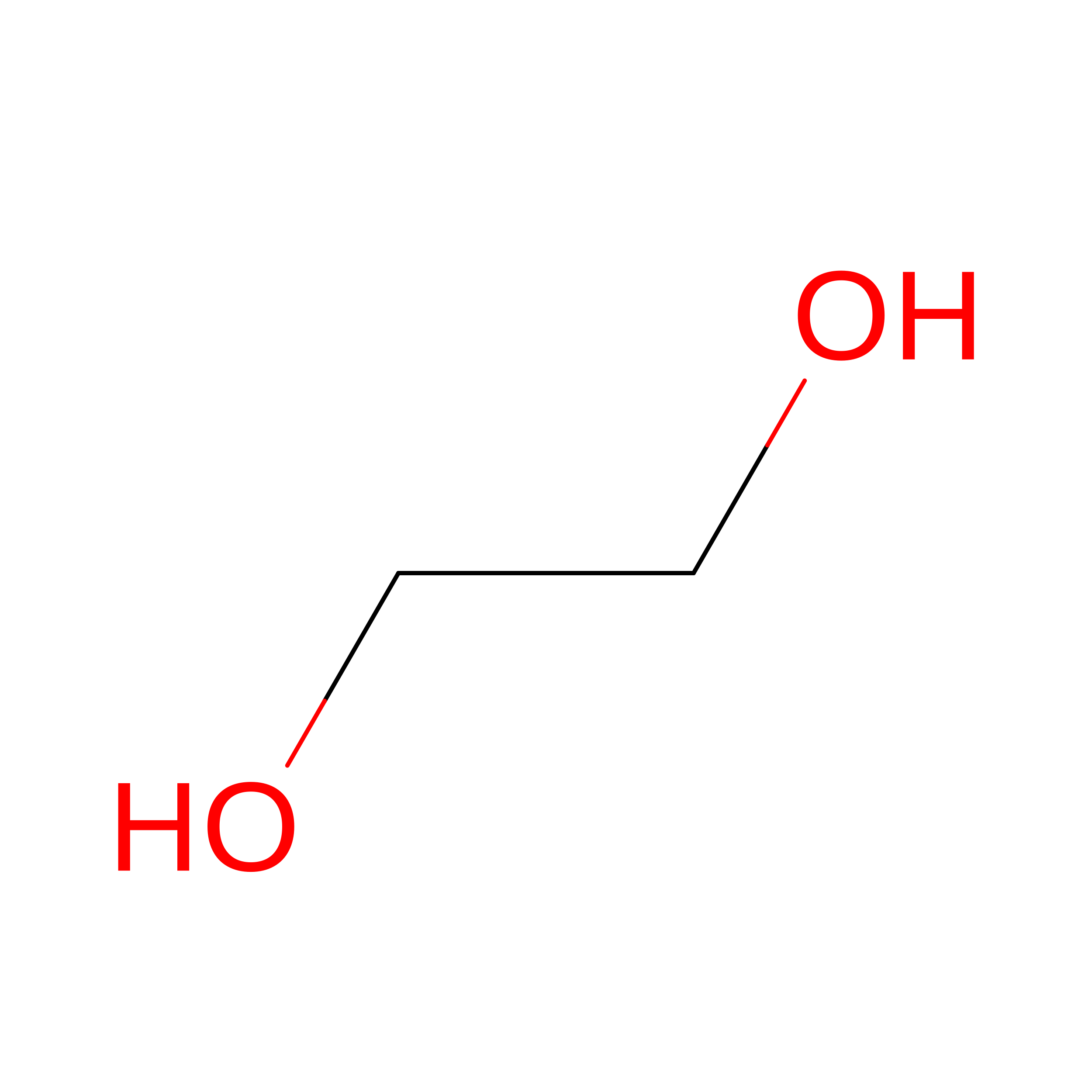
B [auth A]1,2-ETHANEDIOL
C2 H6 O2
LYCAIKOWRPUZTN-UHFFFAOYSA-N

Experimental Data & Validation

Experimental Data

  • Method: X-RAY DIFFRACTION
  • Resolution: 1.53 Å
  • R-Value Free:  0.203 (Depositor), 0.207 (DCC) 
  • R-Value Work:  0.170 (Depositor), 0.175 (DCC) 
  • R-Value Observed: 0.173 (Depositor) 
Space Group: C 2 2 21
Unit Cell:
Length ( Å )Angle ( ˚ )
a = 24.125α = 90
b = 84.257β = 90
c = 97.441γ = 90
Software Package:
Software NamePurpose
PHENIXrefinement
Aimlessdata scaling
XDSdata reduction
PHASERphasing

Structure Validation

View Full Validation Report


Entry History 

& Funding Information

Deposition Data


Funding OrganizationLocationGrant Number
Slovenian Research AgencySloveniaJ1-50026
Slovenian Research AgencySloveniaP1-0201

Revision History  (Full details and data files)

  • Version 1.0: 2025-06-11
    Type: Initial release