Download Mendeley
Mechanistic insights into Bcs1-mediated mitochondrial membrane translocation of the folded Rieske protein.
Rosales-Hernandez, C., Thoms, M., Berninghausen, O., Becker, T., Beckmann, R.(2025) EMBO J 44: 3720-3741
- PubMed: 40410623 Search on PubMedSearch on PubMed Central
- DOI: https://doi.org/10.1038/s44318-025-00459-4
- Primary Citation Related Structures:
9GS2, 9GSN, 9GU9 - PubMed Abstract:
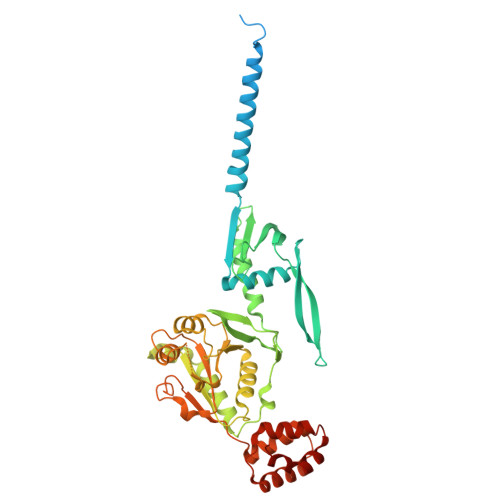
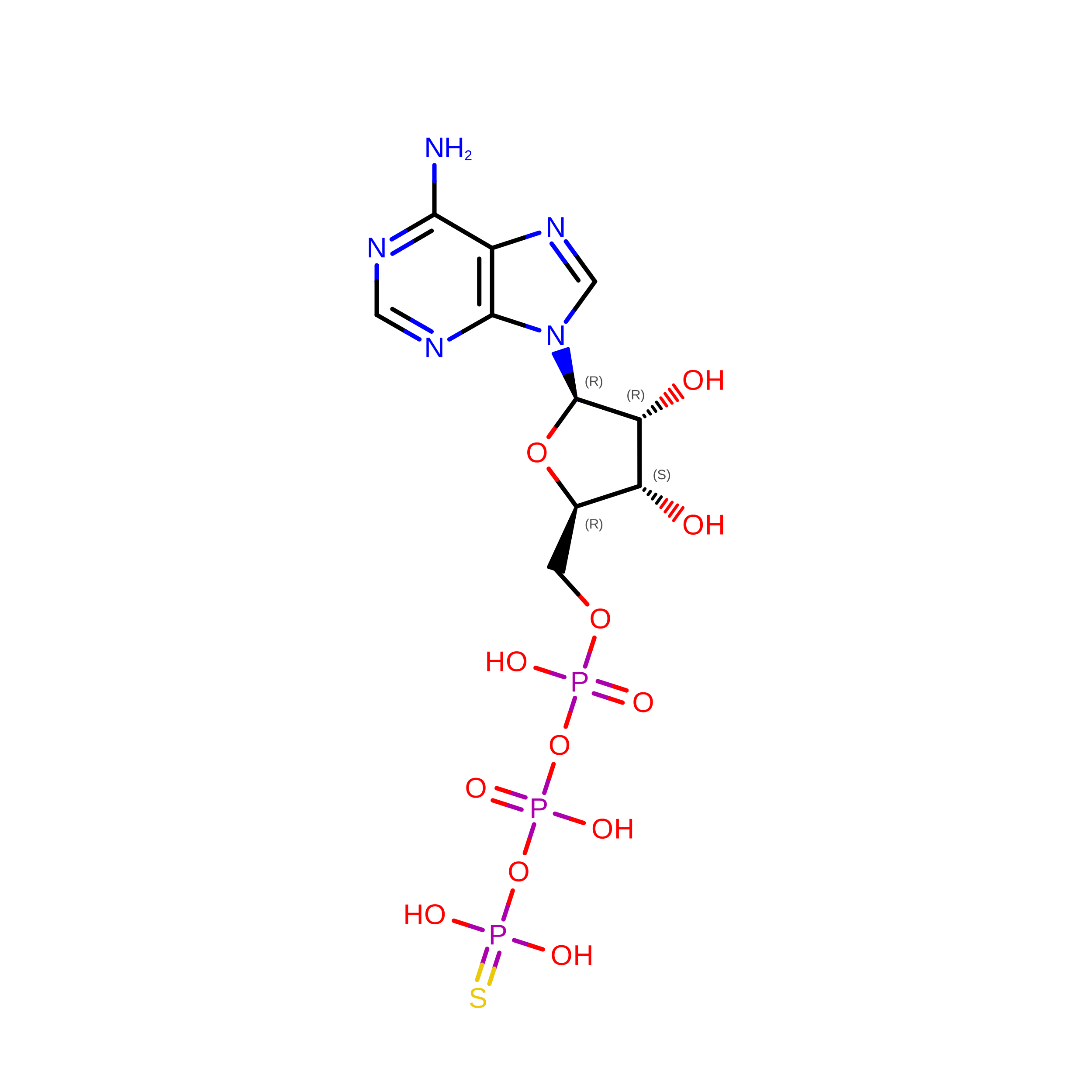
A functional mitochondrial respiratory chain requires coordinated and tightly regulated assembly of mitochondrial- and nuclear-encoded subunits. For bc1 complex (complex III) assembly, the iron-sulfur protein Rip1 must first be imported into the mitochondrial matrix to fold and acquire its 2Fe-2S cluster, then translocated and inserted into the inner mitochondrial membrane (IM). This translocation of folded Rip1 is accomplished by Bcs1, an unusual heptameric AAA ATPase that couples ATP hydrolysis to translocation. However, the molecular and mechanistic details of Bcs1-mediated Rip1 translocation have remained elusive. Here, we provide structural and biochemical evidence on how Bcs1 alternates between conformational states to translocate Rip1 across the IM. Using cryo-electron microscopy (cryo-EM), we identified substrate-bound pre-translocation and pre-release states, revealing how electrostatic interactions promote Rip1 binding to Bcs1. An ATP-induced conformational switch of the Bcs1 heptamer facilitates Rip1 translocation between two distinct aqueous vestibules-one exposed to the matrix, the other to the intermembrane space-in an airlock-like mechanism. This would minimize disruption of the IM permeability barrier, which could otherwise lead to proton leakage and compromised mitochondrial energy conversion.
- Department of Biochemistry, Gene Center, University of Munich, Feodor-Lynen-Str. 25, 81377, Munich, Germany.
Organizational Affiliation: