Download Mendeley
Harnessing indole scaffolds to identify small-molecule IRE1 alpha inhibitors modulating XBP1 mRNA splicing.
Liu, Y., Avathan Veettil, A.K., Gasper, R., Jiang, M., Wagner, L., Hasturk, O., Wu, P.(2025) Nat Commun 16: 8531-8531
- PubMed: 41006348 Search on PubMedSearch on PubMed Central
- DOI: https://doi.org/10.1038/s41467-025-64291-4
- Primary Citation Related Structures:
9GOW - PubMed Abstract:
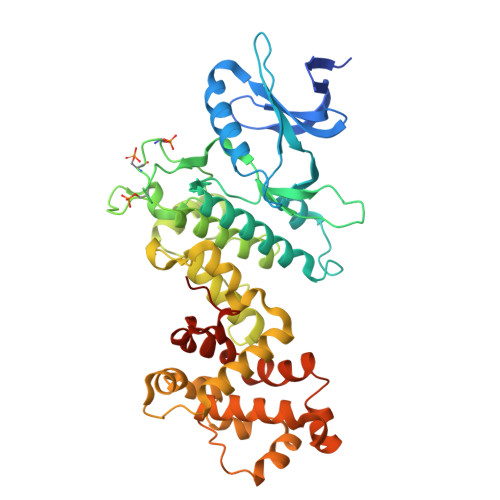
The inositol-requiring enzyme 1 alpha (IRE1α) is an important sensor protein with dual kinase and ribonuclease function. It induces X-box binding protein 1 (XBP1) mRNA splicing and mediates endoplasmic reticulum (ER) stress-triggered downstream unfolded protein response signaling pathways. The dysregulation of IRE1α has been associated with multiple human diseases, and thus IRE1α-targeting small molecules harbor great therapeutic potential. We herein report a series of substituted indoles as IRE1α inhibitors (such as IA107) of excellent potency and selectivity. We also report a resolved co-crystal structure that reveals a unique inhibition mode of IA107 that allosterically inhibits IRE1α RNase activity via binding to the IRE1α kinase domain but without inhibiting the IRE1α dimerization. The following cellular evaluation results demonstrate that IA107 concentration-dependently inhibits the cellular ER stress-induced XBP1 mRNA splicing, and the ester-containing prodrug exhibits a ~ 50-fold increase in cellular activity. Collectively, our results establish the indoles as a potent and selective IRE1α-inhibiting chemotype that modulates RNA splicing and expands the biological application potential associated with IRE1α targeting via small molecules.
- Chemical Genomics Centre, Max Planck Institute of Molecular Physiology, Dortmund, Germany.
Organizational Affiliation: