Download Mendeley
Structural basis of alpha-latrotoxin transition to a cation-selective pore.
Klink, B.U., Alavizargar, A., Kalyankumar, K.S., Chen, M., Heuer, A., Gatsogiannis, C.(2024) Nat Commun 15: 8551-8551
- PubMed: 39362850 Search on PubMedSearch on PubMed Central
- DOI: https://doi.org/10.1038/s41467-024-52635-5
- Primary Citation Related Structures:
9GO9, 9GOA - PubMed Abstract:
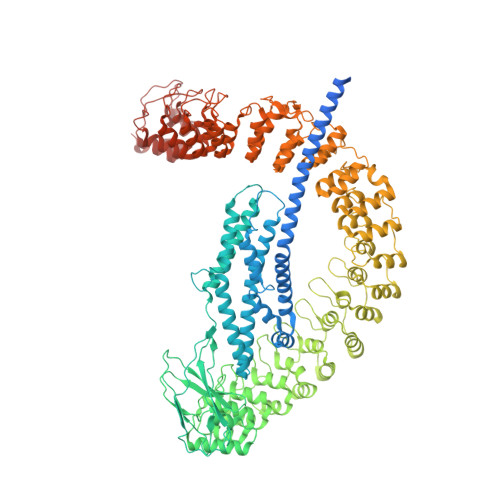
The potent neurotoxic venom of the black widow spider contains a cocktail of seven phylum-specific latrotoxins (LTXs), but only one, α-LTX, targets vertebrates. This 130 kDa toxin binds to receptors at presynaptic nerve terminals and triggers a massive release of neurotransmitters. It is widely accepted that LTXs tetramerize and insert into the presynaptic membrane, thereby forming Ca 2+ -conductive pores, but the underlying mechanism remains poorly understood. LTXs are homologous and consist of an N-terminal region with three distinct domains, along with a C-terminal domain containing up to 22 consecutive ankyrin repeats. Here we report cryoEM structures of the vertebrate-specific α-LTX tetramer in its prepore and pore state. Our structures, in combination with AlphaFold2-based structural modeling and molecular dynamics simulations, reveal dramatic conformational changes in the N-terminal region of the complex. Four distinct helical bundles rearrange and together form a highly stable, 15 nm long, cation-impermeable coiled-coil stalk. This stalk, in turn, positions an N-terminal pair of helices within the membrane, thereby enabling the assembly of a cation-permeable channel. Taken together, these data give insight into a unique mechanism for membrane insertion and channel formation, characteristic of the LTX family, and provide the necessary framework for advancing novel therapeutics and biotechnological applications.
- Institute for Medical Physics and Biophysics, University Münster, Münster, Germany.
Organizational Affiliation: