9GO0 | pdb_00009go0

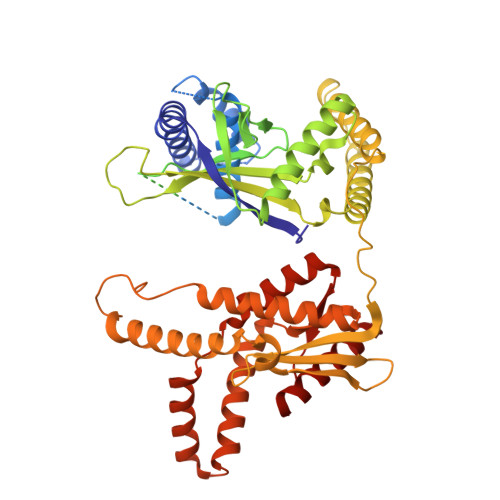
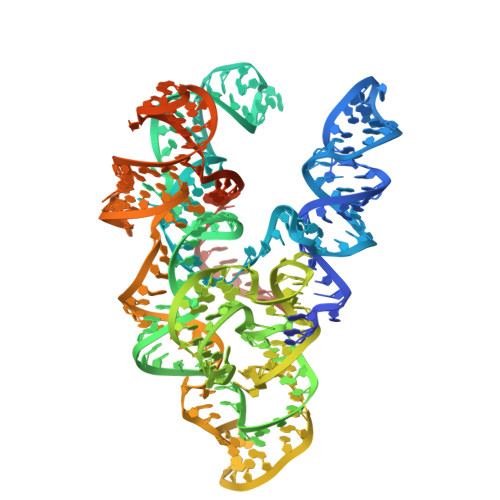
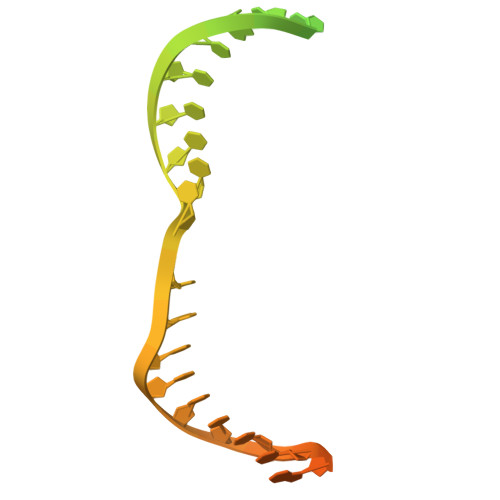
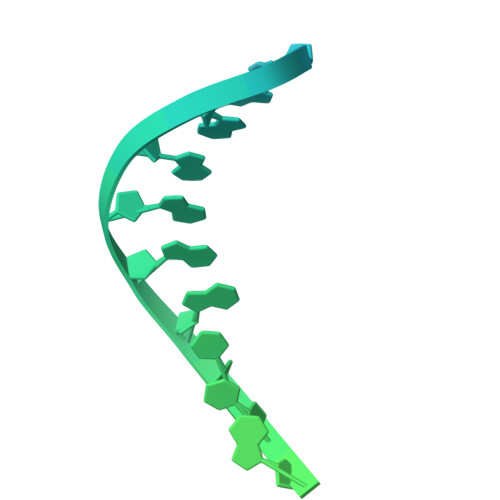
Cryo-EM structure of ShCas12k in complex with a sgRNA and a dsDNA target


Experimental Data Snapshot

  • Method: ELECTRON MICROSCOPY
  • Resolution: 3.04 Å
  • Aggregation State: PARTICLE 
  • Reconstruction Method: SINGLE PARTICLE 

wwPDB Validation   3D Report Full Report

Currently 9GO0 does not have a validation slider image.


This is version 1.0 of the entry. See complete history


Literature

Target site selection and remodelling by type V CRISPR-transposon systems

Querques, I.Schmitz, M.Oberli, S.Chanez, C.Jinek, M.

(2021) Nature 599: 497-502

  • DOI: https://doi.org/10.1038/s41586-021-04030-z
  • Primary Citation of Related Structures:  
    7OXD, 7PLA, 7PLH, 9GO0

  • PubMed Abstract: 

    Canonical CRISPR-Cas systems provide adaptive immunity against mobile genetic elements 1 . However, type I-F, I-B and V-K systems have been adopted by Tn7-like transposons to direct RNA-guided transposon insertion 2-7 . Type V-K CRISPR-associated transposons rely on the pseudonuclease Cas12k, the transposase TnsB, the AAA+ ATPase TnsC and the zinc-finger protein TniQ 7 , but the molecular mechanism of RNA-directed DNA transposition has remained elusive. Here we report cryo-electron microscopic structures of a Cas12k-guide RNA-target DNA complex and a DNA-bound, polymeric TnsC filament from the CRISPR-associated transposon system of the photosynthetic cyanobacterium Scytonema hofmanni. The Cas12k complex structure reveals an intricate guide RNA architecture and critical interactions mediating RNA-guided target DNA recognition. TnsC helical filament assembly is ATP-dependent and accompanied by structural remodelling of the bound DNA duplex. In vivo transposition assays corroborate key features of the structures, and biochemical experiments show that TniQ restricts TnsC polymerization, while TnsB interacts directly with TnsC filaments to trigger their disassembly upon ATP hydrolysis. Together, these results suggest that RNA-directed target selection by Cas12k primes TnsC polymerization and DNA remodelling, generating a recruitment platform for TnsB to catalyse site-specific transposon insertion. Insights from this work will inform the development of CRISPR-associated transposons as programmable site-specific gene insertion tools.


  • Organizational Affiliation
    • Department of Biochemistry, University of Zurich, Zurich, Switzerland.

Macromolecules

Find similar proteins by:  (by identity cutoff)  |  3D Structure
Entity ID: 1
MoleculeChains Sequence LengthOrganismDetailsImage
Cas12k641Scytonema hofmanniiMutation(s): 0 
UniProt
Find proteins for A0A8M0FGU0 (Scytonema hofmannii)
Explore A0A8M0FGU0 
Go to UniProtKB:  A0A8M0FGU0
Entity Groups  
Sequence Clusters30% Identity50% Identity70% Identity90% Identity95% Identity100% Identity
UniProt GroupA0A8M0FGU0
Sequence Annotations
Expand
  • Reference Sequence
Find similar nucleic acids by:  (by identity cutoff)  |  3D Structure
Entity ID: 2
MoleculeChains LengthOrganismImage
sgRNA256Scytonema hofmannii
Sequence Annotations
Expand
  • Reference Sequence
Find similar nucleic acids by:  (by identity cutoff)  |  3D Structure
Entity ID: 3
MoleculeChains LengthOrganismImage
DNA target strand50synthetic construct
Sequence Annotations
Expand
  • Reference Sequence
Find similar nucleic acids by:  (by identity cutoff)  |  3D Structure
Entity ID: 4
MoleculeChains LengthOrganismImage
DNA non-target strand50synthetic construct
Sequence Annotations
Expand
  • Reference Sequence
Experimental Data & Validation

Experimental Data

  • Method: ELECTRON MICROSCOPY
  • Resolution: 3.04 Å
  • Aggregation State: PARTICLE 
  • Reconstruction Method: SINGLE PARTICLE 
EM Software:
TaskSoftware PackageVersion
MODEL REFINEMENTPHENIX1.21.1_5286

Structure Validation

View Full Validation Report

Currently 9GO0 does not have a validation slider image.


Entry History & Funding Information

Deposition Data


Funding OrganizationLocationGrant Number
Swiss National Science FoundationSwitzerland31003A_182567
European Research Council (ERC)European UnionERC-CoG-820152

Revision History  (Full details and data files)

  • Version 1.0: 2025-09-17
    Type: Initial release