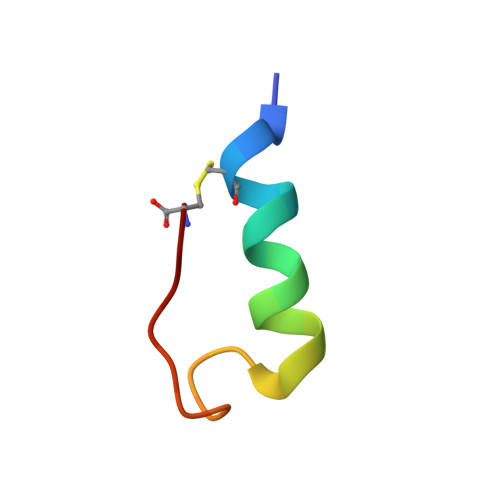
9GDN | pdb_00009gdn

Trp-cage fortified Tc5b-Exenatide chimera with disulfide bond cyclization (Ex-4-Tc5bCC) at 288K

  • Classification: DE NOVO PROTEIN
  • Organism(s): Heloderma suspectum
  • Expression System: Escherichia coli
  • Mutation(s): No 

  • Deposited: 2024-08-06 Released: 2024-09-25 
  • Deposition Author(s): Horvath, D.
  • Funding Organization(s): Hungarian National Research, Development and Innovation Office, European Communitys Seventh Framework Programme

Experimental Data Snapshot

  • Method: SOLUTION NMR
  • Conformers Calculated: 20 
  • Conformers Submitted: 10 
  • Selection Criteria: structures with the lowest energy 

wwPDB Validation 3D Report Full Report

Validation slider image for 9GDN

This is version 1.1 of the entry. See complete history

Literature

Influence of Trp-Cage on the Function and Stability of GLP-1R Agonist Exenatide Derivatives.

Horvath, D.Straner, P.Taricska, N.Fazekas, Z.Menyhard, D.K.Perczel, A.

(2024) J Med Chem 67: 16757-16772

  • DOI: https://doi.org/10.1021/acs.jmedchem.4c01553
  • Primary Citation Related Structures: 
    9G0M, 9G0N, 9G20, 9G21, 9G22, 9G2N, 9G2O, 9G31, 9G32, 9G5P, 9GDL, 9GDN, 9GDT, 9GDU, 9GE1, 9GE9, 9GEB, 9GEC

  • PubMed Abstract: 

    Exenatide (Ex4), a GLP-1 incretin mimetic polypeptide, is an effective therapeutic agent against diabetes and obesity. We highlight the indirect role of Ex4's structure-stabilizing Trp-cage (Tc) motif in governing GLP-1 receptor (GLP-1R) signal transduction. We use various Ex4 derivatives to explore how Tc compactness influences thermal stability, aggregation, enhancement of insulin secretion, and GLP-1R binding. We found that Ex4 variants decorated with fortified Tc motifs exhibit increased resistance to unfolding and aggregation but show an inverse relationship between the bioactivity and stability. Molecular dynamics simulations coupled with a rigid-body segmentation protocol to analyze dynamic interconnectedness revealed that the constrained Tc motifs remain intact within the receptor-ligand complexes but interfere with one of the major stabilizing contacts and recognition loci on the extracellular side of GLP-1R, dislodging the N-terminal activating region of the hormone mimetics, and restrict the free movement of TM6, the main signal transduction device of GLP-1R.


  • Organizational Affiliation
    • HUN-REN-ELTE Protein Modeling Research Group, ELTE Eötvös Loránd University, Pázmány Péter sétány 1/A, Budapest H-1117, Hungary.

Macromolecule Content 

  • Total Structure Weight: 2.82 kDa 
  • Atom Count: 197 
  • Modeled Residue Count: 25 
  • Deposited Residue Count: 25 
  • Unique protein chains: 1

Macromolecules

Find similar proteins by:  Sequence   |   3D Structure  
Entity ID: 1
MoleculeChains  Sequence LengthOrganismDetailsImage
Trp-cage fortified Tc5b-Exenatide chimera (Ex-4-Tc5bSS)25Heloderma suspectumMutation(s): 0 

Experimental Data & Validation

Experimental Data

  • Method: SOLUTION NMR
  • Conformers Calculated: 20 
  • Conformers Submitted: 10 
  • Selection Criteria: structures with the lowest energy 

Structure Validation

View Full Validation Report


Entry History 

& Funding Information

Deposition Data

  • Released Date: 2024-09-25 
  • Deposition Author(s): Horvath, D.

Funding OrganizationLocationGrant Number
Hungarian National Research, Development and Innovation OfficeHungary2018-1.2.1-NKP-2018-00005
European Communitys Seventh Framework ProgrammeEuropean UnionRRF-2.3.1-21-2022-00015

Revision History  (Full details and data files)

  • Version 1.0: 2024-09-25
    Type: Initial release
  • Version 1.1: 2024-10-09
    Changes: Database references, Structure summary