Download Mendeley
Interface integrity in septin protofilaments is maintained by an arginine residue conserved from yeast to man.
Grupp, B., Graser, J.B., Seifermann, J., Gerhardt, S., Lemkul, J.A., Gehrke, J.F., Johnsson, N., Gronemeyer, T.(2025) Mol Biol Cell 36: ar59-ar59
- PubMed: 40137961 Search on PubMedSearch on PubMed Central
- DOI: https://doi.org/10.1091/mbc.E25-01-0041
- Primary Citation Related Structures:
9GD4 - PubMed Abstract:
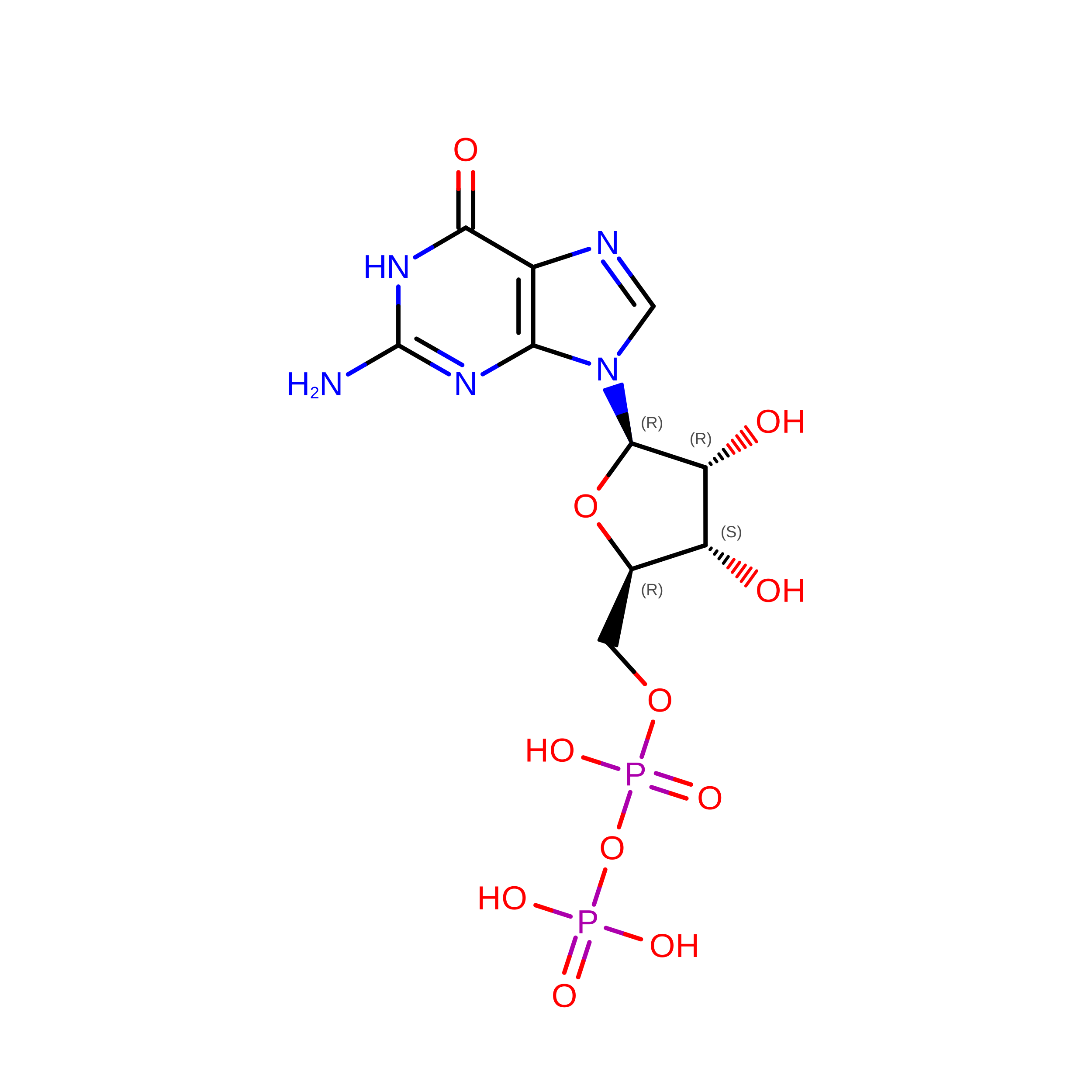
The septins are conserved, filament-forming, guanine nucleotide binding cytoskeletal proteins. They assemble into palindromic protofilaments which polymerize further into higher-ordered structures that participate in essential intracellular processes such as cytokinesis or polarity establishment. Septins belong structurally to the P-Loop NTPases but, unlike their relatives Ras or Rho, do not mediate signals to effectors through GTP binding and hydrolysis. Biochemical approaches addressing how and why septins utilize nucleotides are hampered by the lack of nucleotide-free complexes. Using molecular dynamics simulations, we determined structural alterations and intersubunit binding free energies in human and yeast septin dimer structures and in their in silico generated apo forms. An interchain salt bridge network around the septin unique β-meander, conserved across all kingdoms of septin containing species, is destabilized upon nucleotide removal, concomitant with disruption of the entire G-interface. Within this network, we confirmed a conserved arginine residue, which coordinates the guanine base of the nucleotide, as the central interaction hub. The essential role of this arginine for interface integrity was experimentally confirmed to be conserved in septins from yeast to human.
- Institute of Molecular Genetics and Cell Biology, Ulm University, Ulm 89081, Germany.
Organizational Affiliation: