9G9W | pdb_00009g9w

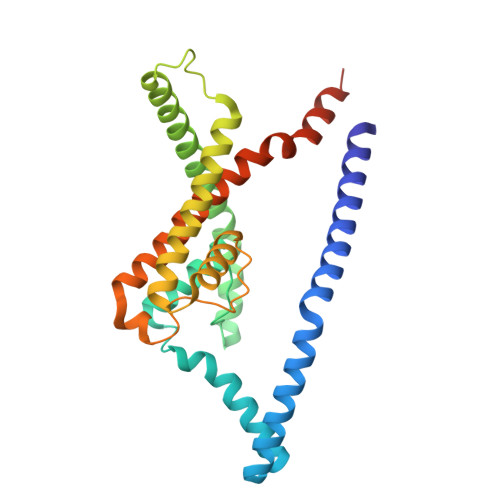
Structure of the human two pore domain potassium ion channel TASK-3 (K2P9.1) G236R mutant


Experimental Data Snapshot

  • Method: ELECTRON MICROSCOPY
  • Resolution: 2.48 Å
  • Aggregation State: PARTICLE 
  • Reconstruction Method: SINGLE PARTICLE 

wwPDB Validation 3D Report Full Report

Validation slider image for 9G9W

This is version 1.1 of the entry. See complete history

Literature

Structures of TASK-1 and TASK-3 K2P channels provide insight into their gating and dysfunction in disease.

Hall, P.R.Jouen-Tachoire, T.Schewe, M.Proks, P.Baukrowitz, T.Carpenter, E.P.Newstead, S.Rodstrom, K.E.J.Tucker, S.J.

(2025) Structure 33: 115

  • DOI: https://doi.org/10.1016/j.str.2024.11.005
  • Primary Citation Related Structures: 
    9G9V, 9G9W, 9G9X

  • PubMed Abstract: 

    TASK-1 and TASK-3 are pH-sensitive two-pore domain (K2P/KCNK) K + channels. Their functional roles make them promising targets for treatment of multiple disorders including sleep apnea, pain, and atrial fibrillation. Mutations in these channels are also associated with neurodevelopmental and hypertensive disorders. A previous crystal structure of TASK-1 revealed a lower "X-gate" as a hotspot for missense gain-of-function (GoF) mutations associated with DDSA (developmental delay with sleep apnea). However, the mechanisms of gating in TASK channels are still not fully understood. Here, we resolve structures for both human TASK-1 and TASK-3 by cryoelectron microscopy (cryo-EM), as well as a recurrent TASK-3 variant (G236R) associated with KCNK9 imprinting syndrome (KIS) (formerly known as Birk-Barel syndrome). Combined with functional studies of the X-gating mechanism, we provide evidence for how a highly conserved gating mechanism becomes defective in disease, and also provide further insight into the pathway of conformational changes that underlie the pH-dependent inhibition of TASK channel activity.


  • Organizational Affiliation
    • Department of Biochemistry, University of Oxford, Oxford, UK; Clarendon Laboratory, Department of Physics, University of Oxford, Oxford, UK; Scripps Institute, San Diego, CA, USA; Kavli Institute for Nanoscience Discovery, University of Oxford, Oxford, UK.

Macromolecule Content 

  • Total Structure Weight: 64.98 kDa 
  • Atom Count: 4,089 
  • Modeled Residue Count: 516 
  • Deposited Residue Count: 544 
  • Unique protein chains: 1

Macromolecules

Find similar proteins by:|  3D Structure
Entity ID: 1
MoleculeChains  Sequence LengthOrganismDetailsImage
Potassium channel subfamily K member 9
A, B
272Homo sapiensMutation(s): 1 
Gene Names: KCNK9TASK3
Membrane Entity: Yes 
UniProt & NIH Common Fund Data Resources
Find proteins for Q9NPC2 (Homo sapiens)
Explore Q9NPC2 
Go to UniProtKB:  Q9NPC2
PHAROS:  Q9NPC2
GTEx:  ENSG00000169427 
Entity Groups
Sequence Clusters30% Identity50% Identity70% Identity90% Identity95% Identity100% Identity
UniProt GroupQ9NPC2
Sequence Annotations
Expand
Reference Sequence

Small Molecules

Ligands 2 Unique
IDChains Name / Formula / InChI Key2D Diagram3D Interactions
Y01

Query on Y01


Download:Ideal Coordinates CCD File
C [auth A]
D [auth A]
E [auth A]
I [auth B]
J [auth B]
C [auth A],
D [auth A],
E [auth A],
I [auth B],
J [auth B],
K [auth B]
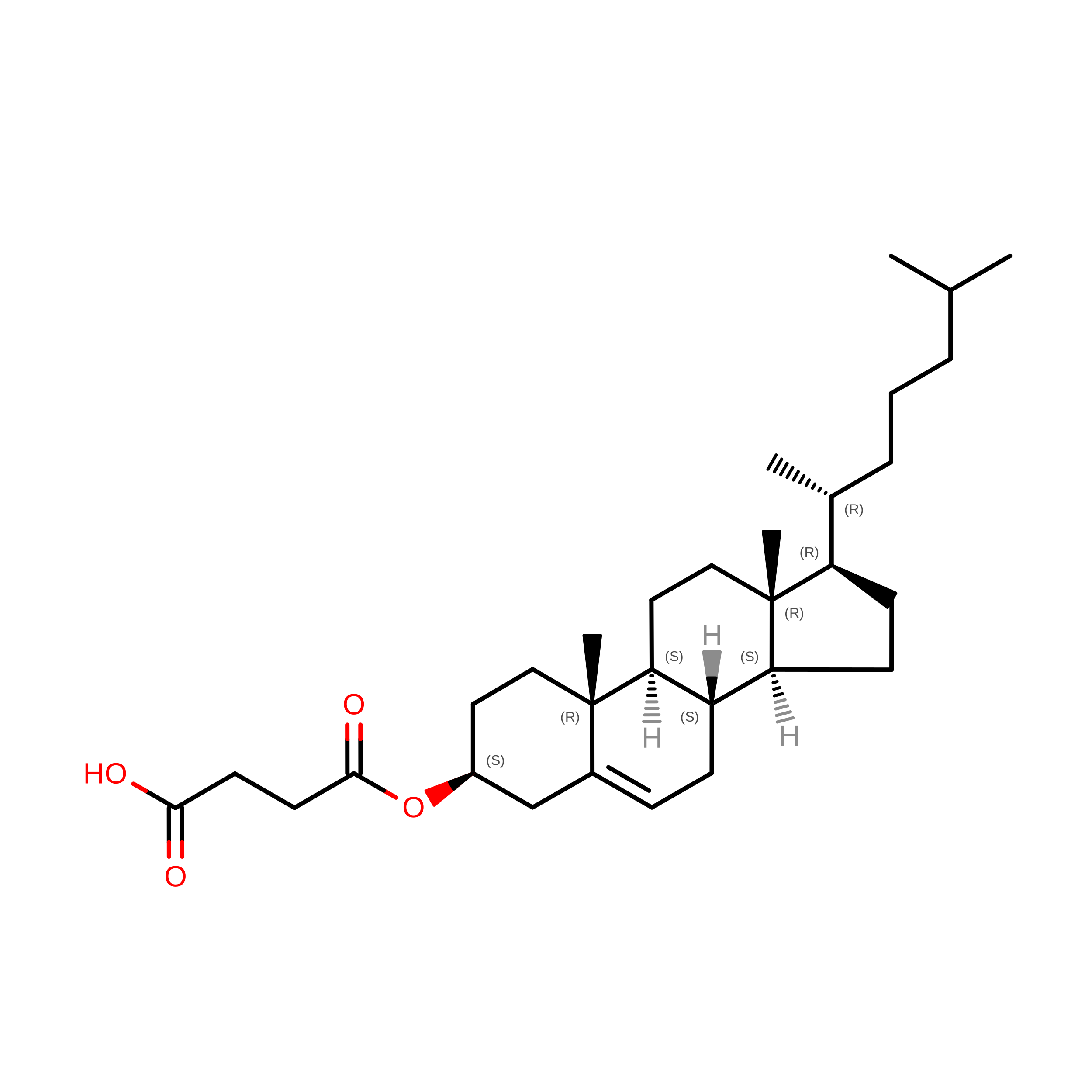
CHOLESTEROL HEMISUCCINATE
C31 H50 O4
WLNARFZDISHUGS-MIXBDBMTSA-N
K

Query on K


Download:Ideal Coordinates CCD File
F [auth A],
G [auth A],
H [auth A]
POTASSIUM ION
K
NPYPAHLBTDXSSS-UHFFFAOYSA-N

Experimental Data & Validation

Experimental Data

  • Method: ELECTRON MICROSCOPY
  • Resolution: 2.48 Å
  • Aggregation State: PARTICLE 
  • Reconstruction Method: SINGLE PARTICLE 
EM Software:
TaskSoftware PackageVersion
MODEL REFINEMENTPHENIX1.20.1-4487
RECONSTRUCTIONcryoSPARC4.4.1

Structure Validation

View Full Validation Report


Entry History 

& Funding Information

Deposition Data


Funding OrganizationLocationGrant Number
Biotechnology and Biological Sciences Research Council (BBSRC)United KingdomBB/T002018/1
Biotechnology and Biological Sciences Research Council (BBSRC)United KingdomBB/S008608/1
Medical Research Council (MRC, United Kingdom)United KingdomMR/W017741/1

Revision History  (Full details and data files)

  • Version 1.0: 2024-12-18
    Type: Initial release
  • Version 1.1: 2025-01-15
    Changes: Data collection, Database references