Download Mendeley
Artificial Gold Enzymes Using a Genetically Encoded Thiophenol-Based Noble-Metal-Binding Ligand.
Veen, M.J., Aalbers, F.S., Rozeboom, H.J., Thunnissen, A.W.H., Sauer, D.F., Roelfes, G.(2025) Angew Chem Int Ed Engl 64: e202421912-e202421912
- PubMed: 39629678 Search on PubMed
- DOI: https://doi.org/10.1002/anie.202421912
- Primary Citation Related Structures:
9G51, 9G52 - PubMed Abstract:
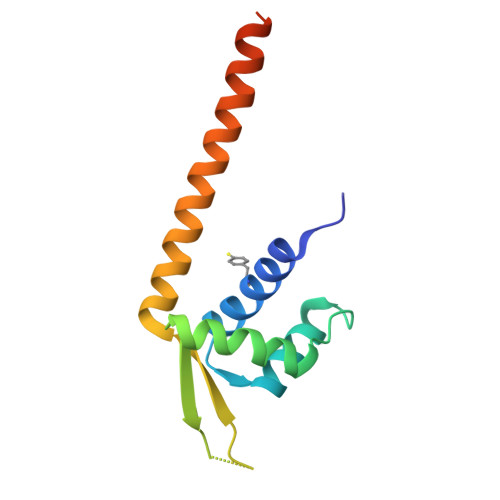
Incorporating noble metals in artificial metalloenzymes (ArMs) is challenging due to the lack of suitable soft coordinating ligands among natural amino acids. We present a new class of ArMs featuring a genetically encoded noble-metal-binding site based on a non-canonical thiophenol-based amino acid, 4-mercaptophenylalanine (pSHF), incorporated in the transcriptional regulator LmrR through stop codon suppression. We demonstrate that pSHF is an excellent ligand for noble metals in their low oxidation states. The corresponding gold(I) enzyme was characterised by mass spectrometry, UV/Vis spectroscopy and X-ray crystallography and successfully catalysed hydroamination reactions of 2-ethynyl anilines with turnover numbers over 50. Interestingly, two equivalents of gold(I) per protein dimer proved to be required for activity. Up to 98 % regioselectivity in the hydroamination of an ethynylphenylurea substrate was observed, yielding the corresponding phenyl-dihydroquinazolinone product, consistent with a π-activation mechanism by single gold centres. The ArM was optimized by site saturation mutagenesis using an on-bead screening protocol. This resulted in a single mutant that showed higher activity for one class of substrates. This work brings the power of noble-metal catalysis into the realm of enzyme engineering and establishes thiophenols as alternative ligands for noble metals, providing new opportunities in coordination chemistry and catalysis.
- Stratingh Institute for Chemistry, University of Groningen, 9747 AG, Groningen, the, Netherlands.
Organizational Affiliation: