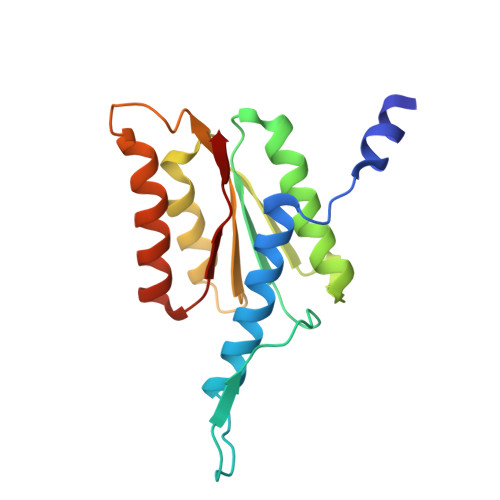
9G3M | pdb_00009g3m

Circularly permuted lumazine synthase triple-stranded straight tube


Experimental Data Snapshot

  • Method: ELECTRON MICROSCOPY
  • Resolution: 3.09 Å
  • Aggregation State: HELICAL ARRAY 
  • Reconstruction Method: HELICAL 

Starting Model: experimental
View more details

wwPDB Validation   3D Report Full Report


This is version 1.1 of the entry. See complete history


Literature

Dynamic Assembly of Pentamer-Based Protein Nanotubes.

Koziej, L.Fatehi, F.Aleksejczuk, M.Byrne, M.J.Heddle, J.G.Twarock, R.Azuma, Y.

(2025) ACS Nano 19: 8786-8798

  • DOI: https://doi.org/10.1021/acsnano.4c16192
  • Primary Citation of Related Structures:  
    9G3H, 9G3I, 9G3J, 9G3M, 9G3N, 9G3O, 9G3P

  • PubMed Abstract: 

    Hollow proteinaceous particles are useful nanometric containers for delivery and catalysis. Understanding the molecular mechanisms and the geometrical theory behind the polymorphic protein assemblies provides a basis for designing ones with the desired morphology. As such, we found that a circularly permuted variant of a cage-forming enzyme, Aquifex aeolicus lumazine synthase, cpAaLS, assembles into a variety of hollow spherical and cylindrical structures in response to changes in ionic strength. Cryogenic electron microscopy revealed that these structures are composed entirely of pentameric subunits, and the dramatic cage-to-tube transformation is attributed to the moderately hindered 3-fold symmetry interaction and the imparted torsion angle of the building blocks, where both mechanisms are mediated by an α-helix domain that is untethered from the native position by circular permutation. Mathematical modeling suggests that the unique double- and triple-stranded helical arrangements of subunits are optimal tiling patterns, while different geometries should be possible by modulating the interaction angles of the pentagons. These structural insights into dynamic, pentamer-based protein cages and nanotubes afford guidelines for designing nanoarchitectures with customized morphology and assembly characteristics.


  • Organizational Affiliation
    • Malopolska Centre of Biotechnology, Jagiellonian University, Krakow 30-387, Poland.

Macromolecules
Find similar proteins by:  (by identity cutoff)  |  3D Structure
Entity ID: 1
MoleculeChains Sequence LengthOrganismDetailsImage
6,7-dimethyl-8-ribityllumazine synthase
A, AA, AB, AC, AD
A, AA, AB, AC, AD, AE, B, BA, BB, BC, BD, BE, C, CA, CB, CC, CD, CE, D, DA, DB, DC, DD, DE, E, EA, EB, EC, ED, EE, F, FA, FB, FC, FD, FE, G, GA, GB, GC, GD, GE, H, HA, HB, HC, HD, HE, I, IA, IB, IC, ID, IE, J, JA, JB, JC, JD, JE, K, KA, KB, KC, KD, KE, L, LA, LB, LC, LD, LE, M, MA, MB, MC, MD, ME, N, NA, NB, NC, ND, NE, O, OA, OB, OC, OD, OE, P, PA, PB, PC, PD, PE, Q, QA, QB, QC, QD, QE, R, RA, RB, RC, RD, RE, S, SA, SB, SC, SD, SE, T, TA, TB, TC, TD, TE, U, UA, UB, UC, UD, V, VA, VB, VC, VD, W, WA, WB, WC, WD, X, XA, XB, XC, XD, Y, YA, YB, YC, YD, Z, ZA, ZB, ZC, ZD
163Aquifex aeolicus VF5Mutation(s): 0 
Gene Names: ribHaq_132
EC: 2.5.1.78
UniProt
Find proteins for O66529 (Aquifex aeolicus (strain VF5))
Explore O66529 
Go to UniProtKB:  O66529
Entity Groups  
Sequence Clusters30% Identity50% Identity70% Identity90% Identity95% Identity100% Identity
UniProt GroupO66529
Sequence Annotations
Expand
  • Reference Sequence
Experimental Data & Validation

Experimental Data

  • Method: ELECTRON MICROSCOPY
  • Resolution: 3.09 Å
  • Aggregation State: HELICAL ARRAY 
  • Reconstruction Method: HELICAL 
EM Software:
TaskSoftware PackageVersion
MODEL REFINEMENTPHENIX1.20.1-4487
RECONSTRUCTIONRELION3.1

Structure Validation

View Full Validation Report


Entry History & Funding Information

Deposition Data


Funding OrganizationLocationGrant Number
Polish National Science CentrePoland2018/31/D/NZ1/01102
Polish National Science CentrePoland2019/35/B/NZ1/02044
European Molecular Biology Organization (EMBO)European UnionEMBO Installation Grant (YA)

Revision History  (Full details and data files)

  • Version 1.0: 2025-03-05
    Type: Initial release
  • Version 1.1: 2025-03-19
    Changes: Data collection, Database references