Download Mendeley
Engineering Penicillium expansum antifungal proteins unveils new clues about their mode of action.
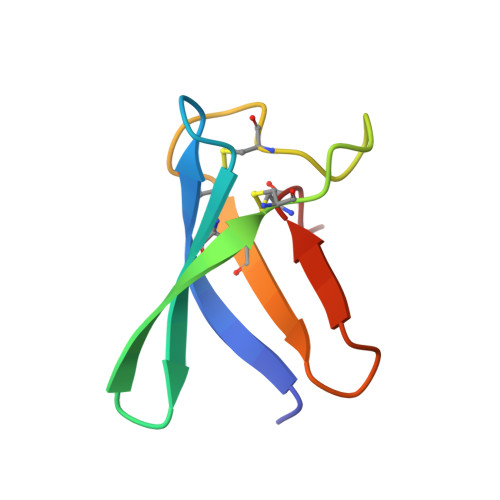
Giner-Llorca, M., Gallego Del Sol, F., de Ovalle, S., Thomson, D.D., Bignell, E.M., Marina, A., Marcos, J.F., Manzanares, P.(2026) Appl Microbiol Biotechnol 110
- PubMed: 42009862 Search on PubMedSearch on PubMed Central
- DOI: https://doi.org/10.1007/s00253-026-13782-5
- Primary Citation Related Structures:
9FQF, 9FQG - PubMed Abstract:
Fungal antifungal proteins (AFPs) are promising biofungicides. PeAfpA and PeAfpB from Penicillium expansum show different activity profiles and potency, with PeAfpA being more active. Based on the PeAfpB solved structure, we had previously designed PeAfpB-PeAfpA chimeras that showed different properties. From these, we engineer here two additional variants, chPeAFPV6 and chPeAFPV7, that revealed novel aspects of the AFP structure, antifungal determinants and mechanism. chPeAFPV6, with a single E11K mutation in the loop L1 that is part of the γ-core motif, increased PeAfpB antifungal activity to that of PeAfpA against filamentous fungi but not yeasts, and promoted internalisation into Penicillium digitatum hyphae. However, changes in loop L3 of PeAfpB as in chPeAFPV7 abolished this increase, resulting in an inactive protein that still internalised. Overall, internalisation is neither sufficient nor essential for killing P. digitatum. Antifungal activity did not correlate with reactive oxygen species production, suggesting that oxidative burst is a fungal stress defence rather than a killing mechanism. Although cell permeabilisation was associated with antifungal activity, it does not seem to be a primary mode of action. Structural analysis showed interactions between the γ-core motif and loop L3, and suggests the importance of the conformation of the E7 residue of PeAfpB. Additionally, PeAfpA was identified as a protein able to penetrate Candida auris by a cell wall-dependent mechanism, and kill yeast cells. This study highlights the potential of the PeAfpB scaffold for engineering new-to-nature AFPs and provides novel insights into their modes of action, paving the way for future applications. KEY POINTS: A single amino acid change in the γ-core of PeAfpB enhances antifungal potency Loop L3 of PeAfpB may block activity through interaction with the γ-core Antifungal activity does not correlate with ROS production.
- Department of Food Biotechnology, Instituto de Agroquímica y Tecnología de Alimentos (IATA), Consejo Superior de Investigaciones Científicas (CSIC), Paterna, Spain.
Organizational Affiliation: