Download Mendeley
Asymmetric Monoreduction of alpha , beta-Dicarbonyls to alpha-Hydroxy Carbonyls by Ene Reductases.
Wolder, A.E., Heckmann, C.M., Hagedoorn, P.L., Opperman, D.J., Paul, C.E.(2024) ACS Catal 14: 15713-15720
- PubMed: 39444529 Search on PubMedSearch on PubMed Central
- DOI: https://doi.org/10.1021/acscatal.4c04676
- Primary Citation Related Structures:
9FH7 - PubMed Abstract:
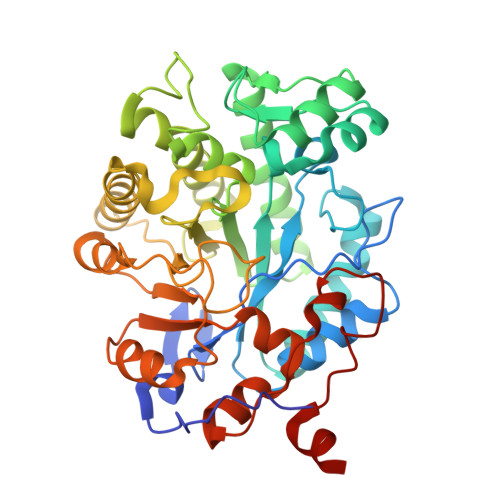
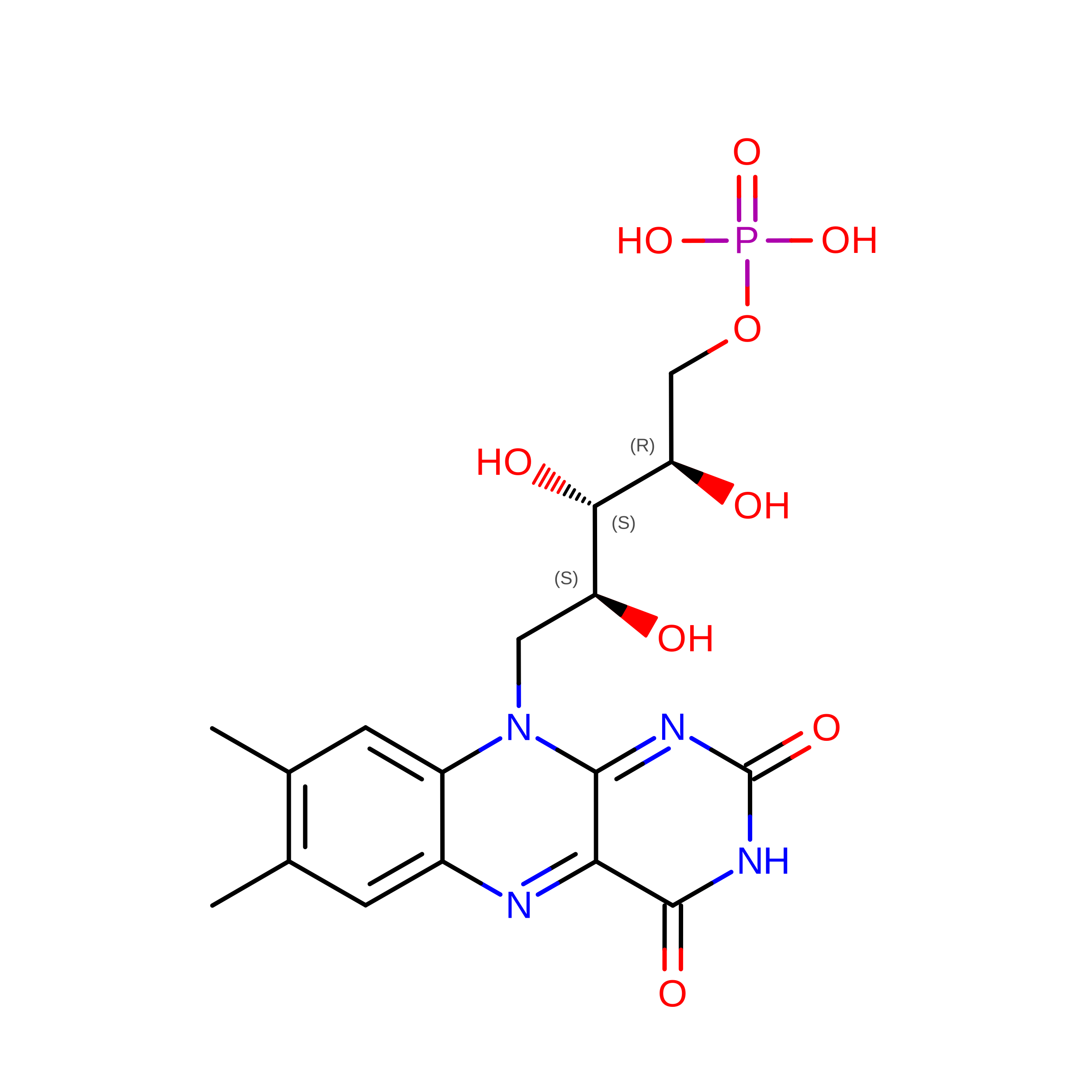
Ene reductases (EREDs) catalyze asymmetric reduction with exquisite chemo-, stereo-, and regioselectivity. Recent discoveries led to unlocking other types of reactivities toward oxime reduction and reductive C-C bond formation. Exploring nontypical reactions can further expand the biocatalytic knowledgebase, and evidence alludes to yet another variant reaction where flavin mononucleotide (FMN)-bound ERs from the old yellow enzyme family (OYE) have unconventional activity with α,β-dicarbonyl substrates. In this study, we demonstrate the nonconventional stereoselective monoreduction of α,β-dicarbonyl to the corresponding chiral hydroxycarbonyl, which are valuable building blocks for asymmetric synthesis. We explored ten α,β-dicarbonyl aliphatic, cyclic, or aromatic compounds and tested their reduction with five OYEs and one nonflavin-dependent double bond reductase (DBR). Only GluER reduced aliphatic α,β-dicarbonyls, with up to 19% conversion of 2,3-hexanedione to 2-hydroxyhexan-3-one with an R -selectivity of 83% ee . The best substrate was the aromatic α,β-dicarbonyl 1-phenyl-1,2-propanedione, with 91% conversion to phenylacetylcarbinol using OYE3 with R -selectivity >99.9% ee . Michaelis-Menten kinetics for 1-phenyl-1,2-propanedione with OYE3 gave a turnover k cat of 0.71 ± 0.03 s -1 and a K m of 2.46 ± 0.25 mM. Twenty-four EREDs from multiple classes of OYEs and DBRs were further screened on 1-phenyl-1,2-propanedione, showing that class II OYEs (OYE3-like) have the best overall selectivity and conversion. EPR studies detected no radical signal, whereas NMR studies with deuterium labeling indicate proton incorporation at the benzylic carbonyl carbon from the solvent and not the FMN hydride. A crystal structure of OYE2 with 1.5 Å resolution was obtained, and docking studies showed a productive pose with the substrate.
- Biocatalysis section, Department of Biotechnology, Delft University of Technology, van der Maasweg 9, Delft 2629 HZ, the Netherlands.
Organizational Affiliation: