9F90 | pdb_00009f90

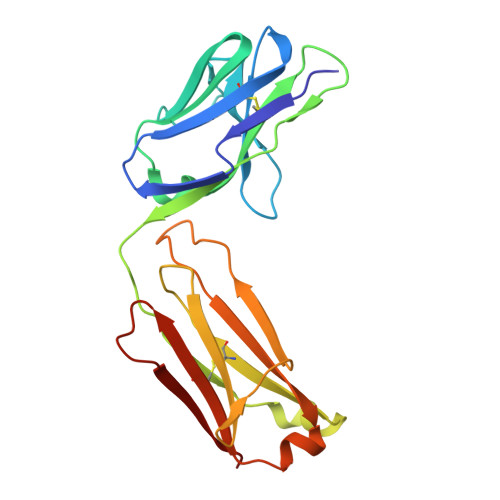
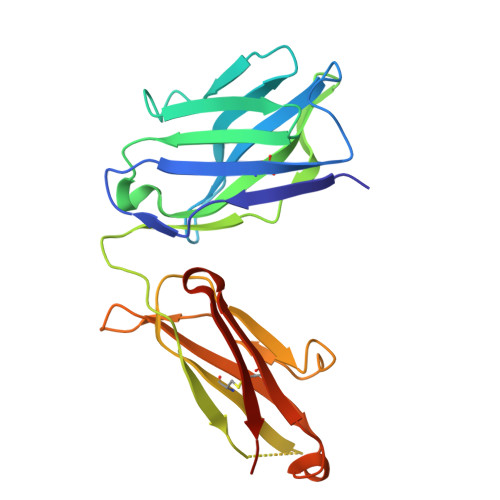
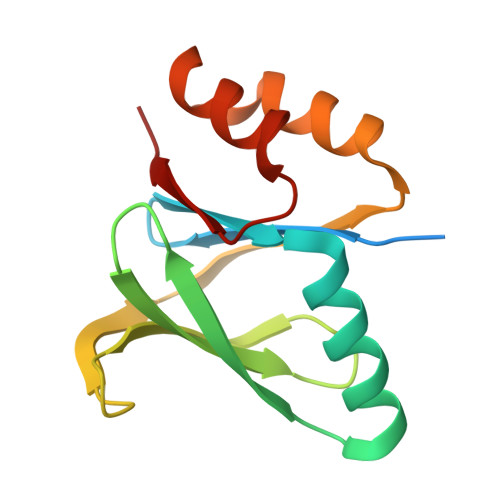
Crystal structure of a designed three-motif Respiratory Syncytial Virus immunogen in complex with motavizumab fab


Experimental Data Snapshot

  • Method: X-RAY DIFFRACTION
  • Resolution: 2.91 Å
  • R-Value Free: 
    0.262 (Depositor), 0.261 (DCC) 
  • R-Value Work: 
    0.224 (Depositor), 0.224 (DCC) 
  • R-Value Observed: 
    0.226 (Depositor) 

Starting Model: in silico
View more details

wwPDB Validation 3D Report Full Report

Validation slider image for 9F90

This is version 1.2 of the entry. See complete history

Literature

Accurate single-domain scaffolding of three nonoverlapping protein epitopes using deep learning.

Castro, K.M.Watson, J.L.Wang, J.Southern, J.Ayardulabi, R.Georgeon, S.Rosset, S.Baker, D.Correia, B.E.

(2026) Nat Chem Biol 22: 604-611

  • DOI: https://doi.org/10.1038/s41589-025-02083-z
  • Primary Citation Related Structures: 
    9F8Y, 9F90, 9F91

  • PubMed Abstract: 

    De novo protein design has seen major success in scaffolding single functional motifs; however, in nature, most proteins present multiple functional sites. Here, we describe an approach to simultaneously scaffold multiple functional sites in a single-domain protein using deep learning. We designed small single-domain immunogens, under 130 residues, that present three distinct and irregular motifs from respiratory syncytial virus. These motifs together comprise nearly half of the designed proteins; hence, the overall folds are quite unusual with little global similarity to proteins in the Protein Data Bank. Despite this, X-ray crystal structures confirmed the accuracy of presentation of each of the motifs and the multiepitope design yields improved cross-reactive titers and neutralizing response compared to a single-epitope immunogen. The successful presentation of three distinct binding surfaces in a small single-domain protein highlights the power of generative deep learning methods to solve complex protein design problems.


  • Organizational Affiliation
    • Institute of Bioengineering, École Polytechnique Fédérale de Lausanne (EPFL), Lausanne, Switzerland.

Macromolecule Content 

  • Total Structure Weight: 126.69 kDa 
  • Atom Count: 8,287 
  • Modeled Residue Count: 1,077 
  • Deposited Residue Count: 1,144 
  • Unique protein chains: 3

Macromolecules

Find similar proteins by:|  3D Structure
Entity ID: 1
MoleculeChains  Sequence LengthOrganismDetailsImage
Motavizumab Fab light chainA [auth B],
C
213Mus musculusMutation(s): 0 
Find similar proteins by:|  3D Structure
Entity ID: 2
MoleculeChains  Sequence LengthOrganismDetailsImage
Motavizumab Fab heavy chainB [auth A],
D
225Mus musculusMutation(s): 0 
Find similar proteins by:|  3D Structure
Entity ID: 3
MoleculeChains  Sequence LengthOrganismDetailsImage
RSVF-multi-epitope designed scaffoldE [auth H],
F [auth G]
134synthetic constructMutation(s): 0 

Experimental Data & Validation

Experimental Data

  • Method: X-RAY DIFFRACTION
  • Resolution: 2.91 Å
  • R-Value Free:  0.262 (Depositor), 0.261 (DCC) 
  • R-Value Work:  0.224 (Depositor), 0.224 (DCC) 
  • R-Value Observed: 0.226 (Depositor) 
Space Group: C 1 2 1
Unit Cell:
Length ( Å )Angle ( ˚ )
a = 184.072α = 90
b = 66.859β = 103.87
c = 109.41γ = 90
Software Package:
Software NamePurpose
PHENIXrefinement
PHENIXrefinement
autoPROCdata reduction
autoPROCdata scaling
PHENIXphasing

Structure Validation

View Full Validation Report


Entry History 

& Funding Information

Deposition Data


Funding OrganizationLocationGrant Number
Swiss National Science FoundationSwitzerland--
European Research Council (ERC)European Union--

Revision History  (Full details and data files)

  • Version 1.0: 2025-05-21
    Type: Initial release
  • Version 1.1: 2025-12-17
    Changes: Database references
  • Version 1.2: 2026-04-15
    Changes: Database references