9F1U | pdb_00009f1u

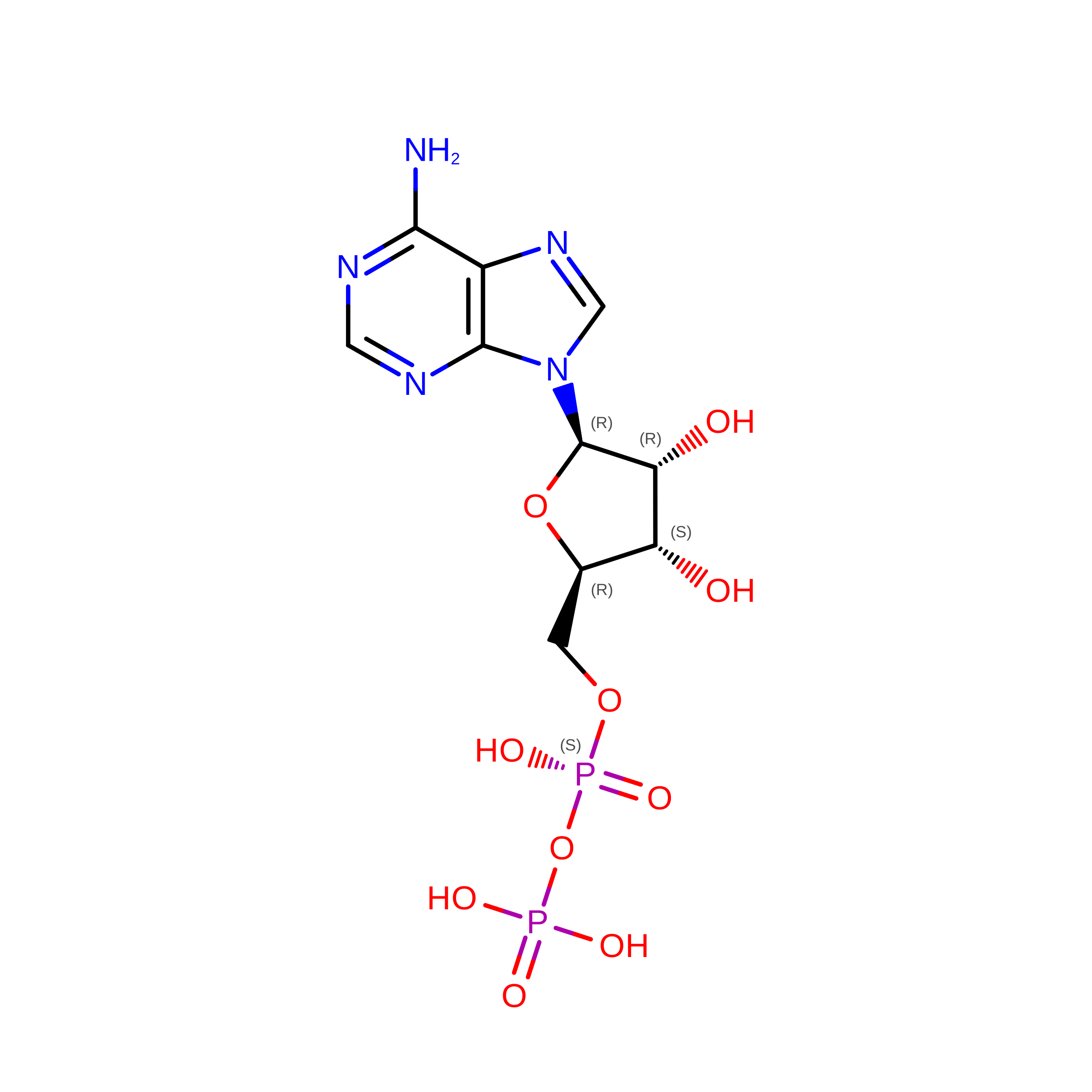
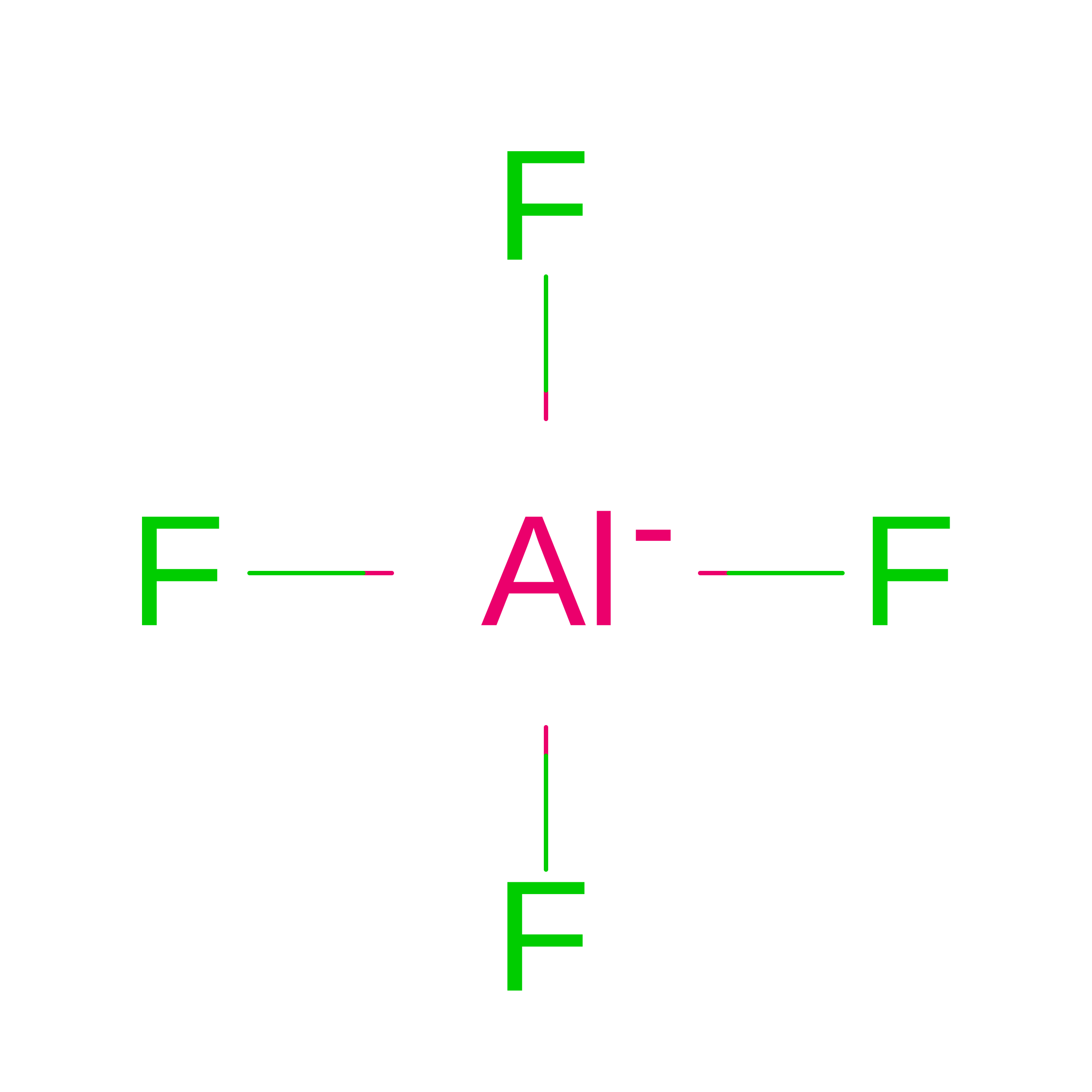
Cryo-EM structure of the I923V MDA5-dsRNA filament with ADP-AlF4 bound and 81-degree helical twist


Experimental Data Snapshot

  • Method: ELECTRON MICROSCOPY
  • Resolution: 3.67 Å
  • Aggregation State: FILAMENT 
  • Reconstruction Method: HELICAL 

Starting Model: experimental
View more details

wwPDB Validation   3D Report Full Report


This is version 1.1 of the entry. See complete history


Literature

Molecular basis of autoimmune disease protection by MDA5 variants.

Singh, R.Joiner, J.D.Herrero Del Valle, A.Zwaagstra, M.Jobe, I.Ferguson, B.J.van Kuppeveld, F.J.M.Modis, Y.

(2025) Cell Rep 44: 115754-115754

  • DOI: https://doi.org/10.1016/j.celrep.2025.115754
  • Primary Citation of Related Structures:  
    9F0J, 9F1U, 9F20, 9F2L, 9F2W, 9F3P

  • PubMed Abstract: 

    MDA5 recognizes double-stranded RNA (dsRNA) from viruses and retroelements. Cooperative filament formation and ATP-dependent proofreading confer MDA5 with the necessary sensitivity and specificity for dsRNA. Many MDA5 genetic variants are associated with protection from autoimmune disease while increasing the risk of infection and chronic inflammation. How these variants affect RNA sensing remains unclear. Here, we determine the consequences of autoimmune-protective variants on the molecular structure and activities of MDA5. Rare variants E627 and I923V reduce the interferon response to picornavirus infection. E627 does not bind RNA. I923V is ATPase hyperactive, causing premature dissociation from dsRNA. Cryoelectron microscopy (cryo-EM) structures of MDA5 I923V bound to dsRNA at different stages of ATP hydrolysis reveal smaller RNA binding interfaces, leading to excessive proofreading activity. Variants R843H and T946A, which are genetically linked and cause mild phenotypes, did not affect cytokine induction, suggesting an indirect disease mechanism. In conclusion, autoimmune-protective MDA5 variants dampen MDA5-dependent signaling via multiple mechanisms.


  • Organizational Affiliation
    • Molecular Immunity Unit, Department of Medicine, University of Cambridge, MRC Laboratory of Molecular Biology, Cambridge CB2 0QH, UK; Cambridge Institute of Therapeutic Immunology & Infectious Disease (CITIID), Department of Medicine, University of Cambridge, Cambridge CB2 0AW, UK; Department of Pathology, University of Cambridge, Cambridge CB2 1QP, UK.

Macromolecules

Find similar proteins by:  (by identity cutoff)  |  3D Structure
Entity ID: 1
MoleculeChains Sequence LengthOrganismDetailsImage
Interferon-induced helicase C domain-containing protein 11,028Mus musculusMutation(s): 1 
Gene Names: Ifih1
EC: 3.6.4.13
UniProt & NIH Common Fund Data Resources
Find proteins for Q8R5F7 (Mus musculus)
Explore Q8R5F7 
Go to UniProtKB:  Q8R5F7
IMPC:  MGI:1918836
Entity Groups  
Sequence Clusters30% Identity50% Identity70% Identity90% Identity95% Identity100% Identity
UniProt GroupQ8R5F7
Sequence Annotations
Expand
  • Reference Sequence

Find similar nucleic acids by:  Sequence   |   3D Structure  

Entity ID: 2
MoleculeChains LengthOrganismImage
RNA (5'-R(P*CP*AP*AP*GP*CP*CP*GP*AP*GP*GP*AP*GP*AP*U)-3')B [auth X]14Mus musculus
Sequence Annotations
Expand
  • Reference Sequence

Find similar nucleic acids by:  Sequence   |   3D Structure  

Entity ID: 3
MoleculeChains LengthOrganismImage
RNA (5'-R(P*AP*UP*CP*UP*CP*CP*UP*CP*GP*GP*CP*UP*UP*G)-3')C [auth Z]14Mus musculus
Sequence Annotations
Expand
  • Reference Sequence
Experimental Data & Validation

Experimental Data

  • Method: ELECTRON MICROSCOPY
  • Resolution: 3.67 Å
  • Aggregation State: FILAMENT 
  • Reconstruction Method: HELICAL 
EM Software:
TaskSoftware PackageVersion
RECONSTRUCTIONRELION4.0
MODEL REFINEMENTPHENIX1.21

Structure Validation

View Full Validation Report


Entry History & Funding Information

Deposition Data


Funding OrganizationLocationGrant Number
Wellcome TrustUnited Kingdom101908/Z/13/Z
Wellcome TrustUnited Kingdom217191/Z/19/Z
Wellcome TrustUnited Kingdom215378/Z/19/Z
Human Frontier Science Program (HFSP)FranceLT000454/2021-L

Revision History  (Full details and data files)

  • Version 1.0: 2025-02-26
    Type: Initial release
  • Version 1.1: 2025-06-18
    Changes: Data collection, Database references