9F13 | pdb_00009f13

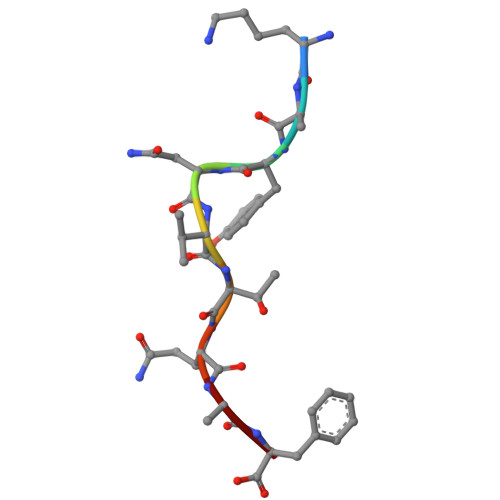
Crystal structure of HLA-C*12:02 in complex with KAYNVTQAF (KF9), a 9-mer epitope from SARS-CoV-2 Nucleocapsid (N266-274)


Experimental Data Snapshot

  • Method: X-RAY DIFFRACTION
  • Resolution: 1.61 Å
  • R-Value Free: 
    0.231 (Depositor), 0.231 (DCC) 
  • R-Value Work: 
    0.204 (Depositor), 0.204 (DCC) 
  • R-Value Observed: 
    0.205 (Depositor) 

Starting Model: experimental
View more details

wwPDB Validation 3D Report Full Report

Validation slider image for 9F13

This is version 1.1 of the entry. See complete history

Literature

Molecular basis of potent antiviral HLA-C-restricted CD8 + T cell response to an immunodominant SARS-CoV-2 nucleocapsid epitope.

Goto, Y.Ahn, Y.M.Toyoda, M.Hamana, H.Jin, Y.Aritsu, Y.Nakama, T.Tajima, Y.Maddumage, J.C.Li, H.Kitamatsu, M.Kishi, H.Yonekawa, A.Jayasinghe, D.Shimono, N.Nagasaki, Y.Minami, R.Toya, T.Sekiya, N.Tomita, Y.Chatzileontiadou, D.S.M.Nakata, H.Nakagawa, S.Sakagami, T.Ueno, T.Gras, S.Motozono, C.

(2025) Nat Commun 16: 8062-8062

  • DOI: https://doi.org/10.1038/s41467-025-63288-3
  • Primary Citation Related Structures: 
    9F13, 9HLJ

  • PubMed Abstract: 

    The emergence of SARS-CoV-2 Variants of Concern (VOC) is a major clinical threat; however, VOC remain susceptible to cytotoxic T lymphocyte (CTL) recognition. Therefore, it is crucial to identify potent CTL responses targeting conserved epitopes across VOCs. Here, we demonstrate that the nucleocapsid (N) protein induces efficient CTL responses in early pandemic COVID-19 convalescent donors. In the context of the HLA-A24-B52-C12 haplotype, prevalent in Japan, the KF9 peptide (N 266-274 : KAYNVTQAF) is immunodominant and restricted by HLA-C*12:02. KF9-specific T cells are cytotoxic and suppress viral replication of both the ancestral and multiple VOC SARS-CoV-2. KF9-specific CD8 + T cells maintain effector memory and terminally differentiated phenotypes for 12 months post-infection and proliferate rapidly upon recall. We also determine the structure of a TCR in the context of the HLA-C*12:02-KF9 complex, providing a prototype for the interaction of HLA-C with viral peptides. Surprisingly, despite the TCR's high affinity, the CDR3β loop almost lacks contact with the KF9 peptide. These findings highlight the importance of conserved epitopes and the role of HLA-C molecules in controlling SARS-CoV-2 VOC.


  • Organizational Affiliation
    • Division of Infection and immunity, Joint Research Center for Human Retrovirus infection, Kumamoto University, Kumamoto, 8600811, Japan.

Macromolecule Content 

  • Total Structure Weight: 53.86 kDa 
  • Atom Count: 3,426 
  • Modeled Residue Count: 385 
  • Deposited Residue Count: 475 
  • Unique protein chains: 3

Macromolecules

Find similar proteins by:|  3D Structure
Entity ID: 1
MoleculeChains  Sequence LengthOrganismDetailsImage
HLA class I histocompatibility antigen C alpha chain366Homo sapiensMutation(s): 0 
Gene Names: HLA-CHLA-Cw
UniProt
Find proteins for Q546I6 (Homo sapiens)
Explore Q546I6 
Go to UniProtKB:  Q546I6
Entity Groups
Sequence Clusters30% Identity50% Identity70% Identity90% Identity95% Identity100% Identity
UniProt GroupQ546I6
Sequence Annotations
Expand
Reference Sequence
Find similar proteins by:|  3D Structure
Entity ID: 2
MoleculeChains  Sequence LengthOrganismDetailsImage
Beta-2-microglobulin100Homo sapiensMutation(s): 0 
Gene Names: B2MCDABP0092HDCMA22P
UniProt & NIH Common Fund Data Resources
Find proteins for P61769 (Homo sapiens)
Explore P61769 
Go to UniProtKB:  P61769
PHAROS:  P61769
GTEx:  ENSG00000166710 
Entity Groups
Sequence Clusters30% Identity50% Identity70% Identity90% Identity95% Identity100% Identity
UniProt GroupP61769
Sequence Annotations
Expand
Reference Sequence
Find similar proteins by:  Sequence   |   3D Structure  
Entity ID: 3
MoleculeChains  Sequence LengthOrganismDetailsImage
Nucleoprotein9Severe acute respiratory syndrome coronavirus 2Mutation(s): 0 
UniProt
Find proteins for P0DTC9 (Severe acute respiratory syndrome coronavirus 2)
Explore P0DTC9 
Go to UniProtKB:  P0DTC9
Entity Groups
UniProt GroupP0DTC9
Sequence Annotations
Expand
Reference Sequence

Experimental Data & Validation

Experimental Data

  • Method: X-RAY DIFFRACTION
  • Resolution: 1.61 Å
  • R-Value Free:  0.231 (Depositor), 0.231 (DCC) 
  • R-Value Work:  0.204 (Depositor), 0.204 (DCC) 
  • R-Value Observed: 0.205 (Depositor) 
Space Group: I 1 2 1
Unit Cell:
Length ( Å )Angle ( ˚ )
a = 62.102α = 90
b = 77.123β = 100.201
c = 83.11γ = 90
Software Package:
Software NamePurpose
PHENIXrefinement
XDSdata reduction
Aimlessdata scaling
PHASERphasing

Structure Validation

View Full Validation Report


Entry History 

& Funding Information

Deposition Data


Funding OrganizationLocationGrant Number
National Health and Medical Research Council (NHMRC, Australia)Australia--

Revision History  (Full details and data files)

  • Version 1.0: 2025-08-06
    Type: Initial release
  • Version 1.1: 2025-09-10
    Changes: Database references