Download Mendeley
Structure of the aminoterminal domain of the birnaviral multifunctional VP3 protein and its unexplored critical role.
Ferrero, D.S., Gimenez, M.C., Sagar, A., Rodriguez, J.M., Caston, J.R., Terebiznik, M.R., Bernado, P., Verdaguer, N.(2024) PNAS Nexus 3: pgae521-pgae521
- PubMed: 39677362 Search on PubMedSearch on PubMed Central
- DOI: https://doi.org/10.1093/pnasnexus/pgae521
- Primary Citation Related Structures:
9EQN, 9EQO, 9EQP - PubMed Abstract:
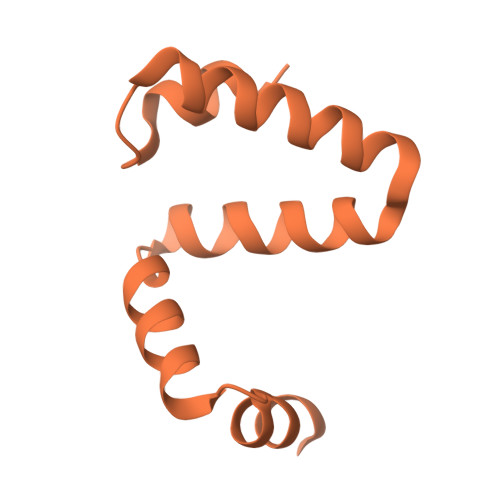
To overcome their limited genetic capacity, numerous viruses encode multifunctional proteins. The birnavirus VP3 protein plays key roles during infection, including scaffolding of the viral capsid during morphogenesis, recruitment, and regulation of the viral RNA polymerase, shielding of the double-stranded RNA genome and targeting of host endosomes for genome replication, and immune evasion. The dimeric form of VP3 is critical for these functions. In previous work, we determined the X-ray structure of the central domains (D2-D3) of VP3 from the infectious bursal disease virus (IBDV). However, the structure and function of the IBDV VP3 N-terminal domain (D1) could not be determined at that time. Using integrated structural biology approaches and functional cell assays, here we characterize the IBDV VP3 D1 domain, unveiling its unexplored roles in virion stability and infection. The X-ray structure of D1 shows that this domain folds in four α-helices arranged in parallel dimers, which are essential for maintaining the dimeric arrangement of the full-length protein. Combining small-angle X-ray scattering analyses with molecular dynamics simulations allowed us to build a structural model for the D1-D3 domains. This model consists of an elongated structure with high flexibility in the D2-D3 connection, keeping D1 as the only driver of VP3 dimerization. Using reverse genetics tools, we show that the obliteration of D1 domain prevents the VP3 scaffold function during capsid assembly and severely impacts IBDV infection. Altogether, our study elucidates the structure of the VP3 D1 domain and reveals its role in VP3 protein dimerization and IBDV infection.
- Institut de Biologia Molecular de Barcelona, CSIC, Parc Científic de Barcelona, Baldiri i Reixac 15, 08028 Barcelona, Spain.
Organizational Affiliation: