Download Mendeley
Engineered Phenylalanine Ammonia-Lyases for the Enantioselective Synthesis of Aspartic Acid Derivatives.
Buslov, I., Desmons, S., Duhoo, Y., Hu, X.(2024) Angew Chem Int Ed Engl 63: e202406008-e202406008
- PubMed: 38713131 Search on PubMed
- DOI: https://doi.org/10.1002/anie.202406008
- Primary Citation Related Structures:
9EQ5 - PubMed Abstract:
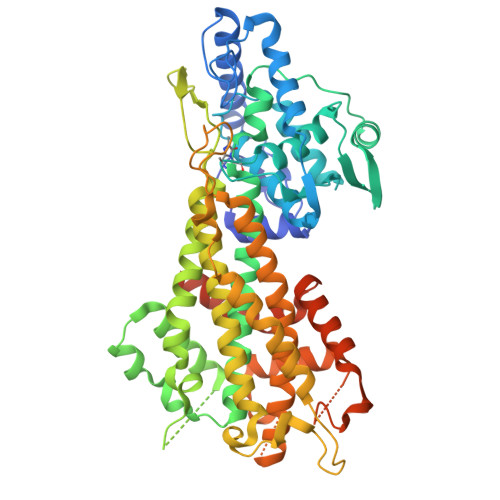
Biocatalytic hydroamination of alkenes is an efficient and selective method to synthesize natural and unnatural amino acids. Phenylalanine ammonia-lyases (PALs) have been previously engineered to access a range of substituted phenylalanines and heteroarylalanines, but their substrate scope remains limited, typically including only arylacrylic acids. Moreover, the enantioselectivity in the hydroamination of electron-deficient substrates is often poor. Here, we report the structure-based engineering of PAL from Planctomyces brasiliensis (PbPAL), enabling preparative-scale enantioselective hydroaminations of previously inaccessible yet synthetically useful substrates, such as amide- and ester-containing fumaric acid derivatives. Through the elucidation of cryo-electron microscopy (cryo-EM) PbPAL structure and screening of the structure-based mutagenesis library, we identified the key active site residue L205 as pivotal for dramatically enhancing the enantioselectivity of hydroamination reactions involving electron-deficient substrates. Our engineered PALs demonstrated exclusive α-regioselectivity, high enantioselectivity, and broad substrate scope. The potential utility of the developed biocatalysts was further demonstrated by a preparative-scale hydroamination yielding tert-butyl protected l-aspartic acid, widely used as intermediate in peptide solid-phase synthesis.
- Laboratory of Inorganic Synthesis and Catalysis, Institute of Chemical Sciences and Engineering, École Polytechnique Fédérale de Lausanne ISIC-LSCI, BCH 3305, 1015, Lausanne, Switzerland.
Organizational Affiliation: