9EGN | pdb_00009egn

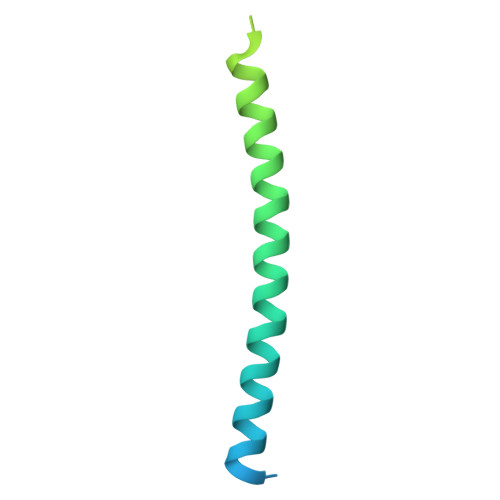
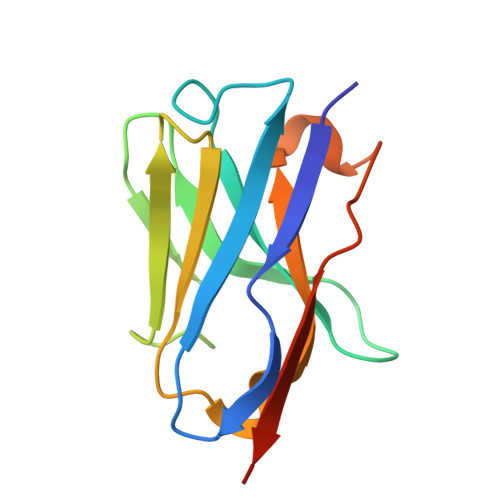
Crystal structure of the human Cavin1 HR1 domain bound to nanobody B7


Experimental Data Snapshot

  • Method: X-RAY DIFFRACTION
  • Resolution: 1.57 Å
  • R-Value Free: 
    0.190 (Depositor), 0.190 (DCC) 
  • R-Value Work: 
    0.173 (Depositor), 0.172 (DCC) 
  • R-Value Observed: 
    0.174 (Depositor) 

Starting Models: experimental
View more details

wwPDB Validation   3D Report Full Report


This is version 1.1 of the entry. See complete history


Literature

Nanobodies against Cavin1 reveal structural flexibility and regulated interactions of its N-terminal coiled-coil domain.

Gao, Y.Tillu, V.A.Wu, Y.Rae, J.Hall, T.E.Chen, K.E.Weeratunga, S.Guo, Q.Livingstone, E.Tham, W.H.Parton, R.G.Collins, B.M.

(2025) J Cell Sci 138

  • DOI: https://doi.org/10.1242/jcs.263756
  • Primary Citation of Related Structures:  
    9EG6, 9EGN, 9EIU

  • PubMed Abstract: 

    Caveolae are abundant plasma membrane structures that regulate signalling, membrane homeostasis and mechanoprotection. Their formation is driven by caveolins and cavins and their coordinated interactions with lipids. Here, we developed nanobodies against the trimeric HR1 coiled-coil domain of Cavin1. We identified specific nanobodies that do not perturb Cavin1 membrane binding and localise to caveolae when expressed in cells. The crystal structure of a nanobody-Cavin 1 HR1 complex reveals a symmetric 3:3 architecture as validated by mutagenesis. In this structure, the C-terminal half of the HR1 domain is disordered, suggesting that the nanobody stabilises an open conformation of Cavin1, which has previously been identified as important for membrane interactions. A phosphomimic mutation in a threonine-serine pair proximal to this region reveals selective regulation of Cavin2 and Cavin3 association. These studies provide new insights into cavin domains required for assembly of multiprotein caveolar assemblies and describe new nanobody tools for structural and functional studies of caveolae.


  • Organizational Affiliation
    • Institute for Molecular Bioscience, The University of Queensland, St. Lucia, Queensland 4067, Australia.

Macromolecules
Find similar proteins by:  (by identity cutoff)  |  3D Structure
Entity ID: 1
MoleculeChains Sequence LengthOrganismDetailsImage
Caveolae-associated protein 1116Homo sapiensMutation(s): 0 
Gene Names: CAVIN1PTRFFKSG13
UniProt & NIH Common Fund Data Resources
Find proteins for Q6NZI2 (Homo sapiens)
Explore Q6NZI2 
Go to UniProtKB:  Q6NZI2
PHAROS:  Q6NZI2
GTEx:  ENSG00000177469 
Entity Groups  
Sequence Clusters30% Identity50% Identity70% Identity90% Identity95% Identity100% Identity
UniProt GroupQ6NZI2
Sequence Annotations
Expand
  • Reference Sequence
Find similar proteins by:  (by identity cutoff)  |  3D Structure
Entity ID: 2
MoleculeChains Sequence LengthOrganismDetailsImage
Nanobody B7121Vicugna pacosMutation(s): 0 
Entity Groups  
Sequence Clusters30% Identity50% Identity70% Identity90% Identity95% Identity100% Identity
Sequence Annotations
Expand
  • Reference Sequence
Experimental Data & Validation

Experimental Data

  • Method: X-RAY DIFFRACTION
  • Resolution: 1.57 Å
  • R-Value Free:  0.190 (Depositor), 0.190 (DCC) 
  • R-Value Work:  0.173 (Depositor), 0.172 (DCC) 
  • R-Value Observed: 0.174 (Depositor) 
Space Group: P 63
Unit Cell:
Length ( Å )Angle ( ˚ )
a = 58.897α = 90
b = 58.897β = 90
c = 113.122γ = 120
Software Package:
Software NamePurpose
PHENIXrefinement
XDSdata reduction
Aimlessdata scaling
PHASERphasing

Structure Validation

View Full Validation Report


Entry History & Funding Information

Deposition Data


Funding OrganizationLocationGrant Number
National Health and Medical Research Council (NHMRC, Australia)Australia--

Revision History  (Full details and data files)

  • Version 1.0: 2025-02-26
    Type: Initial release
  • Version 1.1: 2025-09-10
    Changes: Database references