9E7A | pdb_00009e7a

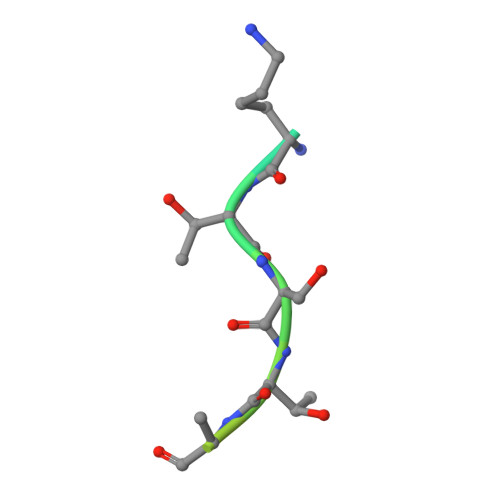
Crystal structure of the MIR domain of the S. cerevisiae mannosyltransferase Pmt4 in Complex with Ccw5


Experimental Data Snapshot

  • Method: X-RAY DIFFRACTION
  • Resolution: 1.69 Å
  • R-Value Free: 
    0.227 (Depositor), 0.227 (DCC) 
  • R-Value Work: 
    0.190 (Depositor), 0.189 (DCC) 
  • R-Value Observed: 
    0.191 (Depositor) 

Starting Model: experimental
View more details

wwPDB Validation   3D Report Full Report


This is version 1.1 of the entry. See complete history


Literature

Pmt4 recognizes two separate acceptor sites to O-mannosylate in the S/T-rich regions of substrate proteins.

Du, M.Yuan, Z.Kovach, A.Lyu, M.Li, H.

(2025) Nat Commun 16: 9726-9726

  • DOI: https://doi.org/10.1038/s41467-025-64729-9
  • Primary Citation of Related Structures:  
    9E61, 9E6I, 9E6V, 9E79, 9E7A

  • PubMed Abstract: 

    Protein O-mannosyltransferases (PMTs) add mannose to serine/threonine (S/T)-rich proteins in the endoplasmic reticulum, facilitating proper folding and trafficking through the secretory pathway. These enzymes share a conserved architecture that includes a large transmembrane domain housing the catalytic pocket and a lumenal β-trefoil-folded MIR domain. Although S/T-rich regions in acceptor proteins are generally disordered, it remains unclear how PMTs selectively target these regions over other intrinsically disordered sequences. Here, using cryo-EM and X-ray crystallography, we demonstrate that the Saccharomyces cerevisiae Pmt4 dimer recognizes an S/T-rich peptide at two distinct sites. A groove above the catalytic pocket in the transmembrane domain binds the mannose-accepting S/T site, while the lumenal MIR domain engages an S/T-X-S/T motif. Notably, the substrate peptide is simultaneously bound by the catalytic pocket of one Pmt4 protomer and the MIR domain of the other, revealing an unexpected cooperative dual substrate recognition mechanism. This mechanism likely underpins the invariant dimeric architecture observed in all PMT family members.


  • Organizational Affiliation
    • Department of Structural Biology, Van Andel Institute, Grand Rapids, MI, USA.

Macromolecules
Find similar proteins by:  (by identity cutoff)  |  3D Structure
Entity ID: 1
MoleculeChains Sequence LengthOrganismDetailsImage
Dolichyl-phosphate-mannose--protein mannosyltransferase 4
A, B, C
211Saccharomyces cerevisiaeMutation(s): 0 
Gene Names: PMT4YJR143CJ2176
EC: 2.4.1.109
UniProt
Find proteins for P46971 (Saccharomyces cerevisiae (strain ATCC 204508 / S288c))
Explore P46971 
Go to UniProtKB:  P46971
Entity Groups  
Sequence Clusters30% Identity50% Identity70% Identity90% Identity95% Identity100% Identity
UniProt GroupP46971
Sequence Annotations
Expand
  • Reference Sequence

Find similar proteins by:  Sequence   |   3D Structure  

Entity ID: 2
MoleculeChains Sequence LengthOrganismDetailsImage
Cell wall mannoprotein CIS3
D, E, F
20Saccharomyces cerevisiaeMutation(s): 0 
UniProt
Find proteins for P47001 (Saccharomyces cerevisiae (strain ATCC 204508 / S288c))
Explore P47001 
Go to UniProtKB:  P47001
Entity Groups  
Sequence Clusters30% Identity50% Identity70% Identity90% Identity95% Identity100% Identity
UniProt GroupP47001
Sequence Annotations
Expand
  • Reference Sequence
Experimental Data & Validation

Experimental Data

  • Method: X-RAY DIFFRACTION
  • Resolution: 1.69 Å
  • R-Value Free:  0.227 (Depositor), 0.227 (DCC) 
  • R-Value Work:  0.190 (Depositor), 0.189 (DCC) 
  • R-Value Observed: 0.191 (Depositor) 
Space Group: P 21 21 21
Unit Cell:
Length ( Å )Angle ( ˚ )
a = 68.599α = 90
b = 78.85β = 90
c = 118.38γ = 90
Software Package:
Software NamePurpose
PHENIXrefinement
MOSFLMdata reduction
SCALAdata scaling
MrBUMPphasing

Structure Validation

View Full Validation Report


Entry History & Funding Information

Deposition Data


Funding OrganizationLocationGrant Number
National Institutes of Health/National Cancer Institute (NIH/NCI)United StatesCA231466
Department of Energy (DOE, United States)United StatesGM131754

Revision History  (Full details and data files)

  • Version 1.0: 2025-10-15
    Type: Initial release
  • Version 1.1: 2025-11-19
    Changes: Database references