Download Mendeley
The interplay between glucose and aromatic compound regulation by two IclR-type transcription factors, LigR1 and LigR2, in Pseudomonas putida KT2440.
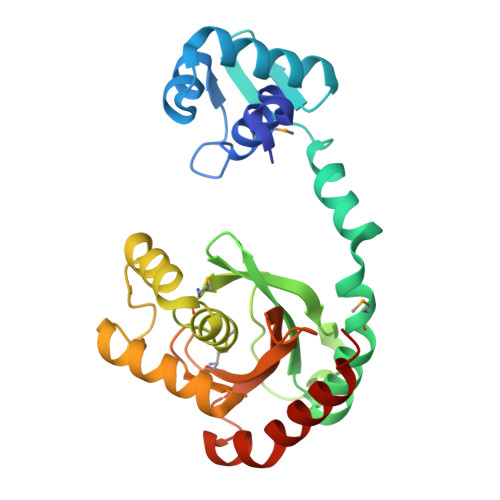
Kadriu, E., Qin, S., Prezioso, S.M., Christendat, D.(2025) Microbiol Res 303: 128382-128382
- PubMed: 41176845 Search on PubMed
- DOI: https://doi.org/10.1016/j.micres.2025.128382
- Primary Citation Related Structures:
9E6A - PubMed Abstract:
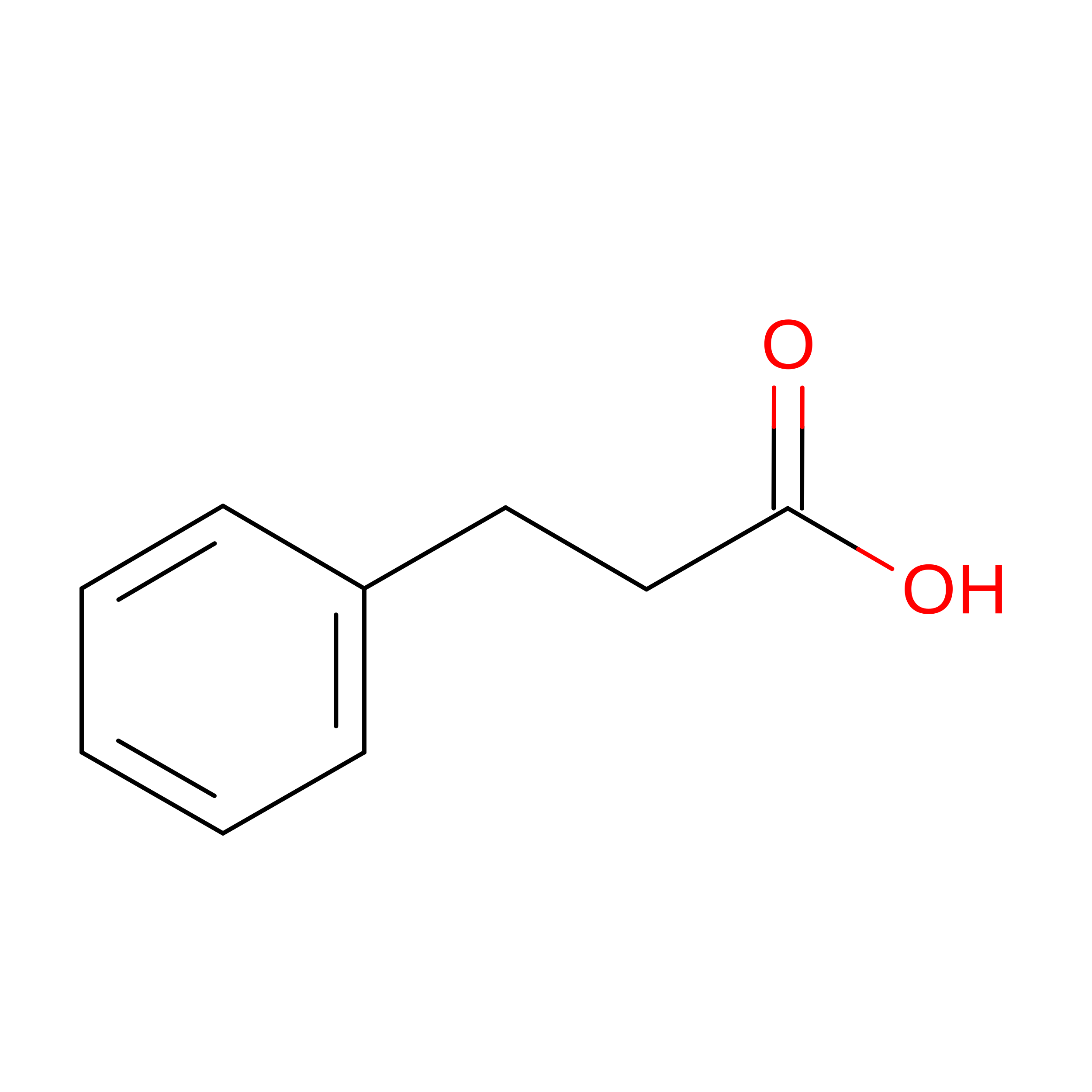
Carbon utilization strategies are fundamental to microbial proliferation within complex ecosystems like the soil microbiome. These strategies dictate how microbes prioritize, and metabolize available carbon compounds, shaping community dynamics and ecological outcomes. Pseudomonas putida KT2440, a soil bacterium renowned for its metabolic versatility, exemplifies this adaptive capacity. However, the regulatory mechanism it employs to prioritize sugars vs aromatic compounds for their energy requirement remains poorly understood. Here, we investigated two IclR-type transcriptional regulators, LigR1 and LigR2, which control expression of the lig1 and lig2 operons. Functional analyses reveal that LigR1 and LigR2 activate lig1 but repress the lig2 operon. 4-hydroxybenzoate binding to LigR1 represses gene expression, whereas quinate, protocatechuate, and 4-hydroxybenzoate bind to LigR2 to induce lig2 operon expression. Additionally, ligR1 deletion causes growth defects on glucose and 4-hydroxybenzoate, accompanied by cell elongation and aggregation. We propose that the lig1 operon mediates dual influx of glucose and aromatics via its major facilitator superfamily transporter, while the lig2 operon catalyzes aromatic breakdown through a protocatechuate intermediate and meta-cleavage pathway, supplying oxaloacetate to the TCA cycle. Importantly, P. putida prioritizes shikimate pathway intermediates as energy sources under specific metabolic conditions, such as their accumulation. Overall, these findings redefine the metabolic flexibility of soil pseudomonads and reveal a novel mechanism for thriving in chemically diverse environments. By illuminating a dual regulatory system, our study offers new insight into microbial carbon flux and on the traditional biosynthetic paradigm of the shikimate pathway, revealing its unexpected role in supplying the organism with energy generating compounds.
- Department of Cell and Systems Biology, University of Toronto, Toronto, ON M5S 3B2, Canada.
Organizational Affiliation: