Download Mendeley
Stabilized designs of the malaria adhesin protein PvRBP2b for use as a potential diagnostic for Plasmodium vivax.
D Sa, J., Krauss, L., Smith, L., D'Andrea, L., Chan, L.J., Abraham, A., Kiernan-Walker, N., Mazhari, R., Lamont, M., Lim, P.S., Sattabongkot, J., Lacerda, M.V., Wini, L., Mueller, I., Longley, R.J., Pymm, P., Fleishman, S.J., Tham, W.H.(2025) J Biol Chem 301: 108290-108290
- PubMed: 39938801 Search on PubMedSearch on PubMed Central
- DOI: https://doi.org/10.1016/j.jbc.2025.108290
- Primary Citation Related Structures:
9DZC, 9DZD - PubMed Abstract:
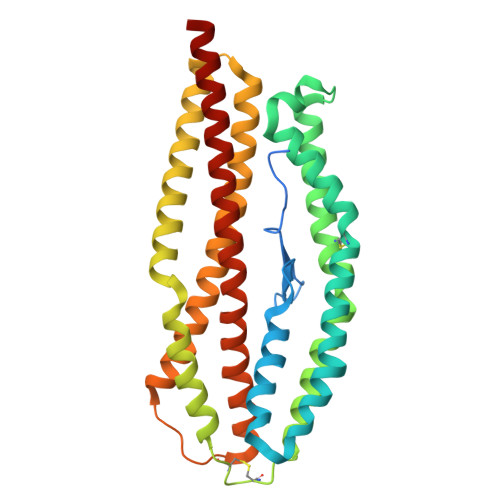
Plasmodium vivax is emerging as the most prevalent species causing malaria outside Africa. Most P. vivax infections are relapses due to the reactivation of the dormant liver stage parasites (hypnozoites). Hypnozoites are a major reservoir for transmission but undetectable by commercial diagnostic tests. Antibodies against P. vivax reticulocyte-binding protein 2b (PvRBP2b) are among the most reliable serological biomarkers for recent P. vivax infections in the prior 9 months and act as indirect biomarkers for risk of relapse. We sought to design stabilized variants of PvRBP2b, under stringent conditions of minimally perturbing the solvent-accessible surfaces to maintain its antigenicity profile. Furthermore, for some of the designs, due to limited diversity of natural PvRBP2b homologs, we combined AI-based ProteinMPNN and PROSS atomistic design calculations. The best, bearing 19 core mutations relative to PvRBP2b, expressed 16-fold greater amounts (up to 11 mg/l), and had 14 °C higher thermal tolerance than the parental protein. Critically, the stabilized designs retained binding to naturally acquired human mAbs with nanomolar affinities, suggesting that the immunologically competent surfaces were retained as was confirmed by crystallographic analyses. Using longitudinal observational cohorts from malaria endemic regions of Thailand, Brazil, and the Solomon Islands, we show that antibody responses against the designs are highly correlated with those against the parental protein and can classify individuals as recently infected with P. vivax. This efficient computational stability design methodology can be used to enhance the biophysical properties of other recalcitrant proteins for use as diagnostics or vaccine immunogens.
- The Walter and Eliza Hall Institute of Medical Research, Parkville, Victoria, Australia; Department of Medical Biology, The University of Melbourne, Melbourne, Victoria, Australia.
Organizational Affiliation: