9DXI | pdb_00009dxi

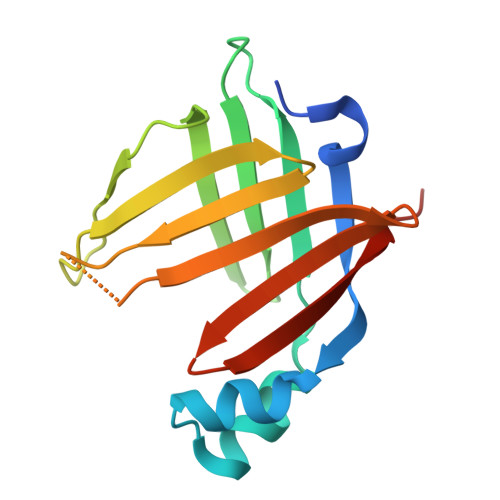
Crystal structure of dimer Caenorhabditis elegans lipid binding protein 3 (LBP-3)


Experimental Data Snapshot

  • Method: X-RAY DIFFRACTION
  • Resolution: 2.17 Å
  • R-Value Free: 
    0.268 (Depositor), 0.268 (DCC) 
  • R-Value Work: 
    0.219 (Depositor), 0.226 (DCC) 
  • R-Value Observed: 
    0.222 (Depositor) 

Starting Model: experimental
View more details

wwPDB Validation 3D Report Full Report

Validation slider image for 9DXI

This is version 1.0 of the entry. See complete history

Literature

Structural dynamics and binding of Caenorhabditis elegans lifespan-extending lipid binding protein-3 to polyunsaturated fatty acids.

Cuevas, A.R.Tillman, M.C.Wang, M.C.Ortlund, E.A.

(2025) Protein Sci 34: e5249-e5249

  • DOI: https://doi.org/10.1002/pro.5249
  • Primary Citation Related Structures: 
    9DXI

  • PubMed Abstract: 

    Intracellular lipid binding proteins (iLBPs) play crucial roles in lipid transport and cellular metabolism across the animal kingdom. Recently, a fat-to-neuron axis was described in Caenorhabditis elegans, in which lysosomal activity in the fat liberates polyunsaturated fatty acids (PUFAs) that signal to neurons and extend lifespan with durable fecundity. In this study, we investigate the structure and binding mechanisms of a lifespan-extending lipid chaperone, lipid binding protein-3 (LBP-3), which shuttles dihomo-γ-linolenic (DGLA) acid from intestinal fat to neurons. We present the first high-resolution crystal structure of LBP-3, which reveals a classic iLBP fold with an unexpected and unique homodimeric arrangement via interstrand interactions that is incompatible with ligand binding. We identify key ionic interactions that mediate DGLA binding within the lipid binding pocket. Molecular dynamics simulations further elucidate LBP-3's preferential binding to DGLA due to its rotational freedom and access to favorable binding conformations compared to other 20-carbon PUFAs. We also propose that LBP-3 dimerization may be a unique regulatory mechanism for lipid chaperones.


  • Organizational Affiliation
    • Department of Biochemistry, Emory University School of Medicine, Atlanta, Georgia, USA.

Macromolecule Content 

  • Total Structure Weight: 34.96 kDa 
  • Atom Count: 2,360 
  • Modeled Residue Count: 279 
  • Deposited Residue Count: 302 
  • Unique protein chains: 1

Macromolecules

Find similar proteins by:|  3D Structure
Entity ID: 1
MoleculeChains  Sequence LengthOrganismDetailsImage
Fatty acid-binding protein homolog 3
A, B
151Caenorhabditis elegansMutation(s): 0 
Gene Names: lbp-3F40F4.4
UniProt
Find proteins for Q20222 (Caenorhabditis elegans)
Explore Q20222 
Go to UniProtKB:  Q20222
Entity Groups
Sequence Clusters30% Identity50% Identity70% Identity90% Identity95% Identity100% Identity
UniProt GroupQ20222
Sequence Annotations
Expand
Reference Sequence

Small Molecules

Ligands 1 Unique
IDChains Name / Formula / InChI Key2D Diagram3D Interactions
GOL

Query on GOL


Download:Ideal Coordinates CCD File
C [auth A]GLYCEROL
C3 H8 O3
PEDCQBHIVMGVHV-UHFFFAOYSA-N

Experimental Data & Validation

Experimental Data

  • Method: X-RAY DIFFRACTION
  • Resolution: 2.17 Å
  • R-Value Free:  0.268 (Depositor), 0.268 (DCC) 
  • R-Value Work:  0.219 (Depositor), 0.226 (DCC) 
  • R-Value Observed: 0.222 (Depositor) 
Space Group: P 21 21 21
Unit Cell:
Length ( Å )Angle ( ˚ )
a = 45.731α = 90
b = 68.846β = 90
c = 103.891γ = 90
Software Package:
Software NamePurpose
PHENIXrefinement
HKL-2000data scaling
HKL-2000data reduction
PHASERphasing

Structure Validation

View Full Validation Report


Entry History 

& Funding Information

Deposition Data


Funding OrganizationLocationGrant Number
Other governmentUnited States--

Revision History  (Full details and data files)

  • Version 1.0: 2025-01-22
    Type: Initial release