Download Mendeley
Detection of non-native species formed during fibrillization of the myocilin olfactomedin domain.
Scelsi, H.F., Close, E.G.S., Huard, D.J.E., Dunn, E., Bogdanovic, N., Mudiyanselage, S.H.W., Grant, A., Stagg, S.M., Schmidt-Krey, I., Van Horn, W.D., Lieberman, R.L.(2025) Protein Sci 34: e70063-e70063
- PubMed: 40095382 Search on PubMedSearch on PubMed Central
- DOI: https://doi.org/10.1002/pro.70063
- Primary Citation Related Structures:
9DOZ - PubMed Abstract:
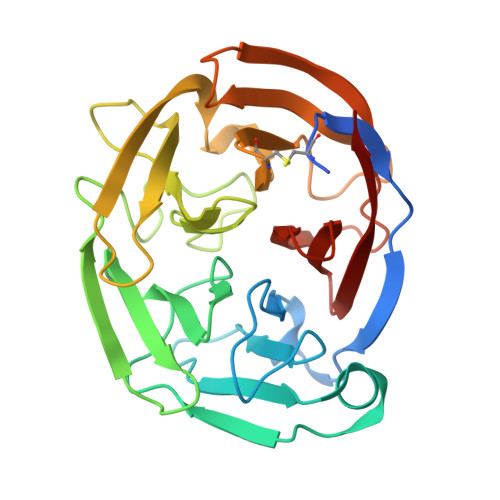
Glaucoma is a group of neurodegenerative diseases that together are the leading cause of irreversible blindness worldwide. Myocilin-associated glaucoma is an inherited form of this disease, caused by intracellular aggregation of misfolded mutant myocilin. In vitro, the myocilin C-terminal olfactomedin domain (OLF), the relevant domain for glaucoma pathogenesis, can be driven to form amyloid-like fibrils under mild conditions. Here we characterize a species present during in vitro fibrillization. Purified OLF was subjected to fibrillization at concentrations required for downstream electron microscopy imaging and NMR spectroscopy. Additional biophysical techniques, including analytical ultracentrifugation and X-ray crystallography, were employed to further characterize the multicomponent mixture. Negative stain transmission electron microscopy (TEM) shows a non-native species reminiscent of known prefibrillar oligomers from other amyloid systems, NMR indicates a minor population of partially misfolded species is present in solution, and cryo-EM imaging shows two-dimensional protein arrays. The predominant soluble species remaining in solution after the fibril reaction is natively folded, as evidenced by X-ray crystallography. In summary, after incubating OLF under fibrillization-promoting conditions, there is a heterogeneous mixture consisting of soluble folded protein, mature amyloid-like fibrils, and partially misfolded intermediate species that at present belie additional molecular detail. The characterization of OLF fibrillar species illustrates the challenges associated with developing a comprehensive understanding of the fibrillization process for large, non-model amyloidogenic proteins.
- School of Chemistry and Biochemistry, Georgia Institute of Technology, Atlanta, Georgia, USA.
Organizational Affiliation: