9DN6 | pdb_00009dn6

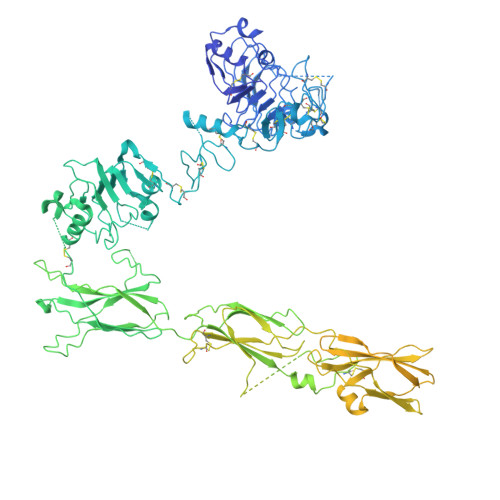
Insulin receptor bound with de novo designed agonist called "RF-405".


Experimental Data Snapshot

  • Method: ELECTRON MICROSCOPY
  • Resolution: 4.00 Å
  • Aggregation State: PARTICLE 
  • Reconstruction Method: SINGLE PARTICLE 

wwPDB Validation   3D Report Full Report


This is version 1.2 of the entry. See complete history


Literature

Tuning insulin receptor signaling using de novo-designed agonists.

Wang, X.Cardoso, S.Cai, K.Venkatesh, P.Hung, A.Ng, M.Hall, C.Coventry, B.Lee, D.S.Chowhan, R.Gerben, S.Li, J.An, W.Hon, M.Gao, M.Liao, Y.C.Accili, D.Choi, E.Bai, X.C.Baker, D.

(2025) Mol Cell 85: 4064

  • DOI: https://doi.org/10.1016/j.molcel.2025.09.020
  • Primary Citation of Related Structures:  
    9DN6, 9DNI, 9DNN

  • PubMed Abstract: 

    Insulin binding induces conformational changes in the insulin receptor (IR) that activate the intracellular kinase domain and the protein kinase B (AKT) and mitogen-activated protein kinase (MAPK) pathways, regulating metabolism and proliferation. We reasoned that designed agonists inducing different IR conformational changes might induce different downstream responses. We used de novo protein design to generate binders for individual IR extracellular domains and fused them in different orientations with different conformational flexibility. We obtained a series of synthetic IR agonists that elicit a wide range of receptor autophosphorylation, MAPK activation, trafficking, and proliferation responses. We identified designs more potent than insulin, causing longer-lasting glucose lowering in vivo and retaining activity on disease-causing IR mutants, while largely avoiding the cancer cell proliferation induced by insulin. Our findings shed light on how changes in IR conformation and dynamics translate into downstream signaling, and with further development, our synthetic agonists could have therapeutic utility for metabolic and proliferative diseases.


  • Organizational Affiliation
    • Department of Biochemistry, University of Washington, Seattle, WA, USA; Institute for Protein Design, University of Washington, Seattle, WA, USA. Electronic address: xinruw7@uw.edu.

Macromolecules
Find similar proteins by:  (by identity cutoff)  |  3D Structure
Entity ID: 1
MoleculeChains Sequence LengthOrganismDetailsImage
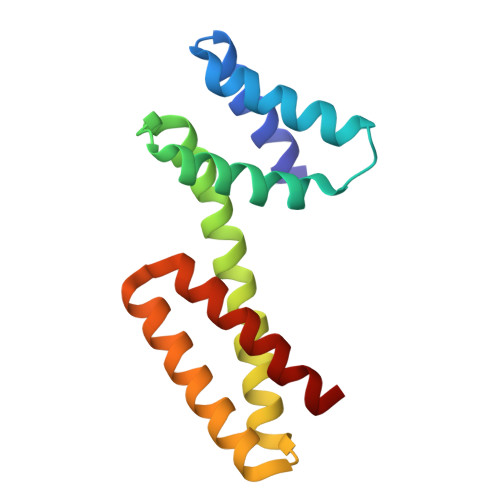
De novo designed IR agonist RF-405
A, B
130synthetic constructMutation(s): 0 
Entity Groups  
Sequence Clusters30% Identity50% Identity70% Identity90% Identity95% Identity100% Identity
Sequence Annotations
Expand
  • Reference Sequence
Find similar proteins by:  (by identity cutoff)  |  3D Structure
Entity ID: 2
MoleculeChains Sequence LengthOrganismDetailsImage
Isoform Short of Insulin receptor
C, D
1,370Homo sapiensMutation(s): 0 
Gene Names: INSR
EC: 2.7.10.1
UniProt & NIH Common Fund Data Resources
Find proteins for P06213 (Homo sapiens)
Explore P06213 
Go to UniProtKB:  P06213
PHAROS:  P06213
GTEx:  ENSG00000171105 
Entity Groups  
Sequence Clusters30% Identity50% Identity70% Identity90% Identity95% Identity100% Identity
UniProt GroupP06213
Sequence Annotations
Expand
  • Reference Sequence
Experimental Data & Validation

Experimental Data

  • Method: ELECTRON MICROSCOPY
  • Resolution: 4.00 Å
  • Aggregation State: PARTICLE 
  • Reconstruction Method: SINGLE PARTICLE 
EM Software:
TaskSoftware PackageVersion
RECONSTRUCTIONRELION
MODEL REFINEMENTPHENIX

Structure Validation

View Full Validation Report


Entry History & Funding Information

Deposition Data

  • Released Date: 2025-10-01 
  • Deposition Author(s): Bai, X.C.

Funding OrganizationLocationGrant Number
National Institutes of Health/National Institute of General Medical Sciences (NIH/NIGMS)United States--

Revision History  (Full details and data files)

  • Version 1.0: 2025-10-01
    Type: Initial release
  • Version 1.1: 2025-10-29
    Changes: Data collection, Database references
  • Version 1.2: 2025-11-19
    Changes: Data collection, Database references