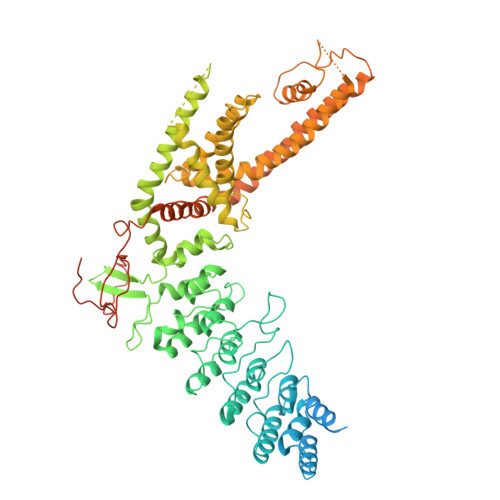
9DIJ | pdb_00009dij

4 Angstrom structure of the human TRPV3 pentamer

  • Classification: MEMBRANE PROTEIN
  • Organism(s): Homo sapiens
  • Expression System: Homo sapiens
  • Mutation(s): No 
  • Membrane Protein: Yes  MemProtMD

  • Deposited: 2024-09-05 Released: 2025-05-21 
  • Deposition Author(s): Lansky, S., Clarke, O.B., Scheuring, S.
  • Funding Organization(s): National Institutes of Health/National Institute of Neurological Disorders and Stroke (NIH/NINDS), National Institutes of Health/National Center for Complementary and Integrative Health (NIH/NCCIH)

Experimental Data Snapshot

  • Method: ELECTRON MICROSCOPY
  • Resolution: 4.07 Å
  • Aggregation State: PARTICLE 
  • Reconstruction Method: SINGLE PARTICLE 

wwPDB Validation   3D Report Full Report


This is version 1.1 of the entry. See complete history


Literature

Structural dynamics and permeability of the TRPV3 pentamer.

Lansky, S.Wang, Z.Clarke, O.B.Chipot, C.Scheuring, S.

(2025) Nat Commun 16: 4520-4520

  • DOI: https://doi.org/10.1038/s41467-025-59798-9
  • Primary Citation of Related Structures:  
    9DIJ

  • PubMed Abstract: 

    TRPV3 belongs to the large superfamily of tetrameric transient receptor potential (TRP) ion channels. Recently, using high-speed atomic force microscopy (HS-AFM), we discovered a rare and transient pentameric state for TRPV3 that is in equilibrium with the tetrameric state, and, using cryo-EM, we solved a low-resolution structure of the TRPV3 pentamer, in which, however, many residues were unresolved. Here, we present a higher resolution and more complete structure of the pentamer, revealing a domain-swapped architecture, a collapsed vanilloid binding site, and a large pore. Molecular dynamics simulations and potential of mean force calculations of the pentamer establish high protein dynamics and permeability to large cations. Subunit interface analysis, together with thermal denaturation experiments, led us to propose a molecular mechanism of the tetramer-to-pentamer transition, backed experimentally by HS-AFM observations. Collectively, our data demonstrate that the TRPV3 pentamer is in a hyper-activated state with unique, highly permissive permeation properties.


  • Organizational Affiliation
    • Department of Anesthesiology, Weill Cornell Medicine, New York, NY, USA.

Macromolecules
Find similar proteins by:  (by identity cutoff)  |  3D Structure
Entity ID: 1
MoleculeChains Sequence LengthOrganismDetailsImage
Transient receptor potential cation channel subfamily V member 3
A, B, C, D, E
806Homo sapiensMutation(s): 0 
Gene Names: TRPV3
Membrane Entity: Yes 
UniProt & NIH Common Fund Data Resources
Find proteins for Q8NET8 (Homo sapiens)
Explore Q8NET8 
Go to UniProtKB:  Q8NET8
PHAROS:  Q8NET8
GTEx:  ENSG00000167723 
Entity Groups  
Sequence Clusters30% Identity50% Identity70% Identity90% Identity95% Identity100% Identity
UniProt GroupQ8NET8
Sequence Annotations
Expand
  • Reference Sequence
Experimental Data & Validation

Experimental Data

  • Method: ELECTRON MICROSCOPY
  • Resolution: 4.07 Å
  • Aggregation State: PARTICLE 
  • Reconstruction Method: SINGLE PARTICLE 
EM Software:
TaskSoftware PackageVersion
MODEL REFINEMENTPHENIX
RECONSTRUCTIONcryoSPARC

Structure Validation

View Full Validation Report


Entry History & Funding Information

Deposition Data


Funding OrganizationLocationGrant Number
National Institutes of Health/National Institute of Neurological Disorders and Stroke (NIH/NINDS)United StatesR01NS134559
National Institutes of Health/National Center for Complementary and Integrative Health (NIH/NCCIH)United StatesDP1AT010874

Revision History  (Full details and data files)

  • Version 1.0: 2025-05-21
    Type: Initial release
  • Version 1.1: 2025-05-28
    Changes: Data collection, Database references